What You’ll Learn
topical authority and cannibalization
Key Takeaways
- Topical authority and cannibalization are site-level effects – search engines reward topic ownership, and suppress sites that look fragmented across overlapping pages.
- Single pages lose when context is weak – a strong page can slide if nearby pages blur scope, compete on intent, or fail to reinforce one clear „owner” URL.
- Cannibalization is usually intent overlap, not keyword overlap – multiple URLs satisfy the same need, so rankings rotate, impressions spread, and no page holds position.
- Clusters stabilize rankings when roles are clear – define scope, set boundaries, and use internal agreement so the system can pick a representative page and trust it.
Most pages don’t lose rankings because they are weak.
They lose because they sit in the wrong neighborhood.
We have seen teams publish fewer articles and gain visibility.
We have also seen teams publish weekly and slowly disappear.
That is not a paradox.
It is how search systems work.
Search engines reward topic ownership, not isolated pages.
Topical authority is the system’s confidence in your coverage.
Cannibalization is when your own pages compete for the same intent.
Both problems come from unclear page roles.
They look for coverage, internal agreement, and clear boundaries between ideas.
A single strong page without context feels risky, even if it is well written.
In real client work, this shows up fast.
One SaaS company added 18 articles in three months. Traffic dropped by 22%.
Nothing broke. The system simply lost confidence.
This is why SEO behaves less like page tuning and more like topic control (structure first).
When pages overlap or compete, the signal weakens instead of compounding.
Cannibalization is not a content mistake.
It is a structure problem.
Imagine a control panel with ten sliders labeled the same, but each one moves a different metric.
You move one, but the system does not know which outcome you want.
This page explains that mechanism.
Not how to write more, but how search engines decide who owns a subject.
This is a structure problem, not a writing problem.
Now let’s look at why single pages still lose.

Why strong single pages still lose
A single great page can rank worse after you publish more content.
We see this often.
Teams improve writing, add depth, and still watch rankings slip over the next few weeks.
That feels wrong.
So why did rankings drop after „improving” content?
Early on, SEO sounds like a page-level game.
The mental model becomes: better page, better outcome, eventually.
But search systems do not judge pages alone.
They judge context.
Place one strong page inside a weak topical neighborhood, and it looks isolated.
Place an average page inside a strong cluster, and it looks supported.
That is the inversion most teams miss.
We worked with a B2B company that rewrote its top article twice in six months.
Time on page went up. Scroll depth improved. Rankings dropped from positions 6-8 to page two.
Nothing was broken on the page.
The problem sat around it.
Search engines evaluate pages the way humans scan shelves.
One solid book on an empty shelf feels uncertain.
Ten related books, neatly grouped, signal confidence without a word.
The system reads coverage, not effort.
This is why publishing more can quietly weaken results.
Each new page reshapes the context of the others.
If those pages overlap, compete, or blur intent, the system hesitates.
That hesitation shows up as swapped winners, lower peaks, and slower recovery after updates.
So if the page looks good, but rankings slide, the signal is not quality.
It is fragmentation.
Strong pages fail when they stand alone.
Single pages lose when the surrounding topic signal is fragmented.
Now zoom out to how the system infers expertise.

How search systems infer expertise
Search systems do not read pages the way people do.
They compare patterns.
One page can look strong in isolation.
Across a site, it may look uncertain.
Expertise is inferred from consistency, not claims.
When multiple pages support each other, the system sees agreement.
When pages overlap or drift, the system sees noise.
Here is what that looks like in practice.
If five pages cover the same idea from slightly different angles, the engine hesitates.
It cannot tell which page should represent the topic.
So it spreads attention thin or withholds it entirely.
We see this with mature content teams.
In Google Search Console, you often see the same query triggering many URLs, each with weak average position.
They often rank once, then stall.
More pages get indexed. Fewer pages win.
One client came to us with strong domain authority and clean technical SEO.
They still rotated between positions 8 and 20 for months.
A crawl showed 14 URLs targeting variations of the same intent.
Nothing was „wrong”.
The system simply could not infer a single expert voice.
Search engines build topic models internally.
A topic model is the system’s guess about your site’s subject coverage, based on meaning, links, and intent separation.
Keywords matter less than relationships.
A page can match a query and still lose the topic.
Owning the topic is what stabilizes rankings.
Pages are evaluated by how clearly they differ and how cleanly they connect.
When relevance is concentrated, expertise becomes legible.
When relevance is scattered, authority dissolves.
This is why strong domains still lose to smaller sites with clearer topic structure.
The smaller site is easier to understand.
And systems reward what they can understand.
If the system cannot choose a representative page, it holds back.
Now let’s define “topical authority” in plain terms.

What topical authority really means
Topical authority is not reputation.
It is not age, links, or brand size.
Topical authority is system confidence in coverage.
Here is what that confidence is built from:
| Signal | What the system is checking | What it looks like on your site |
| Scope | Do you cover the topic end-to-end? | Supporting pages cover sub-questions, not random angles |
| Boundaries | Does each page have a clear job? | One primary page, others support with clean separation |
| Internal agreement | Do pages reinforce each other? | Links and wording point to one „owner” page for the intent |
It means the search system believes you understand a subject end to end.
That belief forms before rankings move.
Scope answers a simple question.
How much of this topic do you actually cover?
Boundaries answer another.
Where does one idea end and the next begin?
Agreement is the quiet one.
Your pages should not argue with each other.
You can see this pattern on many mature sites.
Long-tail pages show up, but core terms stay out of reach.
After structure changes, core visibility often appears within 6-10 weeks, even without new pages.
This is where many teams get stuck.
They confuse topical authority with domain authority.
Domain authority is accumulated trust.
Topical authority is interpreted relevance.
A large site can lack it.
A smaller site can earn it quickly.
Think of it like a library.
A huge building with mixed shelves feels confusing.
A smaller room with labeled sections feels reliable.
Search systems prefer the second.
Topical maps make this legible.
They show which pages lead, which support, and which should stay silent.
When that structure exists, rankings stabilize.
When it does not, growth feels random.
Topical authority is a clarity signal, not a status symbol.
Now let’s name the most common clarity killer: internal competition.

How internal cannibalization happens
Cannibalization rarely looks obvious at first.
Most teams only see symptoms.
One page ranks.
Then another page appears for the same query.
Both begin to slide.
The myth is that cannibalization is just „keyword overlap”.
Most cannibalization is intent overlap: two pages answer the same need.
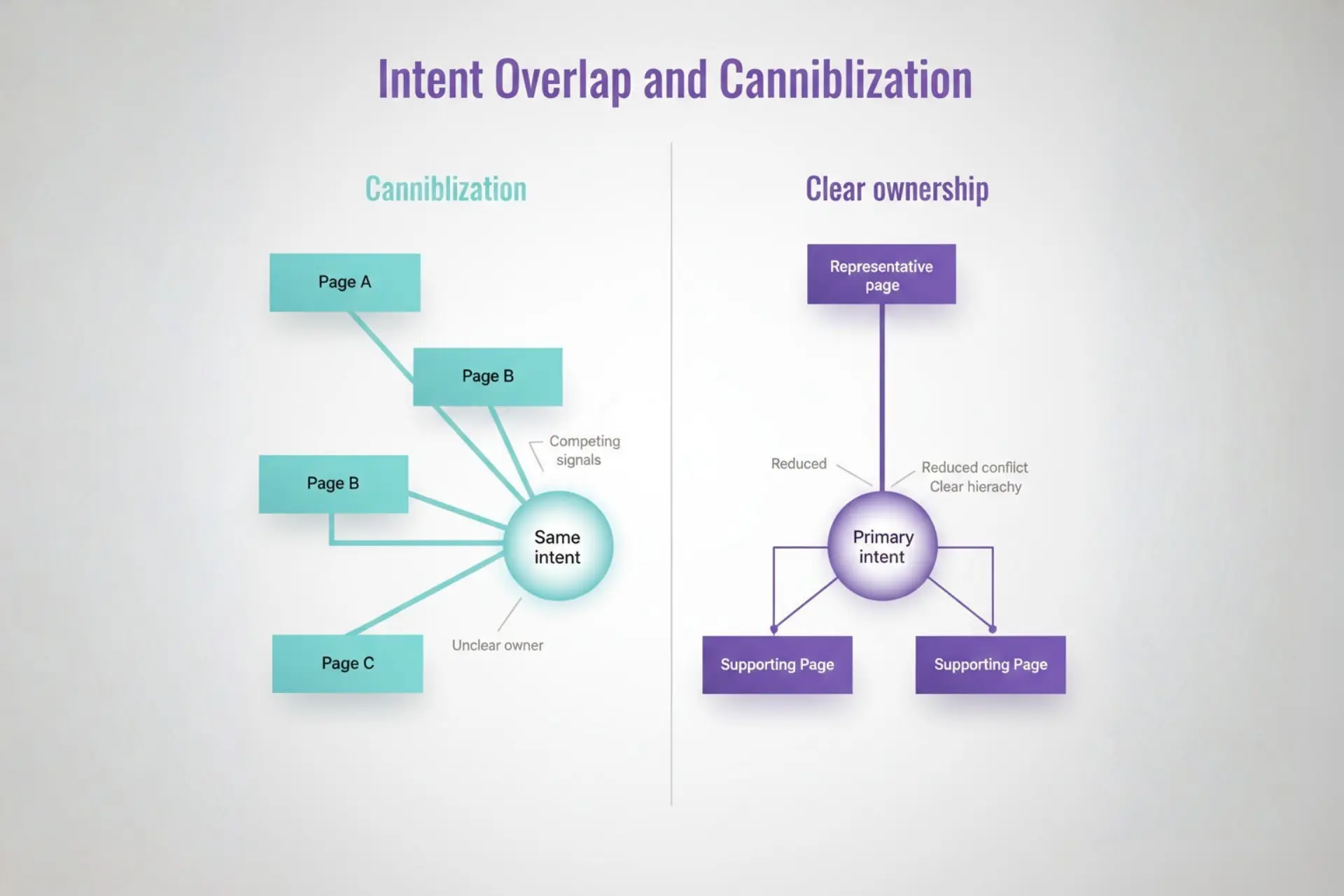
Different keywords can still express the same decision question.
Are we actually competing with ourselves?
Search systems group pages by meaning, not phrasing.
If two URLs satisfy the same need, the system must choose.
Often, it chooses neither.
Common signature:
- impressions spread across many similar URLs
- rankings rotate between those URLs
- no page holds the top spot consistently
We see this after content expansion phases.
A team adds supporting articles to „help” a main page.
Six months later, impressions are spread thin across many URLs.
One B2B client had nine pages receiving impressions for the same commercial query.
No page crossed position 12.
Traffic looked stable. Leads slowed.
Nothing was duplicated.
Everything overlapped.
This confuses crawlers.
It also weakens internal signals.
Internal links point sideways instead of upward.
Context blurs instead of sharpening.
The system cannot infer which page represents the topic.
Cannibalization is not a penalty.
It is hesitation.
Imagine several people answering the same question at once.
Each answer is reasonable.
Together, they sound unsure.
That is how fragmentation reads to a machine.
Once this pattern sets in, publishing more content accelerates it.
Each new page adds another voice to the same argument.
And the system waits.
Cannibalization is the system refusing to commit to one URL.
Now let’s see how clusters prevent that conflict.

Why clusters reduce cannibalization
Clusters change how pages relate to each other.
They assign roles.
Instead of many pages competing, one page leads.
The others support it.
This changes the signal completely.
Search systems read clusters as agreement.
One page defines the topic.
Others deepen, clarify, or narrow parts of it.
We saw this with a company that had grown fast through content.
They consolidated 11 overlapping pages into one core page and six supporting ones.
Impressions rose within three weeks. Conversions followed in the next quarter.
No new links.
No new writing.
The key was hierarchy.
Clusters create semantic order.
Each page has a reason to exist.
Internal links stop looping sideways.
They point with intent.
This matters because engines use internal links as hints.
They help decide which page carries the main responsibility for a topic.
When that responsibility is clear, rankings stabilize.
When it is not, visibility jumps between URLs.
Clusters also prevent accidental overlap.
New pages fit into an existing shape instead of colliding with older ones.
This is where many teams feel relief.
They stop guessing which page should rank.
The structure decides.
Once clusters exist, the system can evaluate relevance cleanly.
That clarity compounds over time.
And it sets up the next question.
Now look at what happens when you publish without roles.

Why publishing more content can make it worse
More content feels like progress.
Often, it is the opposite.
Each new page adds another opinion to the system.
If that opinion overlaps, the signal weakens.
We see this pattern after quarterly content pushes.
Traffic often spikes, then softens as overlap spreads across more URLs.
Index count rises, but lead volume can dip because the system cannot pick a clear winner.
More pages show up, but the signal gets blurry.
Volume without structure creates collisions.
Pages answer similar questions with slight variations.
Intent blurs.
Search systems do not reward repetition.
They reward clarity.
Random publishing also breaks memory.
Older pages lose their role.
New pages have no place.
This is why consolidation often outperforms expansion.
Removing or merging pages can increase visibility faster than adding new ones.
It feels counterintuitive.
It works.
Think of it like noise in a room.
More voices do not create understanding.
They create hesitation.
When content grows without a map, authority thins out.
When growth follows structure, relevance concentrates.
That concentration prepares the final decision layer.
More pages without roles creates noise, not coverage.
Volume without structure increases overlap and weakens certainty.
Now comes the decision layer: which topics deserve ownership.

What decides which topics are worth owning
Not every topic deserves a cluster.
Ownership has a cost.
Search systems favor topics that map to real demand.
They look for repeated signals of intent, not theoretical completeness.
This is where many teams overbuild.
They create clusters around ideas they like.
The market does not respond.
The difference shows up when teams cut the topic list on purpose.
For example, moving from 40+ themes to under 20 often improves focus and stability.
The filter was intent.
High-value topics sit where three forces meet.
Search frequency. Commercial relevance. Decision pressure.
If one is missing, authority does not compound.
Coverage stays invisible.
This is why topical authority always connects to demand understanding.
Structure without demand creates order, not growth.
At this point, the diagnostic shifts.
From „how pages relate” to „what people are actually trying to decide”.
That handoff matters.
It is the difference between owning a topic and maintaining a library.
The next step breaks this down at the demand layer, in keyword research explained(https://www.bivisee.com/capabilities/seo/keyword-research-explained/), where intent is separated before structure is built.
Ownership starts with demand, not coverage.
If you pick the wrong topic, structure cannot save it.

Scientific context and sources
The sources below describe how modern retrieval systems evaluate topical coherence, intent similarity, and structural clarity across multiple documents, rather than ranking pages in isolation. They provide foundational context for the mechanisms described above.
- Topic modeling and semantic coherence
Latent Dirichlet Allocation – Blei, Ng, Jordan – Journal of Machine Learning Research
Introduces topic modeling as a way systems infer subject coverage and coherence across collections of documents, forming the basis for topic-level relevance assessment.
https://jmlr.org/papers/v3/blei03a.html - Intent similarity beyond keywords
Query Understanding for Search Engines – Croft, Metzler, Strohman – SIGIR / IR Foundations
Explains how search systems group queries and documents by inferred intent and meaning rather than surface keyword overlap.
https://www.researchgate.net/publication/220690158_Search_engines_Information_retrieval_in_practice - Internal link structure as a signal
The Anatomy of a Large-Scale Hypertextual Web Search Engine – Brin, Page – Computer Networks (1998)
Describes how link structure and document relationships inform importance, authority, and representativeness within a topic set.
http://infolab.stanford.edu/~backrub/google.html - Ranking instability and ambiguous relevance signals
Evaluation of Retrieval Effectiveness with Incomplete Relevance Judgments – Buckley, Voorhees – SIGIR
Explains how systems struggle to assign stable rankings when multiple documents appear similarly relevant to the same intent, leading to volatility and suppressed confidence.
https://www.nist.gov/publications/retrieval-evaluation-incomplete-information
Questions You Might Ponder
What is topical authority in SEO?
Topical authority is how confident search systems are that a site fully covers a subject. It comes from clear topic clusters, non-overlapping pages, and consistent intent. Authority is built at the topic level, not by domain age, brand size, or a few strong standalone articles.
What is keyword cannibalization and why does it hurt rankings?
Keyword cannibalization happens when multiple URLs satisfy the same search intent. Search systems then rotate those pages instead of committing to one. Impressions and clicks split across URLs, signals weaken, and rankings become unstable, even when the content quality is high.
How do topic clusters help with rankings?
Topic clusters connect one main page with several focused supporting pages through internal links. This structure clarifies which URL owns the primary intent, reduces internal competition, and helps search systems interpret scope and relevance, making rankings more stable over time.
Can publishing more blog posts actually hurt SEO?
Yes. Publishing without structure often creates overlapping pages that compete for the same intent. This confuses search systems about which URL should rank. Instead of increasing authority, high-volume publishing can dilute signals and lead to traffic drops after content expansion.
How do I decide which topics are worth building a cluster around?
Topics are worth clustering when they combine search demand, business relevance, and real decision intent. Validating demand through keyword and SERP analysis helps narrow focus. Concentrating on a smaller set of high-value topics allows authority to accumulate instead of fragment.