What You’ll Learn
when redesigns help
Key Takeaways
- Redesigns help only when driven by clarified user intent systems, not just visual refresh.
- Cosmetic redesigns frequently disrupt trusted user pathways, damaging engagement and SEO if not mapped to real behavior.
- The most effective redesigns preserve familiar recognition signals while iterating core systems – ensuring trust and clarity.
- Sustainable business impact requires cross-team alignment, operational clarity, and continuous post-launch iteration over surface novelty.
What if the urge to redesign isn’t about ROI at all – but about a subtle human craving for closure?
Here’s the surprise: even in B2B, teams will chase a new look, convinced change means progress.
Yet after thirty redesigns with clients, we saw the same decision pattern.
Teams fixate on surface: new fonts, brighter colors, sleeker layouts. But ask about real objectives, and the room goes quiet.

Why redesigns feel attractive – but often miss the mark
Executives often share a feeling that “something must change” when growth plateaus.
The quickest way to scratch that itch?
Make it look new.
It’s visible, shareable, easy to schedule – proof you’re doing something.
It’s like rearranging your office when you can’t solve a strategic problem; the action feels productive, but the core stays untouched.
The appeal of “fresh” aesthetics
One client insisted on modernizing their homepage after seeing a competitor’s update, convinced visual parity would lift conversions.
Six months later, after tracking engagement, there was little measurable shift.
The slicker design pleased the team, not the market.
Why is this so tempting?
Visual refreshes create dopamine spikes for internal stakeholders – a “novelty effect”.
But novelty isn’t the same as breakthrough.
And in digital, aesthetic novelty rarely moves needles unless it links directly to a deeper system change.
Ask yourself: are we changing the paint, or moving the engine?
Why behavior doesn’t follow pixels
Here’s the catch: user intent doesn’t automatically bend to new visuals.
People arrive with jobs-to-be-done already etched in their minds.
They look for signals – navigation, cues, CTAs – that made sense before.
Strip those out, and even beautiful designs can crater results.
We’ve watched it happen: button colors changed, navigation “simplified”, yet bounce rates spiked.
Turns out, users trusted familiar flows more than pretty new ones.
A website redesign intent system means understanding what users intend to accomplish and building the entire experience around those core moments.
An intent system is the structured set of expectations, signals, and pathways that guide users to accomplish their goals on a website, beyond just visuals or layout.
Here’s an analogy: you can repaint the labels on a train map, but commuters still expect their line to run exactly as it did yesterday.
Change too much, and you get confusion – not adoption.
A core myth: “If it looks better, performance will follow”.
Reality: behavior follows friction, habit, and intent – rarely pixels.
If your redesign enables intent better than before, fine.
But if it just adds gloss, recognize the risk of breaking trust, recognition, or path clarity that took years to earn.
Many failed redesigns result from visual vs intent mismatch: changes in appearance that ignore or disrupt the established pathways users rely on to accomplish their goals.
So, before chasing the thrill of “fresh”, ask yourself: what intent system does our current design enable? Are we really ready to change it – or just ready to repaint it?
Redesigns help only when they enable a new intent system, not when they replace visuals.

When redesigns can support, not supplant, intent systems
Why do most redesigns fizzle, even after six figures and six months?
Here’s a statistic that should haunt boardrooms: fewer than 1 in 6 website redesigns drive improved commercial performance without first realigning the intent system.
That means most redesigns are like repainting a locked door – nice to look at, but nobody new gets in.
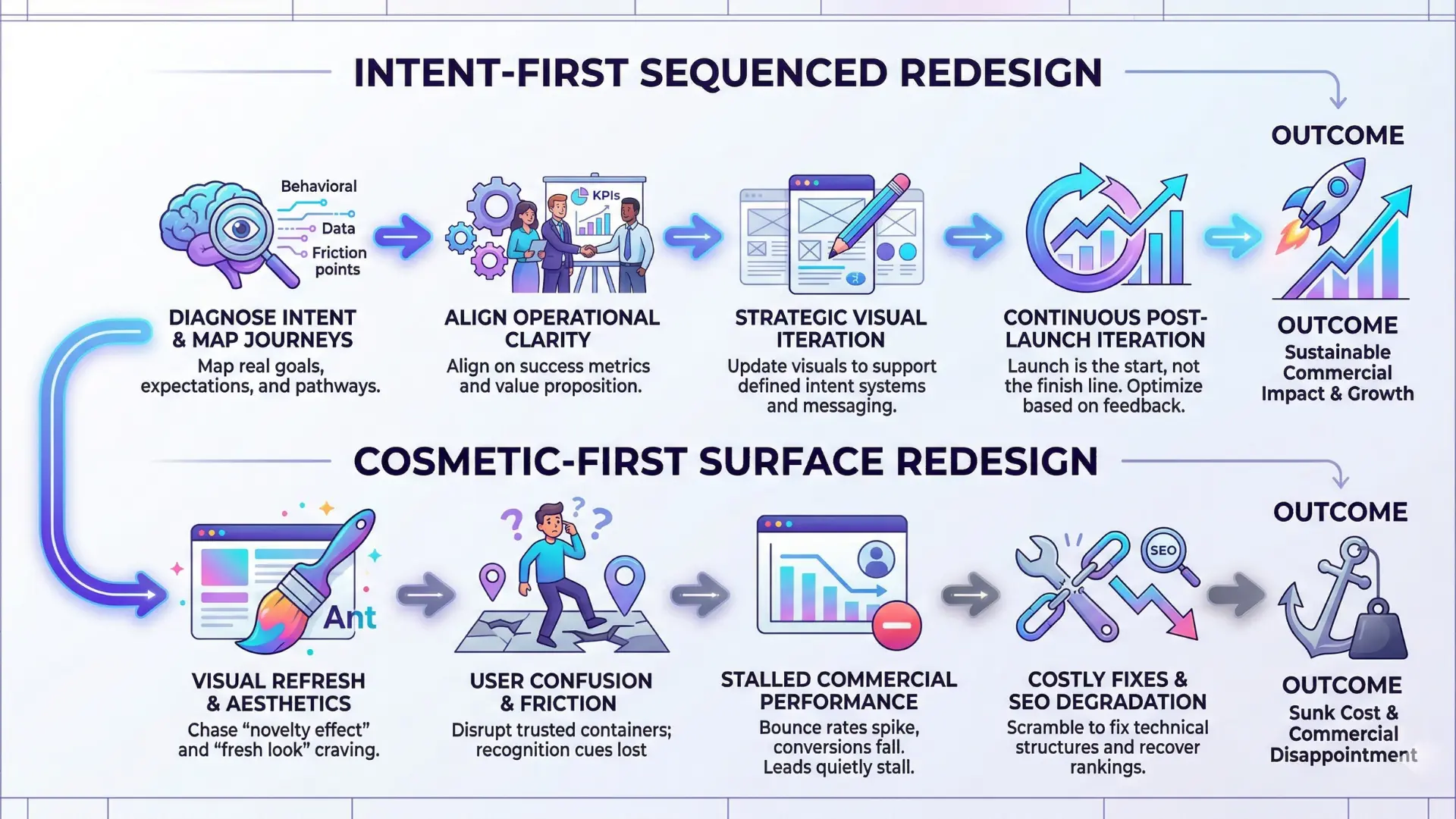
Redesign after clarity – sequence matters
Diagnostic Checklist for Effective Redesign Sequencing
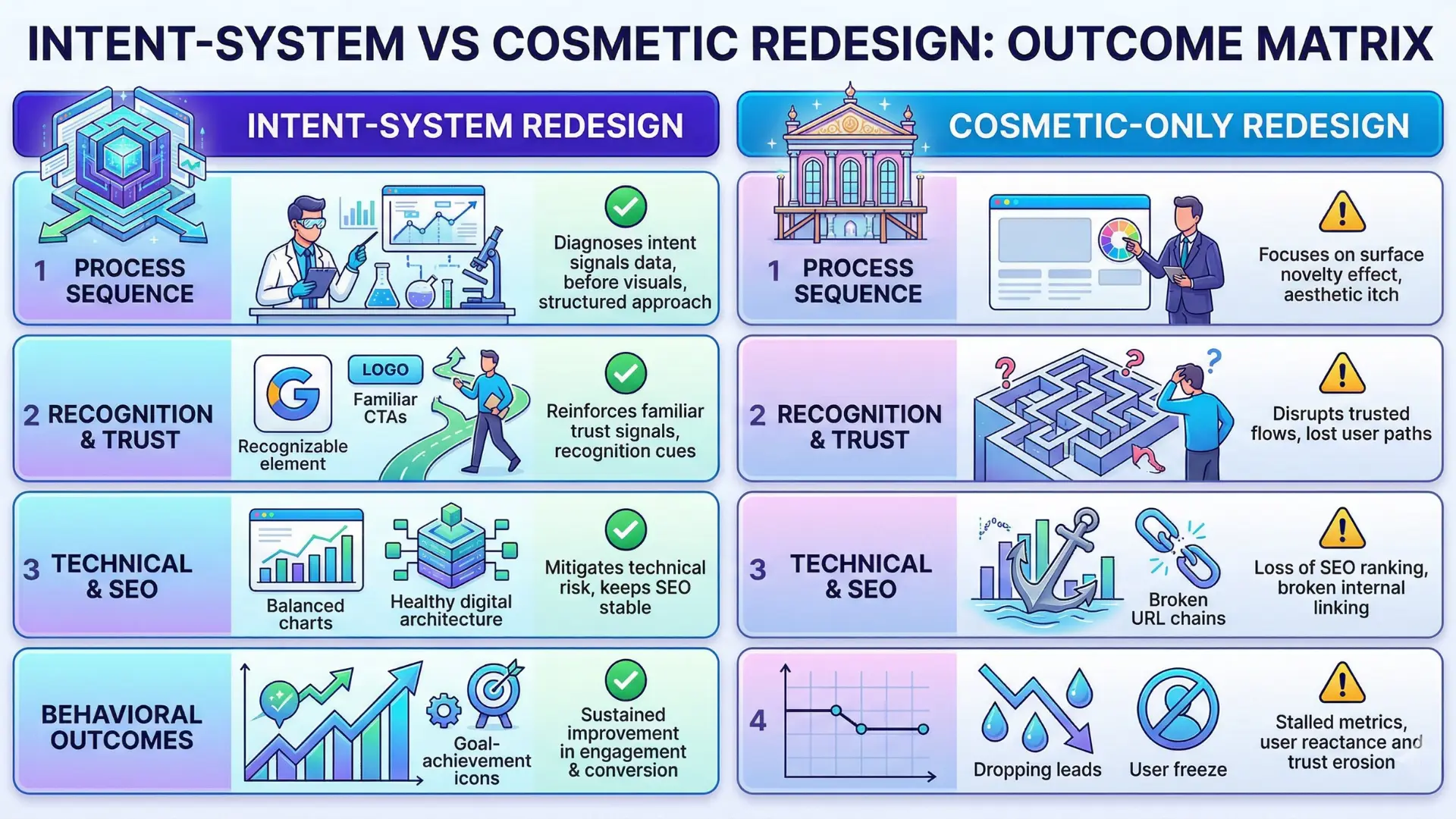
| Aspect | Cosmetic Redesign | Intent-System-Enabled Redesign |
| Focus | Visual appearance only (fonts, colors, layouts) | Underlying intent signals, user journeys, and messaging |
| User Trust | Often disrupted; recognition cues lost | Preserved and reinforced for continued confidence |
| Business Impact | Frequently causes stalled conversions and churn | Improves behavioral outcomes aligned with goals |
| SEO & Technical Risk | High risk due to URL changes and broken links | Anticipated and mitigated with system alignment |
| Post-Launch Outcome | Flat or negative results common; requires costly fixes | Iterative improvement and sustained gains expected |
Before teams chase the glow of new visuals, diagnose how users form and express intent on your current site.
With BiViSee clients, we’ve watched traffic spike and then flatten post-redesign, not for lack of ambition, but for skipping this diagnosis.
One B2B SaaS firm arrived certain their design looked “outdated”.
Their real bottleneck?
A murky value proposition and confusing conversion paths – problems no layout could fix on its own.
- Redesign enables business results only when intent signals are clearly defined and systems (navigation, messaging, CTAs) are recalibrated in support of those signals.
- Sequence is non-negotiable: clarify intent first, then redesign to support it.
- Otherwise, redesign only repaints the exterior without fixing the core problem.
- Visual vs intent mismatch is a core cause of failed redesigns.
Have you ever pushed a new site live, only to wonder why leads stall or churn rises? It’s rarely the surface.
It’s the missing system work beneath. We use tools like behavioral mapping to reveal which journeys are working and which stall out, so design choices genuinely move the needle.
Sequence, not surface, separates the rare high-impact redesign from the usual disappointment.
Reinforcing recognition and trust
The rarest, most effective redesigns don’t erase the familiar.
They reinforce the trust signals your audience already leans on – logos, color anchors, key headline phrasing.
Switching these abruptly is like changing a store’s storefront window in the middle of the night; even loyal customers question if they’ve come to the right place.
In client work, we often see leadership want a clean slate.
But recognition is a shortcut for user trust. One fintech redesign kept just two header elements identical – and user task success rose 18% compared to a variant that shifted everything.
Trust was preserved through recognition, not novelty.
That’s the behavioral impact of redesign most miss.
Think of your interface as a well-worn path in a garden.
Pave over it, and even regulars will stumble.
Enhance the route and trim distractions, and users move faster and more confidently.
A common myth claims redesign must break from the past to signal progress.
In practice, retaining and refreshing trusted elements creates the conditions for progress – without forcing your audience to relearn how intent is expressed.
Want faster adoption?
Keep what works.
Change only the frictions.
Intent systems are delicate.
The best redesigns protect and amplify existing trust, rather than pressing reset.
Redesign, at its best, works behind the scenes – enabling systems already moving in the right direction to go further.

The systemic cost of cosmetic redesigns
Comparing Cosmetic Redesigns vs Intent-System-Enabled Redesigns
| Condition | Description | Impact on Redesign Success |
| Intent System Clarity | User intent signals are well-understood and clearly defined. | Enables redesign to support actual user goals, increasing effectiveness. |
| Stakeholder Alignment | Cross-functional teams agree on success metrics and user pathways. | Ensures coordinated effort, reducing risk of conflicting changes. |
| Visual Changes | Visual updates are made to support intent, not replace it. | Avoids superficial changes that fail to address core problems. |
| Sequence Followed | Intent clarification precedes visual redesign. | Prevents costly failures caused by “repainting the door” without unlocking it. |
| User Journey Mapping | Existing user flows and bottlenecks are diagnosed before redesign. | Targets real pain points, improving conversion and engagement. |
What if the decision to “refresh the look” of your site actually erodes business performance – despite positive feedback?
“Cosmetic redesign” refers to changes focused on visual appearance – fonts, colors, layout – without altering underlying messaging, navigation, or user journeys.
Nearly every executive has been tempted by the visual quick win, but most discover an unsettling reality: users rarely follow pixels.
The impact of a cosmetic redesign ripples across trust, SEO, and the user’s unconscious sense of “am I in the right place, doing the right thing?”
Disruption of intent containers
When redesigns disrupt existing intent containers – those subtle visual cues, labels, and layouts that silently guide a prospect down the funnel – the fallout is almost invisible at first.
We’ve seen clients launch sleek new interfaces only to watch conversion rates quietly stall.
Sometimes, even a minor navigation shift fragments the clear paths that sales-qualified leads used to rely on.
One client cut their demo bookings by 27% simply by changing the position and color of their call-to-action.
Here’s the analogy every executive remembers: imagine rearranging the aisles in a grocery store every quarter, swapping bread and cereal, changing signage, and repainting the walls.
Shoppers may feel lost or just slightly off, often leaving without what they came for – yet the store looks “modern”.
Cosmetic redesigns frequently ignore the website redesign intent system – the deep, behavior-based logic that connects message, structure, and user expectation.
When the look changes without a clear map of pre-existing decision points, intent signals get scrambled.
Ever heard the myth that “freshness always improves engagement”?
It’s as common as it is costly. In practice, repeated treatment without a diagnosis risks breaking more than it fixes.
Technical/SEO warning: Cosmetic redesigns also risk disrupting technical structures.
URL changes, altered internal linking, or shifts in semantic markup may cause loss of SEO ranking, AI-search intent clarity, and engagement – especially when visual renewal is not mapped to existing high-performing systems.
Preserving high‑performing elements
Effective paths and high-performing content elements are often camouflaged within the ordinary.
When a redesign team recodes or removes these – thinking aesthetics alone will compensate – the effects surface fast.
We’ve worked with a SaaS provider who, after streamlining page layouts, lost 35% of organic entrance traffic overnight.
Their top traffic driver had been a humble FAQ box, quietly optimized for high intent queries.
That box, erased in the new design, took its recurring leads with it.
Behavioral impact of redesign ties directly to recognition and trust.
Consistent patterns, familiar CTAs, and proven copy all reinforce user certainty.
Alter these carelessly, and returning users start to doubt they’re in the right place.
Would you trust a familiar bank if their login page suddenly looked like a fashion blog?
The difference between a cosmetic redesign and a redesign enable intent system is the data-driven discipline to inventory what works first.
Tools like Hotjar or Clarity help reveal which paths carry real business value, not just visual weight.
Rhetorical question: What’s the actual risk of “fixing” what already works?
When redesign timing vs aesthetics gets out of sync, sunk cost mounts.
Cosmetic changes can degrade trust faster than teams realize – especially when the intent system isn’t rebuilt first.
Cosmetic wins rarely trump operational clarity.
Preserving what works is often less glamorous, but it protects the growth engine you spent years building.

Timing over visual novelty
Why do so many teams cheer when a new design goes live – only to see flat results?
Think about this: more than half the redesigns we’ve seen over the last five years led to no measurable improvement in core behavioral metrics after launch.
Some even nudged bounce rates up, not down.
Launch as iteration, not finish line
If that sounds brutal, Here’s the hidden pattern.
The true switch in visitor behavior almost never happens the day you hit “deploy;” it happens in the weeks and months after, as real users adapt and teams commit to ongoing improvement cycles.
A redesign is not a “grand reveal” moment. It’s the first lap of a longer race.
One client – an enterprise SaaS brand – made this mistake publicly.
Their redesign was beautiful but static.
No post-launch sprints, no realignment with analytics, no user feedback loops.
Within 60 days, frustration bubbled up both internally and for customers.
Where was the big win?
Here’s an unexpected analogy: a redesign is less like moving into a new house, and more like starting a season in professional sports.
You don’t stop training after the first game.
You review the footage, recalibrate, and adapt to actual conditions.
The redesign enable intent system only works if you plan for change and feedback – not just change for show.
Do your team’s goals demand a one-time reveal or a living system?
Most executives realize, too late, that the market doesn’t reward novelty – it rewards continuous fit.
Aligning cross‑functional clarity before redesign
Redesign projects often feel like the “easy” way to show stakeholder momentum.
But here’s where seasoned leaders pause: true readiness means operational clarity before pushing for visual change.
We’ve watched companies pour six figures into overhauls – only to belatedly discover sales and support teams were using old flows that actually closed more deals, or SEO teams struggling to recover lost rankings for months.
Results compound only when every stakeholder agrees on what success looks like, and which systems truly drive behavior.
One global e-commerce client saw conversion rates climb post-redesign – but only after investing three months aligning marketing, dev, support, and analytics teams around specific KPIs and user intent signals.
This cross-functional harmony became their real competitive edge, not the gradient on their hero section.
Here’s a myth: cosmetic redesigns will unify a brand. In our experience, alignment precedes effective change; visuals reflect, but do not generate, systems that support growth.
Ready for the next iteration?
Sustainable impact doesn’t start with visual freshness.
It starts – and restarts – with timing, cross-team clarity, and intentional cycles of feedback.
Diagnostic summary – when redesigns help:
- When redesigns follow (not precede) deep intent-system clarity
- When trust and recognition cues are preserved, not erased.
- When operational alignment is achieved before launch.
- When technical risks (like URL change impact, internal linking loss, or AI-search intent clarity risk) are anticipated and mitigated.
- When visual change serves system change, not vice versa.
When these criteria are absent, redesigns rarely lead to behavioral or commercial gains.
For a deeper dive on building intent systems before redesign, see our upcoming spoke on pre-redesign system alignment.

Scientific context and sources
The sources below provide foundational context for how decision-making, attention, and performance dynamics evolve under scaling and constraint conditions.
- Human Decision Making in Complex Systems
“Simple Heuristics That Make Us Smart” – Gerd Gigerenzer, Peter M. Todd, and the ABC Research Group – Oxford University Press
Explores how individuals rely on cognitive shortcuts and heuristics in environments where complexity outpaces simple rational calculation, illuminating reasons why cosmetic changes often mislead decision-makers about underlying effectiveness.
https://global.oup.com/academic/product/simple-heuristics-that-make–us-smart-9780195143812 - Trust and Cognitive Friction in Interface Design
“Designing with the Mind in Mind: Simple Guide to Understanding User Interface Design Guidelines” – Jeff Johnson- Morgan Kaufmann
Synthesizes research on user expectations, recognition, and how perceived familiarity underpins trust and effective navigation, directly supporting the article”s claims on trust signals and interface change risk.
https://www.sciencedirect.com/book/9780124079144/designing-with-the-mind-in-mind - Behavioral Dynamics of Habit and Interface Recognition
“User Interface Consistency and Standards: A New Look” – Jakob Nielsen – Communications of the ACM
Examines the empirical relevance of interface consistency, reinforcing why disrupting established pathways erodes user performance and trust, which connects to redesign outcomes discussed in the article.
https://dl.acm.org/doi/10.1145/2555133 - Organizational Traps and the Lure of Visible Solutions
“Organizational Traps: Leadership, Culture, Organizational Design” – Chris Argyris – Oxford University Press
Documents how organizations gravitate towards highly visible but superficial interventions (like cosmetic redesigns) in response to ambiguity, explaining why such efforts rarely resolve root business challenges.
https://global.oup.com/academic/product/organizational-traps-9780199248070 - Technical/Systemic Disruption and Search Performance
“Search Engine Optimization and Its Techniques: A Review” – Nidhi Bansal, Nishchol Mishra – International Journal of Computer Applications
Synthesizes peer-reviewed findings on how structural and navigation changes impact SEO and organic discovery, highlighting technical pitfalls of uncalibrated redesigns.
https://www.ijcaonline.org/archives/volume67/number2/11287-5939
Questions You Might Ponder
When do website redesigns actually improve business outcomes?
Redesigns improve business outcomes only when they follow a strategic diagnosis of user intent and recalibrate navigation, messaging, and call-to-actions to align with those goals. Visual changes alone do not drive performance; intent-system clarity and operational alignment must precede any redesign effort.
What are intent systems in digital product design?
Intent systems are structured sets of cues, pathways, and signals that guide users toward specific goals on a website or product. They encompass everything from navigation logic to trust signals, ensuring user behaviors align with business objectives beyond surface-level aesthetics.
How can cosmetic redesigns harm user engagement and SEO?
Cosmetic redesigns often disrupt technical foundations (URLs, internal links, semantic markup), unsettle established user pathways, and erode trust signals, leading to higher bounce rates and SEO ranking drops. Without data-driven inventory and alignment, cosmetic changes frequently harm engagement and discovery.
What metrics indicate a redesign is needed versus mere visual refresh?
Key indicators for a true redesign include declining user task success rates, confusing conversion paths, or ambiguous value propositions – not just aesthetic dissatisfaction. Metrics like conversion flow drop-offs, increasing support requests, and traffic-to-lead gaps signal deeper system misalignment warranting redesign.
Why is operational alignment essential before launching a new design?
Operational alignment – meaning marketing, sales, product, and analytics teams share a unified vision and KPIs – ensures redesigns reinforce profitable user behaviors and reduce systemic friction. Without alignment, visual changes rarely deliver measurable gains and can trigger unforeseen churn or lost revenue.