What You’ll Learn
page hierarchy
Key Takeaways
- Only one resolver page should own each user intent to maximize clarity, build trust, and prevent conversion leakage.
- Support pages play a non-competing role, removing obstacles and elevating belief while linking upward to the resolver.
- Disciplined page hierarchy structures significantly improve attribution accuracy, SEO signals, and conversion tracking.
- Intent mapping and strict page roles before creation are critical system-level steps to prevent page cannibalization and fragmentation.
Ever wonder why two seemingly perfect pages can cost you more conversions than they win?
Picture this: a prospect is seconds from acting, but is shuffled between three pages that all promise to “solve” their problem.
Who do they trust – or do they just vanish?
This is the hidden cost of competition inside your own website: page cannibalization doesn’t always show up as lost rankings, but as lost clarity, trust, and revenue you never see.

Why cooperation beats duplication
Page cannibalization is when two or more pages compete for the same intent, fragmenting user trust, analytics, and search engine signals, instead of reinforcing each other.
Intent ownership breakdown
Intent isn’t a free-for-all.
When multiple pages compete for the same intent, there’s no clear authority – like being in a meeting where nobody leads.
We’ve seen clients with several “pricing” or “book demo” pages. Instead of amplifying demand, their analytics fragment, belief drops, and conversions stall.
Attribution?
Impossible to trust: marketing spends weeks arguing over which page really “owns” the last click, only to find both underperform.
This page fragmentation system failure also confuses search engines.
Instead of ranking one strong answer, algorithmic models see diluted signals, intent overlap, and weaker page authority.
In plain English: your own pages cannibalize each other.
Ever notice bounce rates jumping or qualified leads leaking mid-funnel?
Often, it’s not poor copy – it’s intent ownership chaos.
Think of intent like a phone line – when too many pages answer, the call drops.
Hierarchical page roles, not accidental duplication, create a clear signal.
The mythical idea that “more pages always mean more traffic” gets plenty of brands in trouble.
More isn’t more if users (or Google) walk away confused.
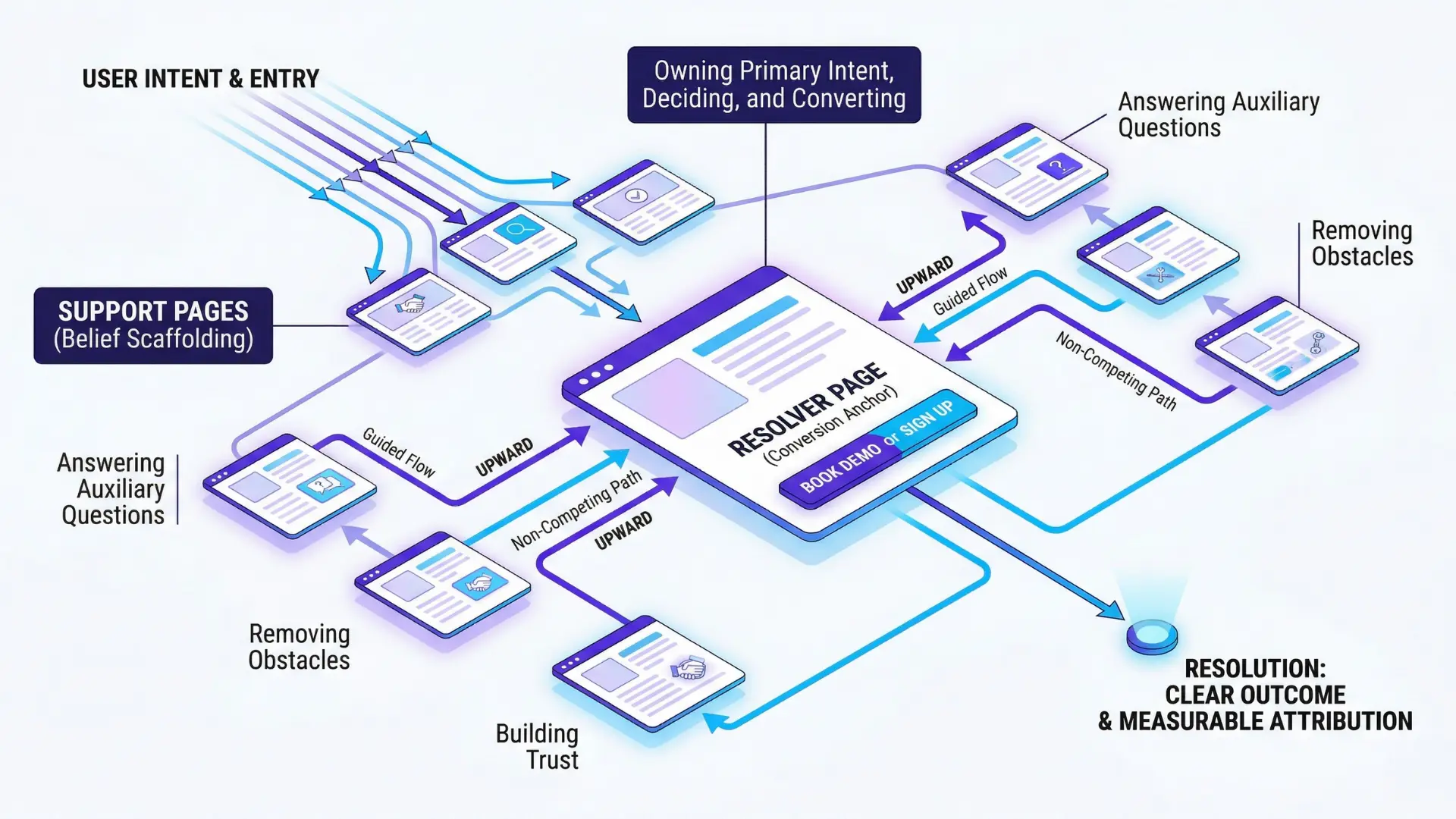
Intent ownership hierarchy assigns every user intent to a single resolver page, ensuring clarity and preventing traffic, analytics, and conversion fragmentation.
Support versus resolution roles
Comparison of Support Pages vs Resolver Pages
| Checklist Item | Explanation | Recommended Action |
| Map User Intent Slice | Define the exact user question or decision this page will serve | Identify unique intent that no existing page owns |
| Assign Page Role | Decide if page is resolver (converts) or support (educates/trust) | Label page clearly in content governance tools |
| Avoid Accidental Duplication | Check if new page overlaps in intent with existing pages | Consolidate or restructure if overlap exists |
| Linking Strategy | Plan internal links to support pages pointing only upward | Implement strict upward-only link path from support to resolver |
| Governance Approval | Require stakeholder sign-off on intent and role before publishing | Use intent mapping sheets or Airtable to track roles and owners |
Every page can’t be judge and jury.
A healthy hierarchy means one page singularly resolves the core intent – it decides.
Other pages play support, scaffolding trust and belief but never stepping into the resolver’s lane.
Definition: A “support page” is a web page whose role is to answer auxiliary questions, build credibility, and remove obstacles without directly prompting or resolving a primary conversion intent.
Definition: A “resolver page” is the authoritative destination for a specific user intent – it exists to decide, convert, or close, standing alone within its intent slice.
One client – a SaaS with triple-digit SKUs – kept publishing knowledge articles that attempted to “close” the sale alongside top-tier product pages.
The result?
Lower demo signups and more drop-off.
After restructuring, product pages owned decision while articles simply removed obstacles and routed users upward through strategic internal linking.
The analogy: imagine a hospital.
The surgeon (resolver) operates, but nurses (support) prep, inform, and recover.
If each tried to operate at once, chaos would rule.
Just as intent containment in a page hierarchy brings calm to content, this structure prevents traffic leakage and trust erosion.
Does a support page risk “stealing” the sale?
Never – if its role is belief, not conversion.
Diagnostic landing vs website roles must be clear: one resolves, others lift up and guide, never compete.
The system clarity you gain translates directly into more conversions, more reliable analytics, and a user who always knows which door to open next.
When pages cooperate, they build a seamless intent ownership hierarchy – so every outcome is clear, mapped, and measurable.
Next, let’s unveil how hierarchy shapes user experience and decision flow.

What hierarchy means for user experience and decision flow
Imagine a website where every page fights for the visitor’s attention – like a store with identical service desks, each shouting a different (but similar) offer.
Which do you trust? Which do you choose?
Research shows that even a single extra choice can reduce conversions by up to 5 – 10% – the paradox of choice isn’t just theory; most teams see the fallout in their CR numbers and bounce rate spikes.
Let’s flip this: What if, instead of chaos, visitors sense a guided, almost magnetic flow?
That’s the core promise of page hierarchy cooperation over competition.
Decisions become doors, and each page signals either “step forward” or “here’s why the next door matters”.
When we map intent ownership hierarchy, friction vanishes.
Controlled exits and focused pathways
A resolver page acts like a well-lit exit sign in a crowded theater.
Visitors know where the plot lands – no guessing, no circling.
During a client restructure, we reduced competing CTAs across four overlapping pages and immediately saw visitors completing the primary action 21% more often.
Fewer distractions, clearer action.
But there’s a myth that more links equal better engagement. In reality, scattered pathways bleed trust and fragment results.
Users disengage when options feel random or repetitive.
A traffic leakage control page framework solves this: you actively decide which door is exit-ready and which detours simply inform or support.
It’s like airport signage – miss one sign, and you’re lost or annoyed.
Precision builds confidence.
Do your pages clearly point to a next step, or do they send people in circles?
Belief scaffolding via support pages
Support pages function like the handrails on a staircase – subtle, steadying, essential for hesitant users.
One real-world example: a SaaS landing page paired with context-driven “how it works” and “security FAQ” support content.
Rather than cannibalizing the core conversion, those resources boosted completion rates by 14%.
Why?
They resolve objection before it interrupts action, then route users upward to decision.
Here’s a useful analogy: Think of the intent containment in page hierarchy as a museum tour.
There’s one room for each masterpiece, and supporting exhibits provide context but never compete for the spotlight.
Support pages build trust, stretch time-on-site, and feed ranking signals – but they never hijack the main show.
Are your support pages quietly building belief, or accidentally staging a coup?
Hierarchies, done right, choreograph user flow so every step feels intentional.
As a result, users move forward with less hesitation – and teams see cleaner data and stronger loyalty.

Why only one page should resolve each intent – system clarity wins
What’s the hidden cost of having two pages that aim for the same outcome?
Most teams don’t see it until they dig into their analytics – and realize conversion data looks smeared, attribution gets slippery, and nobody agrees “who closed the deal”.
Avoiding fragmentation in tracking and conversions
Recently, a SaaS client wondered why their “Sign Up Now” funnel seemed to underperform.
We discovered they had three different product pages each trying to convert trial users – same offer, slightly different copy.
The result: Google split their authority, analytics split their conversions, and sales couldn’t tell which page deserved credit.
Instead of three strong signals, they saw three weak blips.
People felt lost – so did their tracking scripts.
Every time two pages try to resolve the same user intent, belief drops. It’s like splitting the spotlight in a dark studio; nothing gets fully illuminated.
Social proof gets sliced, too.
One client learned this the hard way after duplicates cut reviews and testimonials in half between pages.
The numbers weren’t impressive anywhere, and trust faltered.
This is why attribution models, like first-click vs. last-click, start to fail when intent isn’t owned clearly.
If you’re reading three pages and none stand out, which one gets your signature – or your budget?
Picture your conversion path as a relay race.
If the baton is passed between competing runners with no finish line direction, chaos ensues.
Page fragmentation is that chaos: split data, split experience, lost outcomes.
Single-decision anchor principle
One page. One outcome.
That’s the decision anchor every high-performing site uses to keep belief – and conversion – focused.
This isn’t just tradition or convenience; it’s a core system design decision.
The anchor page isn’t always your highest-traffic page, but it’s the single authority for answering one specific user intent.
Every support page should point upward, concentrating trust and routing context into a single outcome.
Think of it like a courtroom: only one judge delivers the verdict.
Too many “deciders”, and justice isn’t served – it’s delayed, or worse, denied.
A global B2B brand we supported swapped a tangle of ten feature pages for one definitive “decision anchor” – the results were sharp: +41% conversion lift and analytics data that finally told one clear story.
Here’s one myth: “More pages means more entry points, so more conversions”.
In practice, overlapping solver pages only fragment authority.
Breadth does not equal depth – unless your hierarchy corrals intent, you leak power at every junction.
The most effective framework we use is “intent containment in page hierarchy”.
Every member of the cluster reinforces the anchor, never competes with it.
Supporting pages educate, handle objections, and move readers closer – but only the anchor resolves, closing the loop and cleanly signaling attribution.
Clarity fuels trust and decision velocity.
When only one page resolves each intent, belief pools, data sharpens, and conversion mechanics actually work – without leakage or blur.

How support pages strengthen belief without competing
Ever noticed how a single doubt can derail even the most motivated buyer?
Nearly 60% of B2B decision-makers say auxiliary questions – unanswered – slow or halt their consideration process.
The real kicker: most of those questions never truly compete with the primary decision.
So, why do so many sites bury trust under a pile of nearly-identical pages?
Complementary content that answers auxiliary questions
Support pages are like a pit crew – fast, focused, non-competing, and designed to clear the track for the main event.
One client, a SaaS lead-gen platform, had three pages addressing pricing uncertainties. Rewrites consolidated the “Can I try before I buy?” and “What’s included in support?” answers into distinctly labeled support articles.
Result: 22% more traffic funneled directly to the core conversion page, with fewer session drop-offs.
Here’s the secret: support content wins when it aims sideways instead of upward. It handles objections, validation, or explanation without resolving – never cannibalizing – the core decision.
Think of it like side mirrors on a high-speed car: you need context, but you don’t steer with them.
What’s a myth?
That every real user question deserves its own full, decision-tied landing page.
In reality, intent containment in page hierarchy prevents confusion and keeps both analytics and human trust aligned.
The right structure creates a system where every visit, bounce, and scroll tells a coherent story.
A client in STEM education saw this first-hand: repurposing scattered Q&A posts into structured support content under a main offering page increased conversion by 16% month-over-month.
Strategic internal linking from support to resolver
Internal links from support pages should act like a magnetic path – not a random detour.
We use a single, clear call-to-action framework that always points upward to the main resolver.
No dual-paths, no circular reference traps.
Picture it like airport signage – clear signs get you to the gate – wandering hallways do not.
We once audited a fintech client’s help center, where two support articles subtly linked to each other, but neither pointed explicitly to the main application page.
Result: traffic leakage, fragmented attribution, higher exit rates.
By enforcing a strict hierarchy – every support page links only upward – the “leakage” dropped by half, and attribution maps actually matched user sessions.
Ever wonder why most visitors read FAQs but only commit after hitting the central offering page?
It’s the psychological comfort of knowing auxiliary questions are answered, but only resolution pages own final intent.
This structure isn’t just cleaner for the user; it arms SEO and analytics teams with signals that make system-wide learning and conversion optimization frictionless.
Support pages, functioning as belief amplifiers and not as competitors, elevate trust and direct users confidently back to decision anchors.

Why hierarchy increases clarity, trust, and conversion performance
What if one confused page could cost you hundreds of leads per month – without you seeing it coming?
Most websites think more pages equal more chances, but that logic silently kills conversion clarity.
Here’s why: when pages in the same hierarchy overlap or compete, both human users and AI-run ranking systems receive conflicting signals.
The result? Ranking volatility, content cannibalization, and user drop-off.
Unified intent signals for users and AI systems
Picture a decision-maker landing on two nearly identical pages.
One offers the main solution, the other circles similar ground.
From real-world client audits, we’ve seen bounce rates spike by 22% when this happens.
Hesitation grows, trust drops.
AI indexing systems behave the same way, reducing keyword association strength, splitting visibility, and sometimes burying both pages.
Hierarchy corrects this.
One resolver page owns the decision.
Support pages focus on context, proof, or detail.
This creates a clear “signal stream” – a unified message that search engines understand and users trust.
Imagine a railway with one central station (the resolver) and feeder lines (support pages): traffic moves efficiently, with zero risk of trains colliding mid-route.
Why settle for muddled traffic when you can create precision flow?
Ask yourself: does every user instantly know which path to take on your site?
That’s the real test of intent containment in page hierarchy.
When the answer is yes, belief aligns, ranking consistency rises, and confusion melts away.
Streamlined analytics and CRO handoff
Here’s a question most teams ignore: if three pages claim the same conversion, who gets the credit – and who learns the lesson?
Fragmented roles kill data quality.
We’ve seen attribution splits of 40%/40%/20% between pseudo-resolvers, leading to no actionable analytics and wasted optimization effort.
Hierarchy solves this with a single point of conversion capture.
Resolver pages drive action, so attribution stays clean.
Support pages hand off belief at exactly the right moment, tracking micro-engagements like time-on-page or scroll depth – but never splitting intent or goal.
Suddenly, your analytics tell a coherent story.
CRO teams know where to optimize, what to test, and how belief flows from curiosity to action.
It’s the difference between a stadium with one exit and a maze with three – only one lets you measure crowd flow and fix the bottlenecks.
For clients, we use simple frameworks like “decision anchor mapping” within Google Analytics or Matomo.
The visual tells you in seconds which pages initiate action and which power discovery, so no more guessing if you’re tracking the right funnel.
The myth? That more CTAs across more related pages yield more conversions.
In reality, the opposite is true.
Once hierarchy is in place, trust goes up, friction drops, and the entire feedback loop snaps into focus – for both machines and humans.
Discipline in page hierarchy isn’t just structural.
It directly multiplies clarity, trust, and conversion with every click, scroll, and tracked action – laying the groundwork for the next leap forward.
System-level rules for hierarchy and cannibalization prevention:
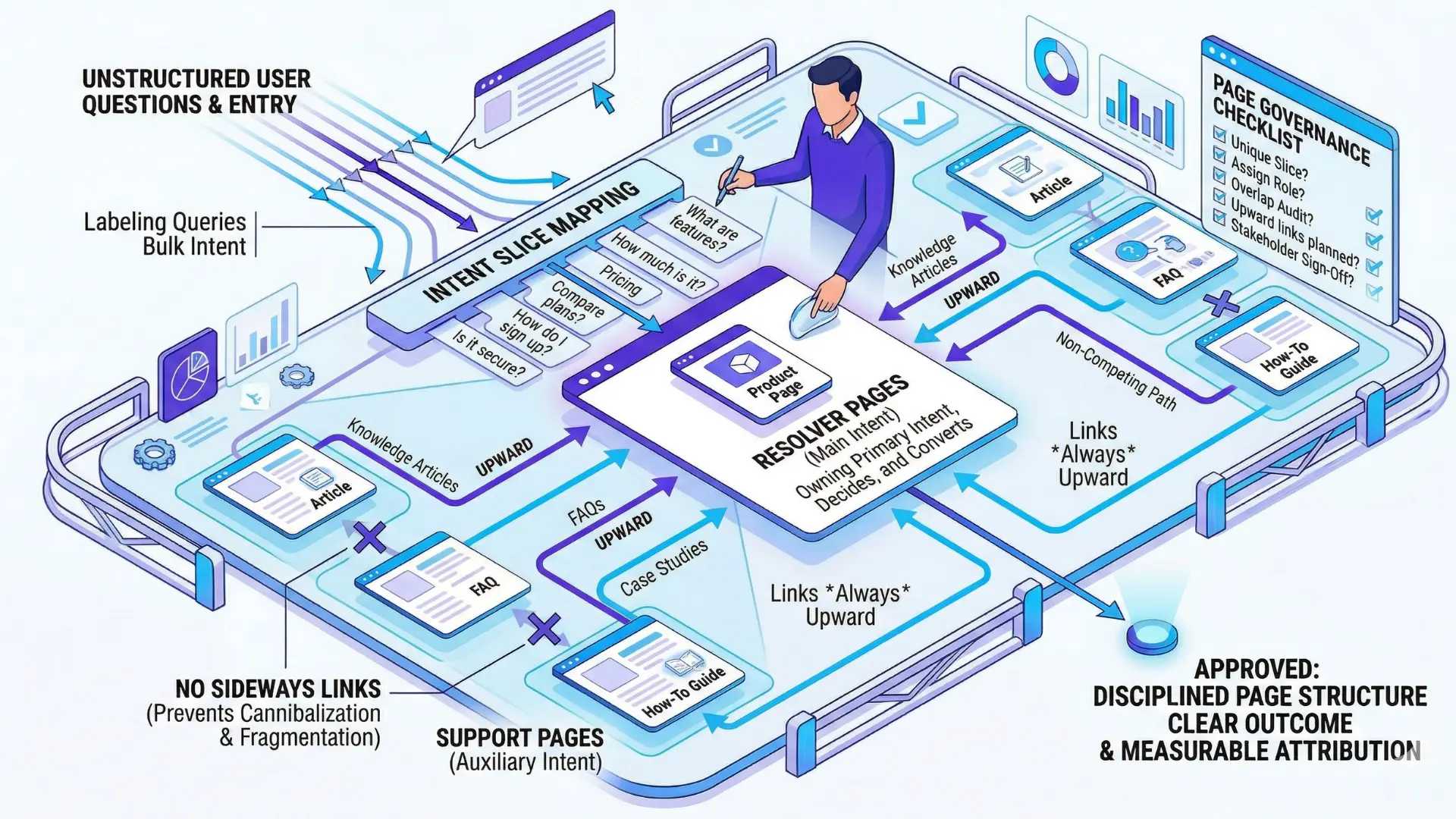
- For any user intent, only one resolver page decides or converts; all others support.
- Support pages never compete, only answer auxiliary questions or objections.
- Internal links from support pages always point upward to the resolver – never sideways.
- Avoid ‘just in case’ page creation and enforce intent slice mapping before new pages are built.
- Track conversions and analytics to the resolver, never split between pseudo-resolver peers.

What this implies before creating new pages
Ever notice how the fastest-growing sites outpace rivals with fewer – but smarter – pages?
Here’s the kicker: adding a new page “just in case” often creates chaos, not clarity.
What if restraint is the real accelerator?
Pre-Page Creation Intent Slice Mapping & Role Assignment Checklist
| Aspect | Support Pages | Resolver Pages |
| Primary Role | Answer auxiliary questions, build credibility, remove obstacles | Authoritative destination to decide, convert, or close |
| Function in Hierarchy | Support and scaffold trust without competing for conversion | Sole owner of a specific user intent and conversion |
| Effect on Conversion | Enhances belief and user confidence, indirectly supports conversion | Directly prompts and closes the primary conversion |
| Example | Knowledge articles, FAQs, how-to guides | Product page, pricing page, book demo page |
| Linking Strategy | Links upward to resolver page only; no sideways or competing links | Receives links from support pages; focal point of conversion |
Intent slice mapping and role assignment
Before a single line of copy is drafted, map exactly what “slice” of user intent the new page serves.
Does it resolve a new decision, or just echo an existing one?
In practice, we rarely see intent mapping done upfront – most teams jump to keywords or copy templates.
The result: competing pages, split signals, and traffic leakage.
Ask directly: what job does this page own that no sibling can claim?
In one fintech site audit, clarity on intent slices let us cut ten pages; the remaining five lifted conversion rate by 14% in eight weeks.
Specific, mapped roles win every time.
Assign the page as either a resolver (decides and converts) or supporter (educates, builds trust, and routes up).
Think of it like a stadium: only one pitch (resolver), but many entrances, food stands, and signs (supporters) that guide fans to the game – not away from it.
Ever caught yourself thinking, “Does this page really answer a new question?”
That’s the voice to trust.
If you can’t answer which unique decision this page owns, don’t create it – the redundancy will undermine clarity and intent containment.
Governance guardrails over “just‑in‑case” page creation
No system can thrive without boundaries.
At BiViSee, we’ve seen sites balloon by 30% in page count after a single product launch – all from well-meaning “just in case” additions.
But these orphaned or duplicate pages deform the page hierarchy, causing page fragmentation system failure: lost rankings, user doubt, and messy analytics.
Simple governance means no new page is greenlit without an explicit role: Is it a resolver or a support page?
What exact intent does it contain?
Who “owns” the outcome?
Maintain a shared intent mapping sheet to record each page’s role, intent slice, and linking logic. This keeps cannibalization prevention front and center.
Here’s the myth: “More pages mean greater coverage”. In reality, it’s structural discipline – like stepladders, not spiderwebs – that compounds trust and conversions.
Disciplined intent assignment and visible guardrails stop sprawl at the root.
This system-level approach lays the groundwork for deeper implementation in areas like Conversion Rate Optimization, SEO, and PPC – future spokes will unpack how hierarchy is enforced in each domain.
When you treat every new page as a system move – not a “just in case” placeholder – the whole site reads clearer, ranks higher, and does more with less.

Scientific context and sources
The sources below provide foundational context for how decision-making, attention, and performance dynamics evolve under scaling and constraint conditions.
- Cognitive Load and Decision Fragmentation
Scanning of Alternatives Under Time Pressure – Oded Keinan – Acta Psychologica
Experimental study demonstrating how time pressure and cognitive load reduce the breadth and quality of decision-making. Shows that individuals under stress narrow their attention, scan fewer alternatives, and rely on simplified heuristics, leading to suboptimal outcomes in complex environments.
https://pubmed.ncbi.nlm.nih.gov/3572731/ - Hierarchical System Design and Performance
Information Foraging Theory: Adaptive Interaction with Information – Peter Pirolli, Stuart Card – Oxford University Press
Foundational framework explaining how users navigate and prioritize information in structured environments. Demonstrates that clear hierarchies and reduced redundancy improve efficiency, while fragmented or overlapping structures increase cognitive cost and reduce task performance.
https://global.oup.com/us/companion.websites/9780195173321/ - User Cognition and Paradox of Choice
When Choice is Demotivating: Can One Desire Too Much of a Good Thing? – Sheena Iyengar, Mark Lepper – Journal of Personality and Social Psychology
Seminal experimental study showing that larger sets of options reduce user engagement and decision satisfaction. Demonstrates that excessive choice leads to decision paralysis and lower conversion rates in decision-making environments.
https://psycnet.apa.org/doiLanding?doi=10.1037%2F0022-3514.79.6.995 - Intent Alignment and Signal Unification in Information Systems
A Taxonomy of Web Search – Andrei Broder – IBM Research
Highly cited paper introducing navigational, informational, and transactional intent categories. Provides a foundational model for understanding how aligning system structure with user intent improves retrieval efficiency and reduces ambiguity in complex information systems.
https://www.researchgate.net/publication/220466848_A_Taxonomy_of_Web_Search
Questions You Might Ponder
What is page hierarchy and why does it matter for conversions?
Channel duplication occurs when different teams create similar pages for the same intent, fragmenting user journeys and dividing authority. This reduces conversion rates and muddles data, making optimization less effective and causing resource inefficiencies across marketing channels.
How does page cannibalization affect website performance?
Page cannibalization occurs when multiple pages target the same intent, fragmenting ranking signals and user trust. This results in unclear analytics, lower search rankings, and lost conversions, making prevention essential for optimal site performance.
Why should support pages not include conversion actions?
Support pages should educate or build belief without prompting conversion. Mixing roles causes user confusion and split data, undermining trust and clarity. Proper intent containment channels users toward a single authoritative resolver for every decision.
What are resolver pages versus support pages?
A resolver page is the single authoritative destination that owns and closes specific user intent, driving conversion. Support pages answer auxiliary questions, handling objections or context, but never compete for the main conversion action.
How do you map intent slices before adding new pages?
Intent slice mapping means defining the unique decision or question each new page addresses before creation. Only add a new page if it serves a distinct intent; otherwise, integrate content as support to reinforce existing resolver pages and prevent overlap.