What You’ll Learn
page competition
Key Takeaways
- Page competition splits authority, trust, and ranking signals, weakening outcomes across all digital channels.
- Overlapping pages create user confusion, trust dilution, and decision delays, reducing conversions even as traffic increases.
- Fragmentation wastes link equity and crawl budget while producing misleading performance metrics that complicate strategy.
- Implementing an intent ownership model with one clear authority per user intent improves clarity, ranking, and conversion rates.
Ever notice that when two landing pages target the same keyword, neither wins? Most teams expect more pages to mean more reach, but the opposite often happens. Ask yourself – when’s the last time duplicating efforts delivered twice the results? Or did it just make things murkier for everyone involved?
Definition: Page competition intent cannibalization occurs when multiple pages target the same user intent, causing confusion, trust dilution, and fragmented performance instead of increasing reach or conversion. Rather than amplifying results, this overlap silently erodes outcomes across all channels.

What page competition actually means
Key Harms of Page Competition
| Page Type | Role |
| Resolving Page | Owns the user intent and final conversion |
| Supporting Pages | Educate, reinforce, or provide additional info |
Intent confusion beats choice
The moment your site offers two nearly identical solutions for the same user query, the advantage of “choice” flips into friction. We’ve seen clients with duplicate service pages watch bounce rates spike even as traffic rises, inevitably asking: “Why is no one converting?”
It’s not choice paralysis in the classic sense. When a user encounters repeated promises – ‘best-in-class CRM’ here and almost identical copy two clicks away – the brain becomes suspicious. Are these alternatives or errors? Instead of driving urgency, the repeated messaging blurs what’s unique. Decision energy quietly evaporates.
An analogy: Imagine walking into a store and seeing the same cereal box on every aisle, but with minor label differences. Rather than grabbing it, you start wondering which is real, and walk out empty-handed.
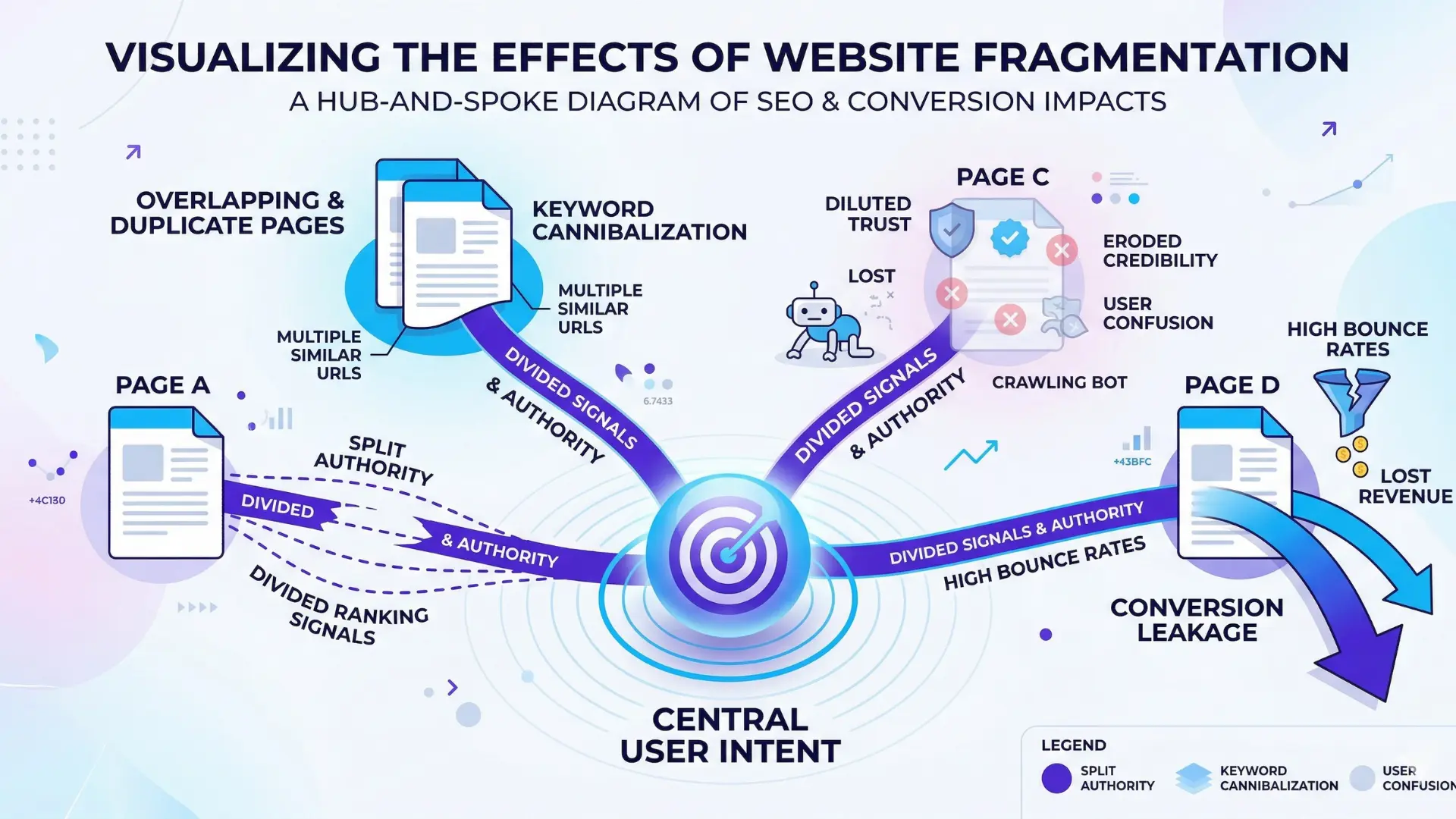
Trust dilution across page versions
Seeing repeating offers isn’t harmless. Trust isn’t built through consistency alone – it’s eroded by ambiguity. Users sense friction between slightly different product descriptions or contradictory CTAs. We’ve reviewed funnel data revealing that whenever competing pages coexist, form fills often drop by 25 – 35%.
Here’s a myth that trips up even experienced teams: “More pages covering the same territory will signal expertise”. The reality? Overlapping content produces user uncertainty from duplicate pages and triggers internal competition pages – your own site, in direct conflict with itself.
If a prospective buyer lands on a page, feels a tinge of déjà vu, then spots a parallel version with only surface changes, their instinct isn’t to act. It’s to compare, postpone, or even doubt the reliability of both offers. The effect is subtle but cumulative – like turning down the volume on trust by a few notches every time repetition creeps in.
Bottom line: When intent ownership slips and parallel page fragmentation sets in, both user confidence and measurable outcomes start to unravel. The pieces might look strong in isolation, but together, they create uncertainty. The real question – how many potential leads hesitate when they sense they’re not seeing the “definitive” answer?
Key Harms of Page Competition:
- Loss of authority and trust dilution repetition
- Increased user uncertainty from duplicate pages
- Link equity dilution and wasted crawl budget
- Higher risk of duplicate content and unclear site hierarchy
- Fragmented data, misleading performance signals, and lower overall ranking
- Greater likelihood of user confusion and decision postponement

System-wide consequences across channels
Would you expect doubling your landing pages to double your results? Here’s the kicker: it usually halves your authority instead. When multiple pages chase the same intent, signals fracture – links scatter, impressions drop by half, and page equity splits like a beam of light through a prism. We’ve seen this firsthand: a SaaS client launched two similar onboarding pages, hoping to A/B test. Instead, both fell out of Google’s top ten, losing combined impressions that took quarters to reclaim.
Authority dilution and signal splitting
Metrics become misleading in this environment. Organic search links distribute across duplicates, reducing the perceived relevance of any single page. Internal competition pages don’t just share traffic – they erode the clear winner that search engines (and buyers) want to see. Imagine pouring water into two glasses from one pitcher; neither gets full. Trust dilution repetition and internal competition pages build silently, fragmenting authority and wasting link equity and crawl budget. This often hides beneath short-term traffic spikes that flatline after redesigns.
Here’s one overlooked angle: equity isn’t just about external links. Internal links, crawl equity, and even high-click SERP snippets all suffer from fragmentation. A well-meaning content refresh might spike clicks on a duplicate for a week, but long-term signal splitting quietly drags down rankings.
Does your site structure unintentionally tell Google you’re unsure what to rank? The answer, more often than leaders admit, is yes.
Parallel pages in SEO, PPC, and service funnels
Page competition intent cannibalization isn’t just an SEO issue. It ripples through paid channels, service funnels – even offline campaigns. Think of your channels like musicians in an orchestra: when every page plays its own tune, the audience (your market) hesitates. One B2B advisor shared their confusion: “We kept sending paid traffic to a range of nearly identical product pages. Conversion rates dipped below industry benchmark, but making a change felt risky”.
This parallel page fragmentation turns coherent channels into rivals. SEO teams try to build authority; PPC teams optimize for cost-per-acquisition; service sales rely on direct response flows. When the landing page environment duplicates intent (or appears disjointed), users encounter conflicting cues that breed user uncertainty from duplicate pages. We’ve noticed that, post-redesign, sites often see flat or declining performance across paid and organic – with tracking showing repeat visitors endlessly circling similar offers.
Here’s a myth worth busting: “Multiple versions catch more demand”. In practice, they leak opportunity. A single, well-owned page – backed by intent hierarchy – builds a pipeline, while fragmentation breeds drift.
When signals and messaging split, results don’t just flatten; they blur, causing a silent, compounding drag on growth across every channel.

Why users don’t compare – they postpone
Here’s a thought no one wants to admit: the more similar your pages, the less likely your user is to act. Not more. There’s a classic marketing myth that more options mean more engagement. In reality, side-by-side “competing” pages often act like a stoplight, not a welcome mat.
Decision paralysis in repeated page encounters
Take a recent client who hoped that multiple landing pages – each targeting the same keyword with slightly different angles – would capture a wider audience slice. Bounce rates didn’t budge. Conversions flatlined. When reviewing screen recordings, we watched users hover, scroll, and then freeze. Do they pick the blue CTA or the red one? Tab juggling. Hesitation. Then exit.
From a cognitive science view, each near-duplicate page actually increases mental load. The brain must compare, contrast, and resolve the risk of making the ‘wrong’ selection. That tension is a recipe for stalling. This is decision fatigue at work: every redundant promise adds weight, not ease. Ever tried to pick a chocolate from a giant variety box and just shut the lid instead? That’s your page competition at work – except these are your leads.
If two pages look like equally safe bets but don’t guide the choice, users wait. Choice doesn’t compel action – clarity does. What happens when clarity blurs? Postponement. The metric nobody tracks.
Leakage via page-switching, not commitment
Switching between lookalike pages isn’t progress. It’s a leak in your conversion funnel. In audit after audit, we spot users toggling between pages obviously written for the same intent. Each time, forward movement halts. Curiosity doesn’t become intent – it disperses.
Real story: An ecommerce brand split “free trial” and “starter offer” onto two nearly identical pages. Customers poked around, bounced between promos, opened both links, but checkout rates dipped. Not a single buyer mentioned which page convinced them, because neither did. The repetition made them second-guess, not commit.
When users sense duplication, they don’t compare and quickly pick; instead, their trust and urgency fade. They explore more, not less. Metrics like ‘unique page views’ rise, but actual conversions don’t. The permeability of intent ownership is the quiet saboteur here.
Decision delay from page competition is silent, accumulative, and nearly invisible in standard reports. Recognize the pattern, and you can break it.
Problem – Symptom – Impact Map:
- Problem: Parallel page fragmentation / Internal competition pages
- User Symptom: Uncertainty, hesitation, repeated decision delay
- System Impact: Link equity dilution, wasted crawl budget, post-redesign performance flat, authority loss, duplicate content risk
A single, decisive path beats a maze – which sets up the structural remedy in the next segment.

Intent ownership as the missing rule
Ever noticed how two nearly identical landing pages both underperform, even with all the expected optimizations? Here’s the buried truth: a single user intent can only have one real digital home. When ownership is blurred, conversion rates stall and visibility crumbles.
Resolving vs Supporting Pages in Intent Ownership Model
| Harm | Description |
| Loss of authority and trust dilution repetition | Repeated similar pages reduce perceived expertise and trust. |
| Increased user uncertainty from duplicate pages | Users become confused by multiple similar pages. |
One owner per intent – authority and clarity
In multiple growth audits, we saw scenarios where three internal teams each owned their “version” of a service page. The result? No one page ranked or converted well. Traffic splintered, and search engines interpreted the competing signals as uncertainty, leading to lower overall authority. The fix wasn’t content tweaks; it was a realignment of internal ownership – one clear authority per intent, one destination for that promise.
Think of intent ownership like managing store aisles. If you spread the same product across different shelves with different labels, shoppers hesitate. They doubt which is official or freshest. The same thing happens in digital channels. Where intent cannibalization creeps in, trust (and metrics) slip away.
Ever wonder why some brands leave you feeling lost, with repeated but almost-right pages everywhere? It’s the echo chamber of last-minute duplication, not innovation.
Assigning a single owner for each user intent prevents parallel page fragmentation. Decision paths become sharp and obvious for both humans and algorithms. It’s authority through clarity, not just consensus.
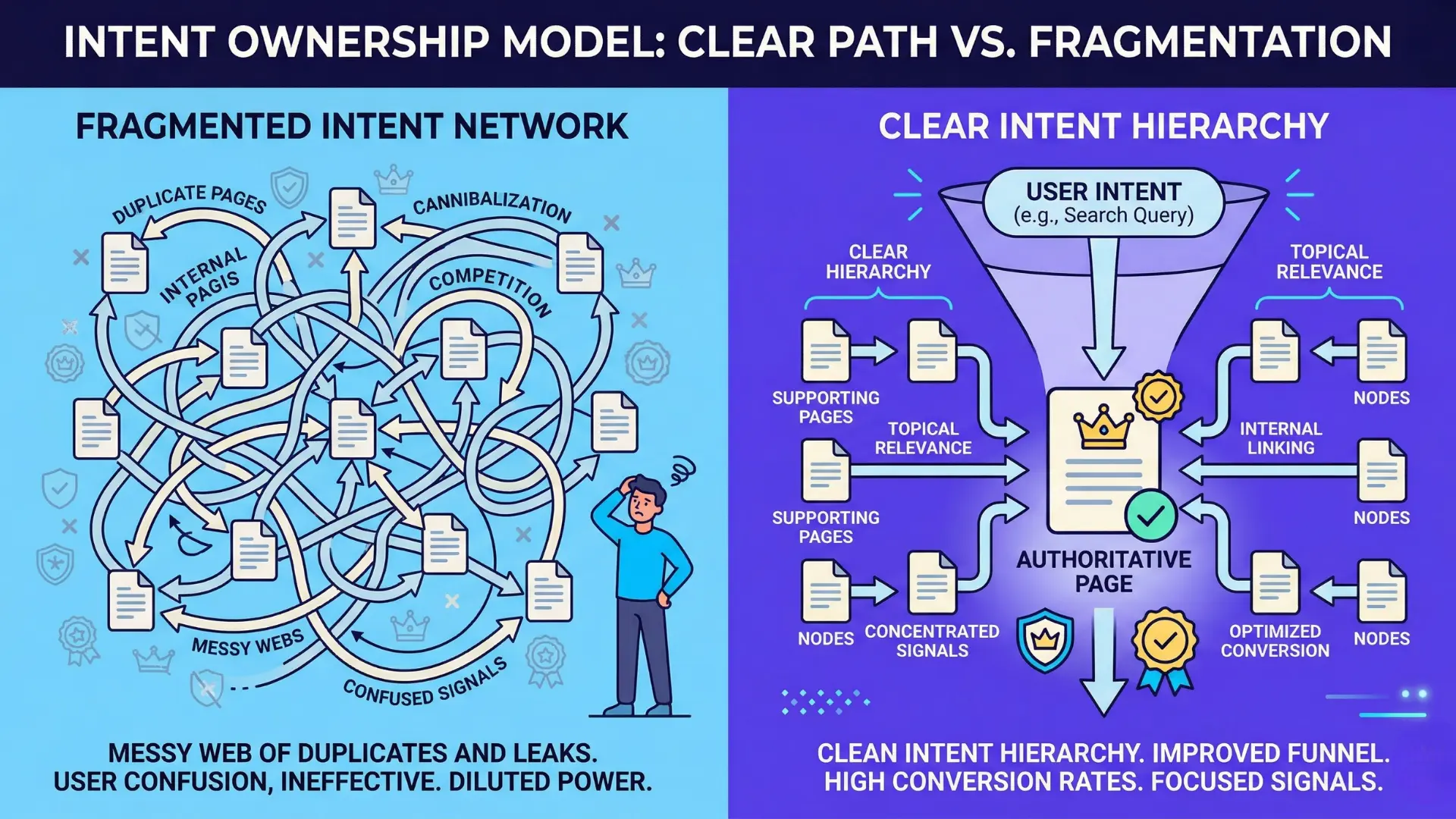
Hierarchy, not duplication: supporting vs resolving pages
Here’s where most redesigns fall flat: they replace one flatland of duplicates with another. The myth? That every need must have a main landing page. Reality asks for structure – a hierarchy where only one page resolves the intent, while others support, reinforce, or educate.
In practice, the most effective site architectures separate resolving pages (main intent-owners) from their supporting content. For instance, one client in B2B SaaS once split onboarding, benefits, and case studies across self-standing landing pages. Each competed for the same conversion. User paths tangled.
We rebuilt around a funnel model (an inverted tree): the main intent page answered the buying question. Supporting pages deepened understanding, linked clearly upward, and never repeated the core pitch. This cut internal competition, lifted engagement by 26% within three months, and ended conflicts in SEO tracking.
Definition: An intent ownership model assigns each user intent to a single, authoritative page within a hierarchy. Supporting pages may educate or reinforce, but only one page ‘owns’ resolution and conversion for the intent, preventing duplication and leakage.
Intent hierarchy beats duplication like a clear train schedule beats a swarm of nearly-identical buses. Everyone knows where to start – and where to get off.
Clarity of ownership is the real leverage point. Make intent unambiguous, and you create decision flow, not friction.

Scientific context and sources
The sources below provide foundational context for how decision-making, attention, and performance dynamics evolve under scaling and constraint conditions.
- Decision fatigue and cognitive load
Making Choices Impairs Subsequent Self-Control: A Limited-Resource Account of Decision Making, Self-Regulation, and Active Initiative – Kathleen D. Vohs, Roy F. Baumeister et al. – Journal of Personality and Social Psychology
Experimental research demonstrating that repeated decision-making depletes cognitive resources and reduces subsequent self-control. Shows that as decision load increases, individuals exhibit reduced persistence, poorer performance, and greater tendency to avoid effortful tasks – a core mechanism behind decision fatigue and user hesitation.
https://pubmed.ncbi.nlm.nih.gov/18444745/ - Information foraging and user behavior
Information Foraging Theory: Adaptive Interaction with Information – Peter Pirolli – Oxford University Press
Foundational framework explaining how users search, evaluate, and abandon information paths based on perceived value (“information scent”). Demonstrates that fragmented or competing paths increase cognitive cost and lead to early abandonment, directly mapping to leakage in complex navigation systems.
https://dl.acm.org/doi/10.5555/1450927 - SEO performance and signal coordination
The Anatomy of a Large-Scale Hypertextual Web Search Engine – Sergey Brin, Lawrence Page – Computer Networks and ISDN Systems
Seminal paper describing how search engines evaluate link structure, authority signals, and relevance across web pages. Establishes the foundation for understanding how fragmented or competing signals dilute ranking strength and reduce visibility in large-scale information systems.
https://research.google/pubs/pub334/ - Hierarchy and decision architecture
The Paradox of Choice: Why More Is Less – Barry Schwartz – Harper Perennial
Foundational work on how increasing the number of options leads to cognitive overload, reduced satisfaction, and decision avoidance. Demonstrates that excessive or overlapping choices degrade clarity and engagement, especially in structured decision environments.
https://en.wikipedia.org/wiki/The_Paradox_of_Choice - Internal competition in digital ecosystems
Managing Internal Competition: The Case of Knowledge Sharing in Multinational Corporations – Nicolai J. Foss et al. – Organization Science
Empirical study showing that internal competition for overlapping goals reduces knowledge sharing and fragments organizational performance. Demonstrates how parallel structures competing for the same outcomes create inefficiencies and weaken overall system effectiveness.
https://link.springer.com/article/10.1057/s41267-019-00270-4
Questions You Might Ponder
What is page competition in SEO and why does it matter?
Page competition occurs when multiple webpages on the same domain target the same keyword or user intent, leading to confusion, diluted authority, and lower rankings. Instead of increasing visibility, competing pages often hamper conversions and signal uncertainty to both users and search engines.
How does intent cannibalization harm website performance?
Intent cannibalization splits signals and user trust by presenting similar solutions for the same need, causing hesitation and lower conversion rates. It fragments link equity, wastes crawl budget, and results in misleading analytics that obscure which page is truly effective.
Can having more landing pages ever increase authority?
No – expanding duplicate pages usually weakens domain authority. Rather than signaling expertise, it creates internal competition, trust dilution, and fragmented backlinks. Search engines prefer one clear, authoritative page per user intent, which supports higher ranking and user confidence.
Why do users delay decisions when facing overlapping pages?
Users encountering nearly identical options experience decision fatigue and trust erosion. Instead of choosing, they compare, hesitate, or exit altogether. This increases bounce rates and leaks conversions, as users can’t clearly identify the definitive or most trustworthy solution.
What’s the best structural solution to page competition?
Assign one dedicated, authoritative page per primary user intent – an ‘intent owner’ – and link supporting or educational content hierarchically beneath it. This clarifies authority, consolidates signals, and guides both users and search engines to the intended conversion path.