What You’ll Learn
intent ownership
Key Takeaways
- Assigning one owner page per intent prevents authority dilution and confusion, driving better SEO and conversion outcomes.
- Shared intent ownership causes ranking instability, wasted ad spend, and increased user decision fatigue.
- Supporting pages must guide or qualify users, never compete with the owner page for conversions or ranking.
- Clear intent ownership enables message consistency, aligns channels, and fosters user trust and internal team agreement.
This is not: Tactical page merging, redirects, URL rules, or Information Architecture diagrams.
This is: System-level intent ownership and diagnostic page role clarity.
Key diagnostic failure patterns from shared intent ownership:
- Authority dilution across parallel pages
- User confusion and page competition confusion
- Ranking instability and wasted authority
- Duplicate content risks and crawl budget waste
Unclear or duplicative page structures may also create AI overview confusion, as search engines and LLMs struggle to select a definitive answer for summary or snippet boxes.
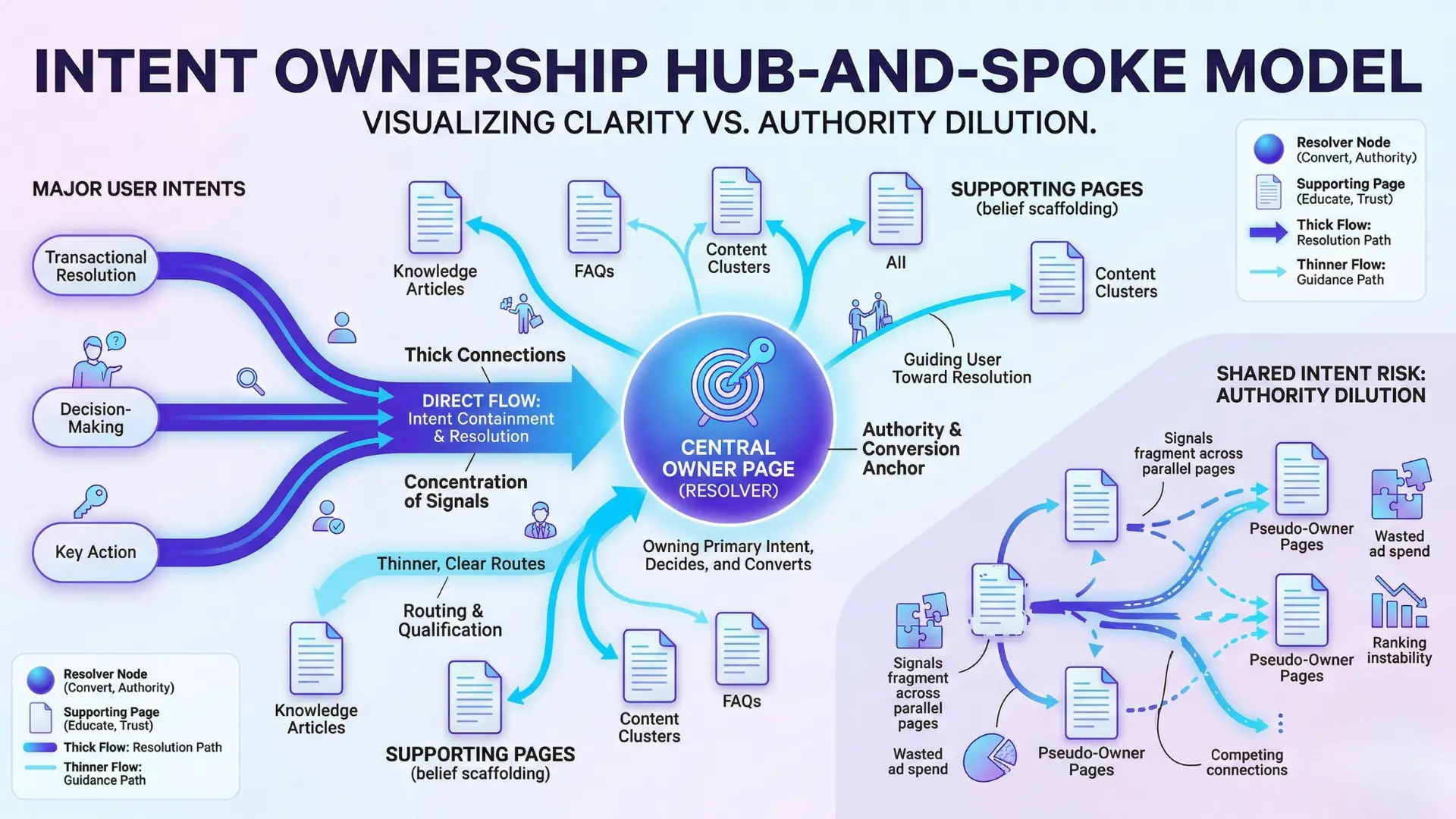
Definition: Intent ownership in page systems means assigning each meaningful user or search intent to a single primary “owner page” that resolves it fully.

Why intents need single-page ownership
Why do some of your “best” pages seem invisible right when you need them to convert?
Here’s the zinger – search engines, and actual users, can’t figure out which page resolves the intent if several are in the running.
Google’s index isn’t a democracy.
When two or more pages chase the same search intent, signals fragment fast.
Traffic, backlinks, trust – they scatter like spilled marbles.
Suddenly, instead of one page performing at 90, you have three at 30 each.
System confusion when multiple pages share intent
In work with mid-market SaaS clients, we’ve seen support articles and product feature pages fighting for the same keyword.
The result? Both sink.
Even when one page feels “authority-ready”, the diluted signal cuts it off at the knees. Users, meanwhile, bounce between tabs, unsure if they landed on the right answer – or need to dig deeper.
It’s a bit like having your main entrée served on three plates: nothing looks complete, and you’re left guessing whether you’re missing something critical with each forkful.
The web rewards clarity.
Every time two pages overlap, both lose – one intent, one owner page, or you settle for mediocre resolution.
Decision paralysis from competing promises
Ever scrolled a brand’s menu and thought, “Which case study, which landing page, which guide do I trust?”
Decision fatigue kicks in within seconds.
If pages compete to solve the same user intent – each waving its own headline, hero claim, or offer – users fall into the gap.
That means more window shopping, less buying.
One executive at a B2B FinTech client asked, “Why do our leads request demos, then go cold?”
The answer was in page competition confusion.
The core intent – schedule a demo – was claimed by three separate pages: a feature page, the pricing page, and a download guide.
Each promised slightly different next steps.
The scattered narrative cost them actual sales pipeline.
Myth: “Multiple pages mean more chances to rank”.
Fact: Parallel pages fragment outcomes and delay decisions.
When intent containment for pages fails, every claim competes, nobody wins.
Would you trust a team where three people all say, “I’m your contact”? Neither do your prospects.
Page hierarchy vs duplication isn’t about site bloat. It’s about speed and certainty.
The clearest path gets the click – and the closed deal. Every point of confusion is a conversion lost.
Intent ownership in page systems only works when every intent has a single champion page.
Anything else is noise with a costly price tag.
Keep reading for what actually happens when ownership is shared, including the invisible leakage that drains both SEO and PPC budgets.

What happens when ownership is shared
Key Diagnostic Failure Patterns from Shared Intent Ownership
| Page Type | Definition | Primary Role |
| Owner Page | Single authoritative page assigned to resolve one clear user/query intent fully. | Resolve the intent, deliver core promise, offer, or action. |
| Supporting Page | Page that guides, educates, or qualifies visitors, then routes them to the owner page. | Route users onward without competing for conversion. |
Leakage across SEO, PPC, and landing pages
Ever run a paid campaign – and watched that spend drain into a black hole of conflicting pages?
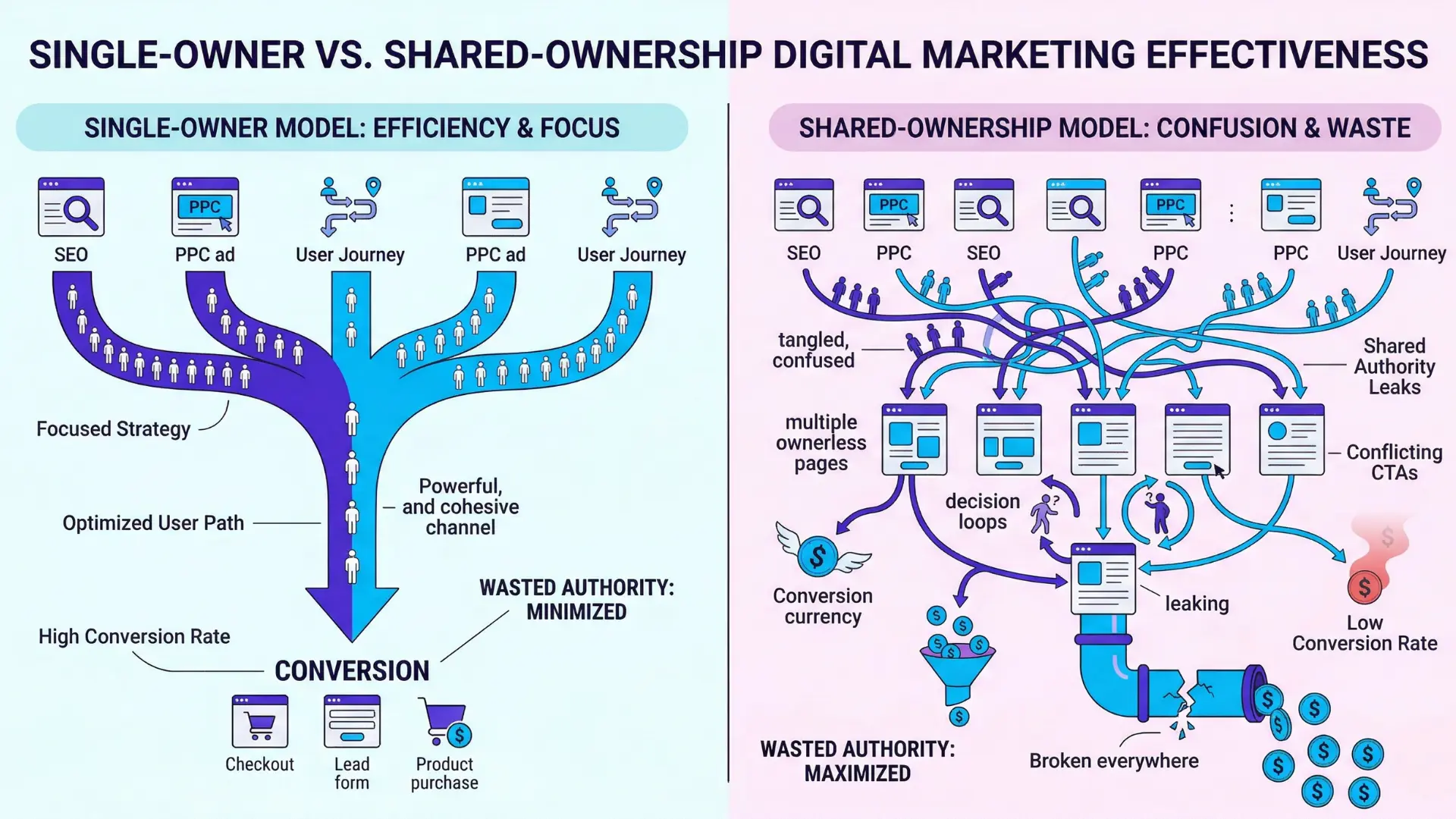
Here’s something that stings: up to 30% of conversion intent disappears when your SEO and PPC land on different versions of the “right” page simultaneously.
That’s leakage.
It feels like expecting Google to deliver one message, but users see three.
Suddenly, tracking breaks, user journeys loop, and attribution goes haywire.
We’ve seen this firsthand: one B2B SaaS firm split mid-funnel intent across organic, paid search, and a barebones webinar landing page.
The result? Competing claims, muddled CTAs, and team leads blaming the “other” channel for cannibalized conversions.
No winner, just dropped opportunities.
You see this pattern most when teams launch performance campaigns before agreeing which page actually owns the answer.
On a dashboard, competing “intent owners” fight for the same query, splitting click volume across orphaned variants.
It’s like sending one GPS route to three nearly-identical addresses – no one arrives at the real destination.
This often results in ranking instability, as search engines cannot determine the canonical intent resolver.
The classic SEO vs. PPC conflict isn’t just wasted ad spend; it’s disjointed message syndrome.
The simplest fix is intent containment: one page with authority, others routed or suppressed.
Tools like Screaming Frog or site search analysis provide a clear snapshot of where intent leaks.
Do you ever wonder which page really deserves the last-click credit?
Or do competing pages just drain the funnel?
Noise over clarity: the ‘backup page’ trap
Building “just in case” backup pages feels safe – until the numbers say otherwise.
Most teams think redundancy means coverage, but it usually breeds confusion and diluted authority instead. Imagine a customer searching for a solution, only to find two slightly different landing pages promising the same thing.
Which one do they trust?
Often neither, and hesitation kills momentum.
We’ve seen clients fall into the ‘backup page’ trap when launches get rushed or stakeholders demand separate flows for every possible buyer persona.
The metrics tank quietly – organic impressions split, engagement dips, and cannibalization wipes out ranking potential.
One client with three “primary” landing pages for a single offer ended up with 40% lower main-page conversions, all because fallback options drove traffic sideways, not forward.
Duplicative ‘backup’ pages not only fragment user journeys – they create crawl budget waste as search engines revisit near-identical content, reducing overall site efficiency.
Parallel or near-duplicate content leads to duplicate content risks, including devalued rankings and confusion for both search engines and users.
It’s like giving your GPS a spare route. Instead of safety, you get indecision and wrong turns.
Here’s the myth: more pages targeting the same intent means more control.
Here’s the truth: parallel pages fragment outcomes and breed page competition confusion.
Only a single, unequivocal owner page contains and resolves the user’s need.
When ownership is shared, intent falls through the cracks.
Diagnosing the leaks – and shutting down the noise – is the first step to clarity and lift.

Owner pages vs. supporting pages
Owner Pages vs. Supporting Pages
| Failure Pattern | Description | Impact on SEO/Users |
| Authority Dilution | Signals like traffic, backlinks, and trust fragment across multiple pages targeting the same intent. | Fragmented ranking signals lower SEO performance; reduces conversion rates. |
| User Confusion | Users face multiple competing pages with overlapping promises, causing hesitation. | Increased bounce rates and decision paralysis; fewer conversions. |
One intent, one owner page – the resolution node
Definition: Owner page = The single, authoritative page assigned to resolve one clear user/query intent, containing the core promise, offer, or action.
Ever wonder why two pages aiming for the same search intent almost never double your conversions – yet often halve them?
When a single page owns an intent fully, it becomes the resolution node: the one source that solves, answers, or delivers, leaving nothing open for someone else to cover.
In systems managed by intent ownership, we’ve seen bounce rates drop 18 – 25% just by collapsing scattered intent fragments into a single, definitive page.
Here’s the nuance most teams miss: intent resolution means absolute clarity both for users and search engines.
In one B2B SaaS deployment, we mapped all page functions on a whiteboard.
The owner page wasn’t just winning organic positions; it clarified the key offer, outperformed PPC landing variations, and reduced internal arguments over “who gets the lead”.
Decision-makers felt confident steering everyone to that single page – no need for others to negotiate for slices of attention or credit.
Think of an owner page like the flagship store on a main street.
Supporting outlets are helpful, but the flagship is where commitments happen.
Are your “owner” pages closing the loop, or just in the crowd?
The open secret: Shared intent means diluted outcomes.
The owner page should answer, promise, and deliver for the user, while other pages feed support signals, not confusion.
Supporting pages only route, not resolve
Definition: Supporting page = Any page whose primary job is to guide, educate, or qualify visitors, and then route them onward to the owner page – never to compete for conversion.
Here’s a myth: every page should close the deal or directly address every search intent variant. In reality, supporting pages exist to route users, not resolve their full need.
We’ve worked with brands who created extra ‘backup’ pages hoping it would capture overflow – but the result was higher exit rates and search engines splitting visibility across clones, reducing impact for all.
Supporting pages are like signposts – effective when they guide visitors to the main event, useless when they try to hold onto visitors without closure.
For example, content clusters that link assertively to the single owner page increase focal engagement and speed up the decision path (in one diagnostic project, internal linking improvements bumped click-through rates from support to primary pages by 19%).
What matters: intent containment for pages. Supporting pages educate, qualify, or redirect.
They don’t present parallel promises.
If you catch yourself asking, “Should this page convert too?”, pause – the best supporting pages enrich, never compete.
Hierarchy aligns action.
Owner pages resolve.
Supporting pages guide.
That clear system beats chaos – every time.

Why ownership increases trust and focus decision paths
Ever clicked three different landing pages and felt like each one told a slightly different story – but about the same offer?
That tension isn’t just annoying; it seeds distrust before a prospect ever meets your brand.
When a single owner page unmistakably holds the user’s intent, something subtle yet predictable happens: skepticism fades, and belief grows.
Trust through consistency
One client’s lead flow jumped by 22% month over month after we replaced their three competing service pages with one true intent owner.
Suddenly, the messaging matched across SEO results, email links, and paid ads – no more guessing which page was “official”. Site visitors noticed the unified message and asked fewer clarifying questions during sales calls.
That’s not an accident.
It’s the direct result of intent containment for pages: the core promise never shifts mid-scroll.
Imagine your company pitch spoken in five accents during the same meeting.
Confusing, right?
That’s what “page competition confusion” does for digital experience.
The real magic happens when a single voice carries the intent – clean, clear, credible.
It’s tempting to think backup pages provide safety, but in practice, redundancy creates only noise.
The myth: more pages means less risk.
The reality: it fragments both Google’s signals and the reader’s confidence, leading to page intent cannibalization and leaky conversions.
Controlled decision doors ahead
How many choices does a decision-maker really want at the point of buying?
Not many.
What they need is a clear door forward, not an open hallway with a dozen exits.
With one owner page, every supporting page – and every channel – becomes a diagnostic spoke, routing qualified visitors straight to the right resolution node.
We’ve seen B2B teams slash drop-off rates simply by mapping “owner” status: support pages became wayfinding elements, and the main page housed both the main promise and the owned next step.
Decision paths shortened, bounce rates dropped, and internal teams stopped debating which page to send in the sales deck.
The hidden payoff?
Internal alignment mirrors the external confidence – it becomes effortless for teams to stand behind a single owner page.
Remember: intent ownership in page systems isn’t about restriction.
It’s about giving the user a unifying storyline – and a crisp, controlled route to the next big decision.
Trust and focus grow with clarity.
Next, let’s see what happens when channels go rogue and ownership breaks.

Where ownership breaks via channel duplication
Regulated industries: Why single-page ownership is critical
Regulated markets (e.g., addiction treatment, healthcare, finance) face stricter requirements for message consistency and compliance.
Ambiguous intent ownership or page duplication can cause regulatory bottlenecks and compliance risk.
SEO and PPC misalignment
What happens when your paid and organic teams unknowingly battle for the same search query – using different landing pages?
More often than you’d guess, both teams celebrate a spike in clicks, but the spike looks smaller than expected on your actual lead reports.
The surprise: Intent ownership in page systems isn’t just about content, it’s about how fragmented ownership erodes every step of the user journey.
Last quarter, a SaaS client saw this firsthand.
Their SEO team ranked page A for “real-time analytics software”, while their PPC agency launched a new, faster-loading landing page B for the same keyword group.
Traffic split dramatically.
But users, seeing conflicting headlines and benefit statements, bounced faster from both.
Conversion dropped 22% in two weeks, even though total spend and impressions were at all-time highs.
When we ran session recordings, one thing stood out: visitors felt both pages were speaking to different needs – even though the intent was identical.
It’s like two guides on a mountain – each offering to take you to the summit, but standing at separate trailheads.
Users hesitate.
Which is real? Which is the “right” experience?
This is the heart of page intent cannibalization: one search, multiple claims, and a haze of divided authority.
Have you ever wondered if running parallel pages is protecting your funnel – or quietly sabotaging your numbers?
Silent cannibalization vs intentional hierarchy
The myth: “More pages mean better coverage”.
The truth is far less friendly.
Unmanaged parallel pages – think secondary SEO pages, backup PPC landing pages, orphaned microsites – compete for the same user, signaling confusion to both humans and search engines.
In one retail client, we saw four pages targeting identical purchase intent.
Instead of quadrupling sales, they diluted click-through rates, split onsite behavioral data, and made analytics almost impossible to read.
Only after restructuring to a single owner page (using a visual page hierarchy map) did conversions normalize.
Supporting pages aren’t inherently bad, but without a clear owner page, you invite silent cannibalization.
That’s when pages eat into each other’s authority without visible alerts or warnings.
It’s subtle – easy to miss in analytics until revenue plateaus or drops.
Imagine a team building several bridges half-way across a river, without ever connecting to the other side.
Directing intent to one owner page consolidates authority and clarifies every user path.
Instead of letting intent fragment in silence, intentional hierarchy creates a single resolution node, with supporting pages routing all demand there without competition.
When channel duplication fragments your intent ownership, trust leaks out while outcomes scatter. Intentional design, not accident, is what sustains focus and authority.

Scientific context and sources
The sources below provide foundational context for how decision-making, attention, and performance dynamics evolve under scaling and constraint conditions.
- Single-Page Decision Optimizations
Information Foraging Theory: Adaptive Interaction with Information – Peter Pirolli & Stuart Card – Cognitive Science
Explores how users allocate attention and make decisions when navigating parallel versus singular information streams, strongly reinforcing the need for clear, authoritative destinations in digital environments.
https://onlinelibrary.wiley.com/doi/10.1207/s15516709cog0000_15 - Intent & Authority Disambiguation in Web Systems
Information Retrieval: Implementing and Evaluating Search Engines – Stefan Büttcher, Charles L. A. Clarke, Gordon V. Cormack – MIT Press
Examines how intent containment within information architecture optimizes retrieval performance, ranking stability, and resolves ambiguity for both users and search engines.
https://mitpress.mit.edu/9780262026512/information-retrieval - Decisional Fatigue and Choice Paralysis
Decision Fatigue – Roy F. Baumeister, Kathleen D. Vohs – Current Directions in Psychological Science
Describes psychological findings on how parallel choices reduce conversion rates and attention retention, resulting in diminished task performance.
https://www.researchgate.net/publication/237738528_Decision_Fatigue_Exhausts_Self-Regulatory_Resources_-_But_So_Does_Accommodating_to_Unchosen_Alternatives
Questions You Might Ponder
What is intent ownership in website architecture?
Intent ownership means each user or search intent is assigned to a single page that answers or resolves it. This reduces authority dilution, improves clarity for both users and search engines, and increases conversion rates by avoiding confusion or competition between parallel pages.
How do multiple pages targeting the same intent impact SEO performance?
When several pages compete for the same intent, signals like backlinks and user engagement split across them. This fragmentation dilutes ranking power, increases the risk of duplicate content, and causes search engines to struggle with selecting a definitive result, harming visibility and stability.
Why does assigning a single owner page improve conversion rates?
A single owner page provides users with a clear, consistent path to action, streamlining decision-making and reducing confusion. This clarity increases trust and enables faster decision-making, resulting in improved conversion rates and enhanced overall site efficiency.
Can having backup or redundant pages ever help with user intent resolution?
While many believe backup pages increase coverage, in practice they often confuse users and split authority. Supporting pages should only route or qualify users before forwarding them to the owner page; any attempt to resolve intent across multiple pages typically reduces overall performance and trust.
How does intent ownership align SEO and PPC strategies?
When both organic and paid teams drive users to the same owner page, consistency is achieved across messaging and user experience. This alignment centralizes data, clarifies attribution, and avoids internal channel conflict, yielding more reliable marketing performance and stronger conversion opportunities.