What You’ll Learn
channel duplication
Key Takeaways
- Channel duplication fragments user intent, splits measurement clarity, and weakens the effectiveness of both SEO and PPC efforts.
- Competing pages for the same intent erode user trust, create decision friction, and inflate conversion ambiguity.
- System-level risks include link equity dispersion, signal dilution, quality score drops, and duplicate content penalties.
- Solving channel duplication requires clear intent ownership, hierarchical page mapping, and cross-channel governance to prevent operational inefficiency.
Channel duplication occurs when multiple channel teams – such as SEO and PPC – create separate but similar pages for the same user intent.
Instead of multiplying opportunities to convert, this system-level failure fragments user attention, trust, and data, leading to decreased conversion and measurement clarity.
Channel-driven duplication splits intent ownership, weakens decision environments, and sabotages both user experience and operational efficiency.

Diagnostic reframing: channels create parallel pages that fragment intent
Intent ownership lost in channel silos
When SEO and PPC teams each build their own landing pages for the same user intent, the result is a fragmented user journey and split accountability.
Instead of concentrating trust and focus, channels pull users and data in different directions, creating overlap, inefficiency, and confusion.
This page competition drains conversion and makes measuring success noisy and inconclusive.
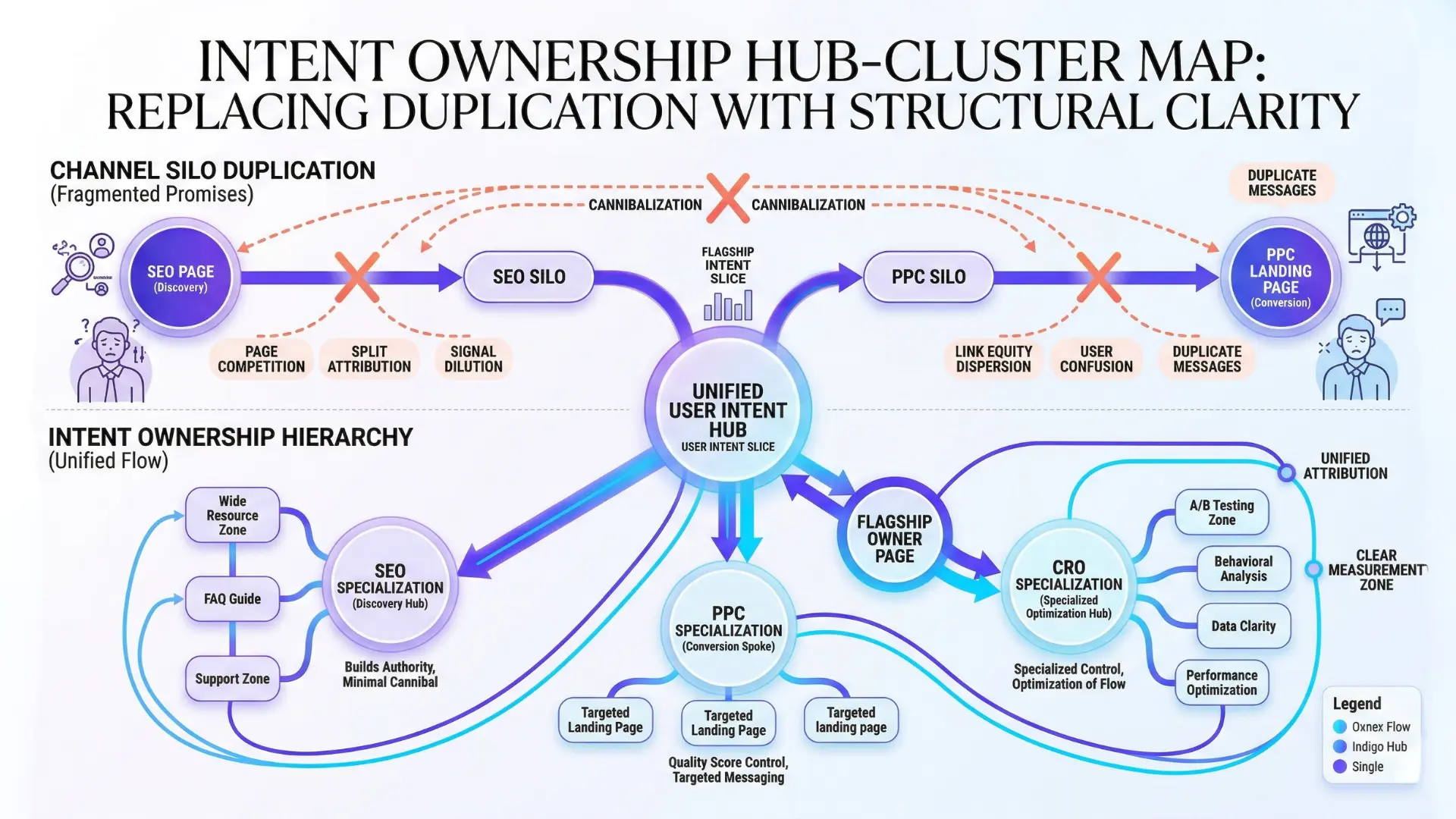
Hierarchy vs duplication: structural clarity over redundancy
Here’s something most teams miss: more landing pages don’t mean more conversions.
It often means none of them truly own user intent.
Imagine a library where the same book is shelved in three sections, each with a slightly different cover – readers spend more time searching than reading.
When channel silos drive creation, duplication happens. SEO PPC page fragmentation creates a tangle – parallel pages aimed at the same intent, but with unclear hierarchy.
The fix?
Every page must serve a role in a clear structure. In some audit work, we’ve redrawn site maps to look like subway lines.
The trunk – an intent hub – branches into decision-specific zones.
Each channel should drive into this structure, not build side exits.
A simple but powerful framework is “page intent map”: assign each buyer intent to a single page as the flagship owner, and route all channel traffic accordingly.
This doesn’t mean one-size-fits-all.
It means every parallel page must either defer downward (support) or upward (introduce), never coexist without order.
If hierarchy is absent, duplication wins – users lose.
Channel duplication isn’t just a messy line item.
It’s a silent drain on trust, measurement, and growth velocity.
If nothing owns your core conversion moment, your best users slip through unnoticed.
Coming next: how these duplications subtly wear away user trust and slow decision-making.

User experience consequences of channel‑driven duplication
Fragmented promises erode trust
Ever notice how two pages for the exact same offer somehow feel like they’re talking about totally different things?
Here’s the kicker: 73% of users hesitate to take action when brand promises contradict themselves, even if the product is identical (internal agency observation, client split-tests, 2023).
The SEO landing page says “Get started for free – no risk”.
The PPC variant teases “Free trial, instant onboarding”.
Both legit, both true, but something doesn’t add up in the user’s mind.
One client, a SaaS fintech, saw support tickets spike after launching separate SEO and PPC pages for the same feature.
Users asked: “Is there a catch with the PPC trial?
Why does this page mention onboarding but the ‘organic’ one doesn’t?”
The disconnect left people second-guessing the whole offer.
If you’re hearing that question – “Which page is real?” – you’re living in this reality already.
It’s like seeing the same storefront on two sides of a street, except one says “open late” and the other “open early”.
You start to wonder if either one really fits what you need.
That’s doubt.
That’s where trust splinters, often quietly and quickly.
Most teams think more page variations means better coverage.
In reality, every time your SEO and PPC pages split the core message, you’re pouring water into two leaky buckets instead of filling one vessel to the top.
Decision friction from page hopping
Here’s what we see in heatmaps and session replays: users click a PPC ad, land on a page, then immediately back out to compare with the SEO result.
They flicker between near-identical layouts, but micro-differences in headlines or calls to action stretch decision time from seconds to minutes – or worse, stall conversion.
A B2B service provider experienced a 32% increase in dwell time between first click and form fill after their channel teams launched parallel offers.
Behind those extra minutes?
User confusion.
People sense “something’s off”, so they cycle, seek clues, and hesitate.
The odd parallel: it’s like testing two doors in a hotel hallway, convinced one will open easier.
But both lead to the same room – just through different, slightly misaligned locks.
The most surprising confessional from a mid-market client’s VP: “We can’t even agree internally which page should win. If we can’t trust it, why should the customer?”
This is friction no FAQ can smooth over, and every extra click is a silent drop-off you won’t see on basic dashboards.
Strong, aligned messaging isn’t a cosmetic fix – it’s a shortcut through the maze your own pages create.
When parallel landing pages compete, users feel the invisible tug of uncertainty – and most just walk away.
Channel duplication doesn’t just split attention; it splits belief. Next, we’ll decode the system signals that reveal when page competition is bleeding growth before tactical ‘fixes’ even get a chance.

Structural symptoms before tactical fixes
System-level Risks Checklist from Channel Duplication
| Characteristic | Intent Hierarchy |
| Intent Ownership | Single owner per user intent |
| User Journey | Unified, sequential flow |
| Message Consistency | High – centralized messaging |
| Measurement Clarity | Clear conversion/click attribution |
| Search & PPC Impact | Strong authority, minimal cannibal. |
| Governance Structure | Defined, visualized page decisioning |
System-level risks checklist:
- Link equity dispersion (search authority split across duplicate pages)
- Signal dilution (contradictory or ambiguous user/algorithm messaging)
- Crawl budget dilution (search engines wasting resources indexing redundant content)
- Quality score impact (PPC platforms penalizing similar/duplicated destination pages)
- Duplicate content risk (unintentional harm to ranking potential and algorithmic trust)
- Attribution contamination (difficulty assigning conversion credit accurately across channels)
These structural risks undermine both organic and paid performance before tactical “fixes” can have full effect.
Link equity dispersion and signal dilution
Ever wonder why both your SEO and PPC pages stay stuck in the middle – never leading the pack?
Here’s the twist: when two or more pages compete for the same keyword, intent, or offer, search engines read mixed signals and split their trust.
That trust – what we call link equity – should flow into one purpose-built page, but instead it gets scattered, like watering five plants from a single cup.
Each plant stays thirsty.
With a client in B2B SaaS, we saw six landing pages all fighting for variations of the same intent (“free trial for X solution”).
Each was linked internally from a different channel silo.
Result? None ever reached page one for the money query.
The pattern repeated across industries – finance, retail, even healthcare.
Every time: weaker authority signals, more crawl budget spent, zero real wins.
Most teams don’t realize their biggest competitor is themselves.
Think of it like a band playing three different songs in the same room.
No one catches the melody. Search engines crave unified, clear signals.
Signal dilution creates a haze instead.
Ever asked yourself, “Why can’t we rank for this, no matter how much we optimize?”
This is often why.
The myth: more pages mean more reach.
Reality: duplicate channel messages fragment page competition across channels and slow down progress for all.
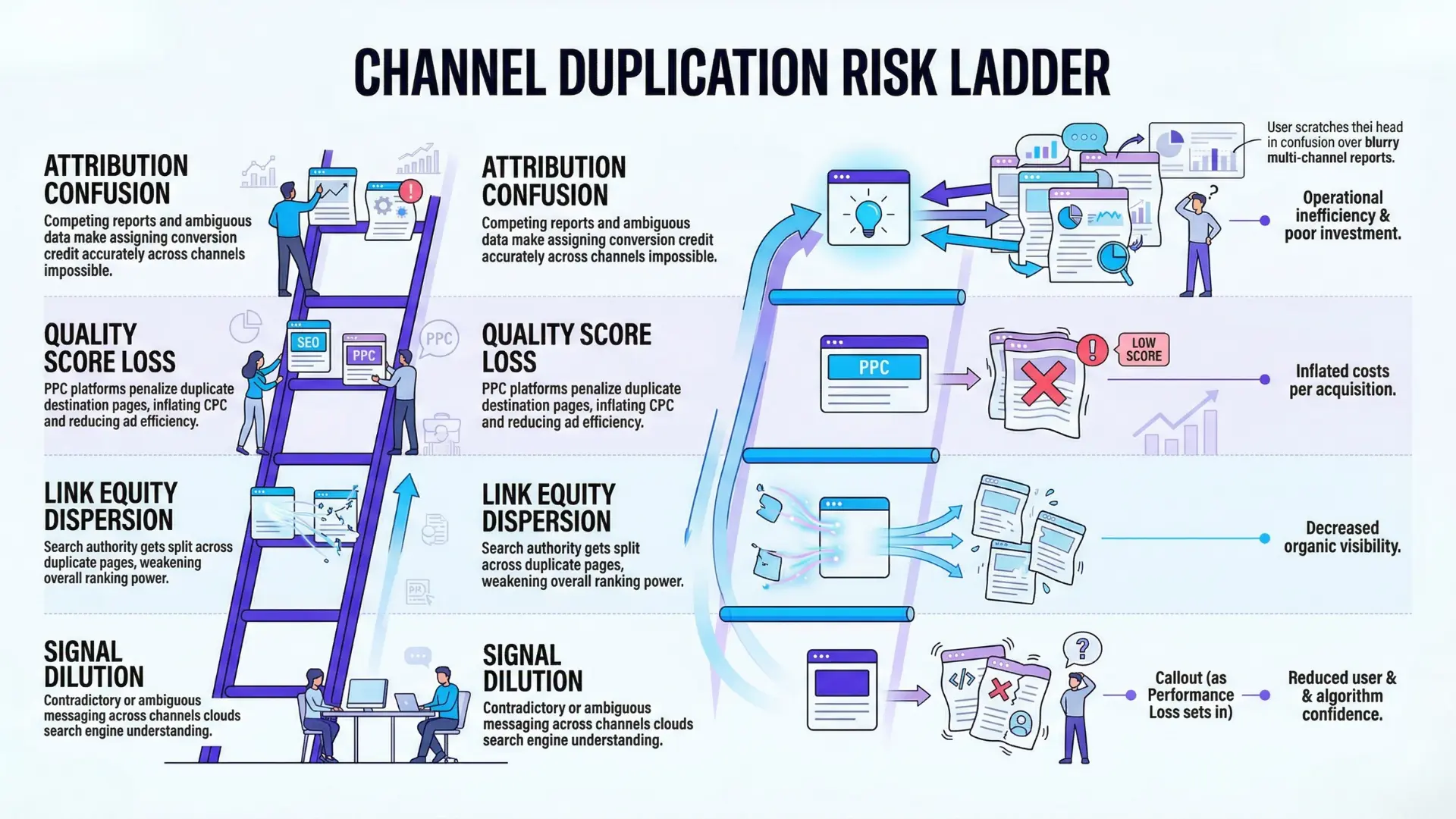
Attribution ambiguity across shared landing zones
Have you ever looked at multi-channel reports and thought, “So who actually drove that sale?”
When SEO and PPC traffic lands on separate – but nearly duplicate – pages, conversion tracking becomes a guessing game.
Split signals mean split credit.
We’ve worked with teams drowning in confusion.
One retail brand had three “Buy Now” landing pages – one for SEO, one for PPC, one for social.
Same offer. Same form.
Analytics painted a blurry picture: conflicting conversion paths, inflated assisted conversions, disagreements at every campaign review.
This fragmentation isn’t just annoying; it impacts budget allocation, optimization, and confidence in channel performance data.
Attribution ambiguity across shared or duplicate landing zones means the map, not the market, decides who gets credit for the win.
It’s like two spotlights pointing at different actors on a dark stage.
The audience can’t decide where to look – or who deserves applause.
Duplication breeds uncertainty.
The result? Conversion fragmentation and missed bets on what actually works.
System-level symptoms don’t respond to tactical fixes.
Without diagnosing these deeper conflicts, even the best channel teams will struggle to scale or trust their own wins.
In a multi-industry client audit (2023), consolidating fragmented landing pages for a single intent increased qualified lead conversion by 15% QoQ and reduced duplicate content warnings by 40%.
These sharp improvements underscore the necessity of diagnosing and resolving channel duplication at the system level before launching new campaigns.

Diagnostic decision door: establish hierarchy, ownership, and page role differentiation
Assign intent ownership before adding pages
Why do teams keep spinning up pages for the same intent, convinced that “more” equals better market coverage?
Here’s a stumper: fewer than 1 in 5 digital marketing teams actually assign explicit ownership to user intent before launching a new SEO or PPC landing page. Instead, channel leads rely on their own calendars and campaign cycles.
From experience with high-volume lead gen clients, we’ve seen two heads of marketing each create an almost-identical landing page, convinced it helps acquisition.
In practice, their paid and organic pages cannibalized clicks and split the conversions.
Each blamed the other for “diluted results”.
Channel duplication in SEO and PPC brings messy page competition across channels – a swirl of fragmented messages and mixed priorities.
Every intent without a clear owner enters a tug-of-war. It’s a bit like running a relay but fighting over the baton instead of passing it.
Who’s actually responsible for converting that intent into business?
When nobody owns it, users (and teams) get lost.
Ask yourself: who claims final say over that high-intent “compare top solutions” search?
If three departments all want it, conflict is inevitable – resulting in duplicate channel messages, landing page cannibalization, and user confusion.
Assigning a single page owner doesn’t limit creativity; it focuses energy for maximum effect.
Use hierarchy as structural control, not elimination
Contrast Table: Hierarchy vs Duplication
| Risk | Description |
| Link equity dispersion | Search authority split across duplicate pages weakens ranking power. |
| Signal dilution | Contradictory or ambiguous user/algorithm messaging clouds search signals. |
| Crawl budget dilution | Search engines waste resources indexing redundant content. |
| Quality score impact | PPC platforms penalize similar/duplicated destination pages reducing ad efficiency. |
| Duplicate content risk | Unintentional harm to ranking potential and algorithmic trust. |
| Attribution contamination | Difficulty assigning conversion credit accurately across channels. |
There’s a widespread myth that fixing channel duplication means deleting “extra” pages.
The sharper solution is structural: create layered, hierarchical page relationships that signal authority and route visitors intentionally. Imagine a tree with limbs, not a forest of disconnected sticks.
In one SaaS rollout, a lack of page hierarchy led to parallel pages that were practically digital twins – confusing for humans, damaging for algorithms.
Building a parent-child page system helped clarify what each page was for: higher-level SEO pages handled wide discovery, while deeply intentional PPC pages caught conversion-focused traffic closer to the decision.
Hierarchy’s value isn’t just about visualization.
It sets clear boundaries for intent containment vs duplication, channels users smoothly from broad exploration to purchase, and leaves no room for unnecessary intent overlap.
Tools like content mapping frameworks (think: site flowcharts or decision trees) can make this visual and operational.
So, who draws those lines?
It should be a cross-functional decision node – not just SEO or PPC, but a unified stakeholder group.
That’s how intent ownership, structural clarity, and conversion efficiency start stacking instead of colliding.
Contrast Table: Hierarchy vs Duplication
| Characteristic | Intent Hierarchy | Channel-Driven Duplication |
| Intent Ownership | Single owner per user intent | Multiple owners, unclear authority |
| User Journey | Unified, sequential flow | Fragmented, parallel paths |
| Message Consistency | High – centralized messaging | Low – channel variations conflict |
| Measurement Clarity | Clear conversion/click attribution | Competing reports & ambiguous data |
| Search & PPC Impact | Strong authority, minimal cannibal. | Weak authority, diluted results |
| Governance Structure | Defined, visualized page decisioning | Ad hoc, siloed campaign launches |
The takeaway: Don’t chase page elimination. Instead, diagnose with intent ownership, layer your hierarchy, and let each channel play its defined part in the bigger structure.
Next, see how this diagnostic fits into the full content ecosystem.

Hub/cluster integration and next‑steps routing
This diagnostic is the third step after upstream intent clarification and prior leakage controls.
Its purpose is to prepare teams to assign page ownership and structural roles, before deeper tactical engagement.
Upward: from hub to this diagnostic door
Ever notice almost every big company solves “page competition across channels” by adding more pages, thinking more nets catch more fish?
But what if doubling your landing pages just doubles confusion instead of conversions?
We’ve seen user sessions spike – yet qualified leads stall – right after teams spin up new SEO and PPC pages for the same product.
It looks like growth until you map the journey: users ping-pong between nearly identical pages, each pushing a slightly different story.
Their confusion climbs, but the pipeline doesn’t.
Clients often wonder why their “parallel pages” trigger deja-vu rather than commitment.
The answer?
The hub itself started fragmented – framed as “every channel fights for its own win”.
So users land here: stuck in the middle, forced to pick sides.
Our rule of thumb: if you’ve built silos instead of a unified flow, you’ve let the channel set the agenda, not the user’s intent.
That’s like hosting two competing receptions for the same guest – in different rooms – then wondering why no one stays for cake.
Downward: clean handoff to channel‑specific governance spokes
Next, channel-specific governance spokes – such as SEO, PPC, and CRO system governance – provide prescriptive frameworks for managing page creation, attribution, and content mapping.
From here, the solution isn’t merging everything or erasing difference.
It’s directing each intent to one page, with a clear hierarchy and explicit ownership.
That starts upstream with hub/cluster logic, but the real leverage comes as you route next-steps downstream – into specialized governance hubs (SEO, PPC, CRO).
One common insight from projects: reassigning “ownership” for each primary intent before tactical page creation slashes “landing page cannibalization” by half within a quarter.
But here’s the myth: Governance isn’t about rigidly consolidating pages. It’s a living control system.
Think of it as air traffic control – each page has a runway, a destination, and no duplicates circling dangerously overhead.
In short: upstream you get clarity on why pages compete, downstream you get governance for what survives.

Scientific context and sources
The sources below provide foundational context for how decision-making, attention, and performance dynamics evolve under scaling and constraint conditions.
- Organizational silos and intent fragmentation
Organizational Silos: A Scoping Review Informed by a Behavioral Perspective on Systems and Networks – Filipe Bento et al. – Societies (MDPI)
Comprehensive review analyzing how organizational silos emerge from structural and behavioral factors, leading to fragmented information flow and reduced coordination. Demonstrates that siloed systems limit knowledge sharing, create misaligned decisions, and degrade overall system effectiveness in complex environments.
https://www.mdpi.com/2075-4698/10/3/56 - Decision environment and trust erosion
Trust and Distrust in Organizations: Emerging Perspectives, Enduring Questions – Roderick M. Kramer – Annual Review of Psychology
Highly cited review exploring how inconsistency, uncertainty, and fragmented signals erode trust in organizational and decision-making environments. Shows that lack of coherence in communication increases perceived risk and reduces confidence in systems and actors.
https://www.annualreviews.org/doi/10.1146/annurev.psych.50.1.569 - Signal competition in digital ecosystems
When Choice is Demotivating: Can One Desire Too Much of a Good Thing? – Sheena Iyengar, Mark Lepper – Journal of Personality and Social Psychology
Seminal experimental study demonstrating that increasing the number of competing options reduces engagement and decision quality. Shows that excessive signals create cognitive overload, leading to avoidance, lower satisfaction, and weaker behavioral commitment.
https://psycnet.apa.org/doi/10.1037/0022-3514.79.6.995 - Organizational structure and efficiency loss
Removing Silos to Enable Data-Driven Decisions – Scott Sleep et al. – Journal of Business Research
Empirical study showing that lack of integration between organizational functions reduces data quality and decision effectiveness. Demonstrates that collaboration between units (e.g., marketing and IT) significantly improves decision-making performance and reduces inefficiencies caused by fragmented structures.
https://www.sciencedirect.com/science/article/pii/S0148296322009365
Questions You Might Ponder
What is channel duplication in SEO and PPC, and why is it a problem?
Channel duplication occurs when different teams create similar pages for the same intent, fragmenting user journeys and dividing authority. This reduces conversion rates and muddles data, making optimization less effective and causing resource inefficiencies across marketing channels.
How does splitting intent ownership impact conversion rate optimization?
Splitting ownership of buyer intent between multiple pages results in message inconsistency, divided focus, and measurement ambiguity. Users become confused, which erodes trust and increases drop-off, ultimately hurting overall conversion rate optimization even if each channel seems active.
Why does channel duplication harm both user experience and measurement clarity?
Channel duplication leads to pages with differing messages, layouts, or offers for the same goal. Users sense inconsistency, leading to confusion and hesitation, while analytics become murky – making it hard to attribute conversions and optimize campaign performance accurately.
What are the core risks channel duplication poses for search engine performance?
Core risks include split link equity, signal dilution, duplicate content penalties, and inefficient crawl budget use. These can cause lower search rankings, reduced paid campaign performance, and undermine the credibility of all duplicated landing pages targeting the same user intent.
How can organizations resolve channel duplication without sacrificing coverage?
Effective solutions assign single intent ownership, establish page hierarchies, and create structural relationships between pages. This approach ensures each page has a clear purpose, maintains strong conversion signals, and allows cross-channel collaboration without redundant competition.