What You’ll Learn
intent collision
Key Takeaways
- Intent collision arises when web pages mix multiple user goals, leading to confusion and lower conversion rates.
- High exit rates and decision paralysis signal that a page fails to channel user intent effectively.
- A focused design emphasizing a single user action enhances clarity and drives better conversion outcomes.
- Regulatory environments complicate intent containment, demanding specialized strategies for clarity under constraints.
Definition: Intent collision on websites means multiple competing user goals are presented in one environment, resulting in decision paralysis and poor outcomes.
Intent collision on websites is defined as the failure that occurs when a single page attempts to serve more than one core intent, leading to user confusion and inaction.

The problem: pages that accept mixed intent
Imagine someone stands at your door, expecting either a sales pitch or a support hotline – both signs hang overhead.
Which do they choose?
That’s the digital version of an “intent collision”.
Most teams struggle to understand why their websites – often well designed – fail to produce clear business outcomes.
The reason is rarely surface-level or tactical.
This spoke explains how intent collision on websites, not design flaws, turns sites into decision dead zones.
Definition: website vs landing page
Comparison of Websites and Landing Pages
| Sign | Description | Action to Take |
| High Exit Rates | 30-60% higher rate on mixed intent pages | Analyze user flow to reduce conflicting options |
| Conflicting CTAs | Multiple calls-to-action present | Consolidate to one clear action |
| User Confusion | Users express uncertainty in surveys | Streamline content for clarity |
| Stalled Decisions | Users leave without taking action | Limit choices to guide next steps |
| Increased Bounce Rate | Visitors quickly leaving the site | Refine entry points to focus on intent |
Here’s a question most teams never ask: why do perfectly designed websites with lots of content still lose visitors with zero action?
It’s not about the graphics, load time, or the latest UX trend.
The real cause hides in plain sight – intent collision.
Intent collision on websites: when a single page tries to resolve more than one audience intent, clarity is lost, and user action collapses.
Mixed intent website pages have ambiguous calls to action and serve conflicting user goals, producing uncertainty and lower conversion.
Think of a website as an airport terminal.
It’s filled with travelers asking, “Where do I go next?”
Some are browsing.
Some are hunting for answers.
Others want to buy, but not all of them are ready to board the same plane.
A website is designed for exploration.
It contains multiple pathways, serving people who are comparing, learning, or just checking credentials.
A landing page, in contrast, is an express train.
It moves everyone in one direction, tuned for a single purpose – register, book, demo, buy.
It doesn’t waste your attention on detours.
Landing pages cut away all lines but one.
I’ve reviewed hundreds of sites, and every time leadership confuses these two environments, chaos follows.
One SaaS client mapped their homepage as a one-size-fits-all conversion point – then watched paid traffic bounce at twice the industry average.
Why?
The homepage was a buffet, not a checkout line.
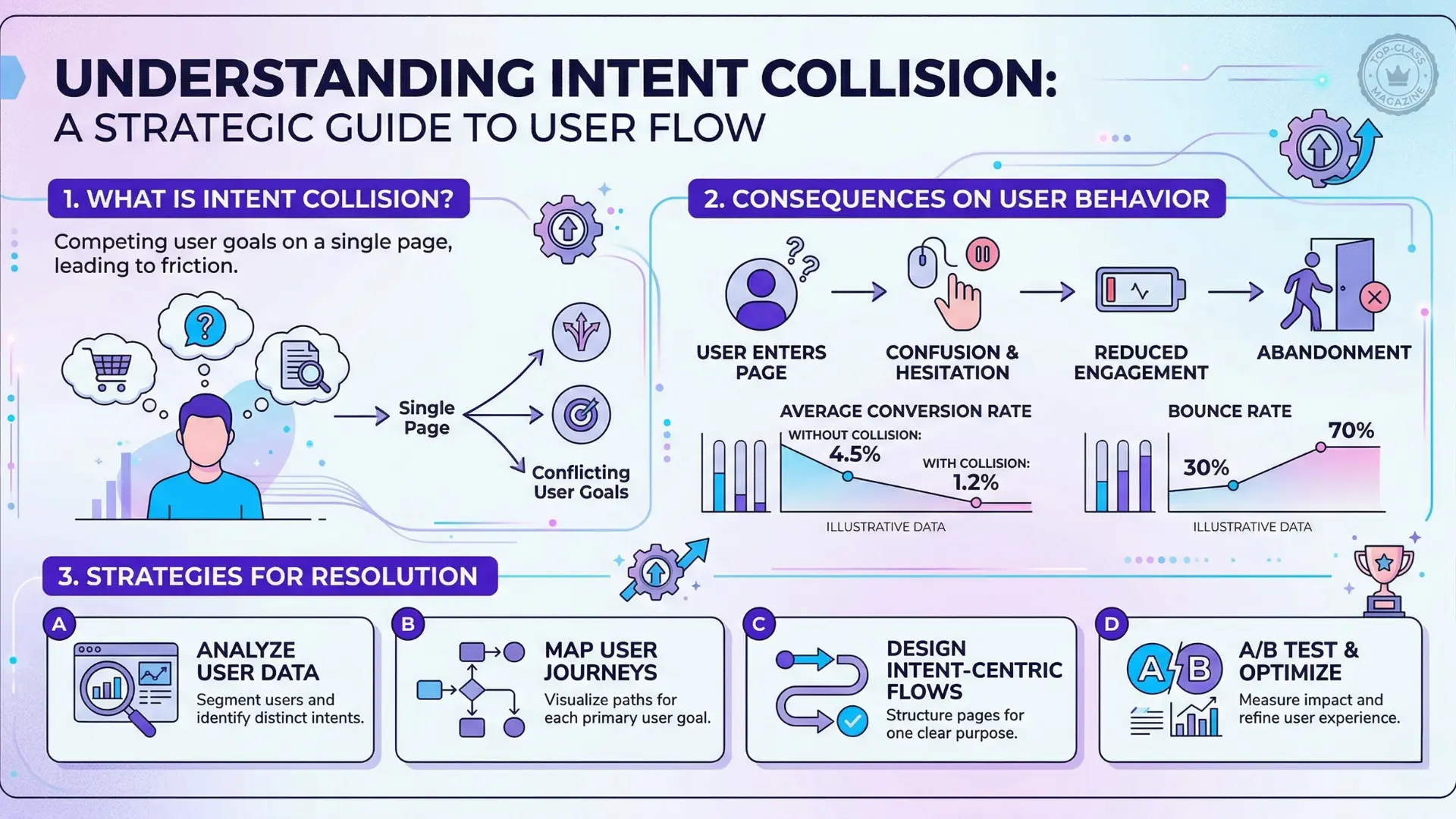
Pages fail when they accept multiple intents
Warning Signs of Intent Collision
| Feature | Website | Landing Page |
| Purpose | Serves multiple user intents | Focused on a single user intent |
| Design | Often complex and exploratory | Simple and straightforward |
| User Journey | Exploratory paths | Direct path to action |
| Calls to Action | Multiple, often conflicting | One clear call to action |
| Example | Company homepage | Sign-up page for a webinar |
Here’s the truth: pages that try to cater to multiple intents become paralyzed.
It’s like inviting five chefs to make one dish – conflicting flavors, no signature taste.
The user’s mind stalls.
Look at the numbers: on “mixed intent website pages”, exit rates jump 30 – 60% higher.
If traffic comes for pricing but lands on an explainer + demo + company values mashup, confusion reigns.
One client’s lead form sat just below three competing CTAs – free trial, case studies, product tour.
Clicks split, conversions tanked.
Most teams assume “more options” means “more chances”.
In reality, decision paralysis wins.
The homepage intent mismatch is subtle but lethal – a slow leak, not a blowout.
Have you ever left a site, thinking, “I just need one next step… but they gave me ten”?
User intent must be channeled not fragmented; otherwise, decision paralysis website pages result.
Apply frameworks like the Fogg Behavior Model to pressure-test for clarity on a single intent per page.
Myth buster: “Pages competing each other” isn’t a backend issue.
It’s visible in the flow.
When website intent is leaking traffic, the first cue is not technical, but in the moment where users simply slip away, uncommitted, unimpressed.
Intent collision turns clarity into noise.
When every page tries to do everything, the only outcome is lost growth – and silent exits.
This is the root cause of homepage intent mismatch and multiple intent confusion website failures.
Get intent containment right, and the rest of your funnel suddenly makes sense.

This is not / This is
Not about design or UX patterns
What if the real website killer isn’t your block padding, but something far less obvious?
Most teams rush into new layouts, color schemes, or the “latest UX pattern” – expecting clarity and conversions to magically rise.
Still, we’ve watched C-suites spend five-figure budgets on award-winning redesigns, only to see lead volumes stall or bounce rates climb.
The pattern repeats: clever animations, trend-driven navigation, giant hero videos – all while conversions stall.
Here’s the part most folks miss: these tactics can polish the surface but never solve confusion at its core.
The problem is deeper than buttons or white space.
Design still matters, but it can’t rescue a site from intent collision.
Think you can fix intent collision on websites with a fresher look or a smarter menu structure?
That’s as effective as rewiring a house with every visit, hoping the lights might feel more inviting.
The myth: better UI alone fixes clarity.
Reality check: intent misalignment creates friction design can’t sand away.
This is about intent containment and decision environments
When a website feels foggy or overwhelming, the likely culprit is not weak aesthetics – but competing intents clashing on the same page.
We call it “intent containment”: each page should trap only one user goal at a time, like a room with one, obvious door.
One VP we worked with asked, “Why can’t we combine the product overview, pricing options, and blog highlights on the homepage to please everyone?”
The result: decision paralysis.
Users saw too many choices, too soon – nobody moved forward.
Focused environments convert.
Mixed intent website pages scatter user attention, draining energy and leaking traffic.
Imagine walking into a grocery store where produce, checkout, and customer service are all in one booth.
Chaos – and nobody checks out.
Intent collision doesn’t just confuse; it creates invisible resistance.
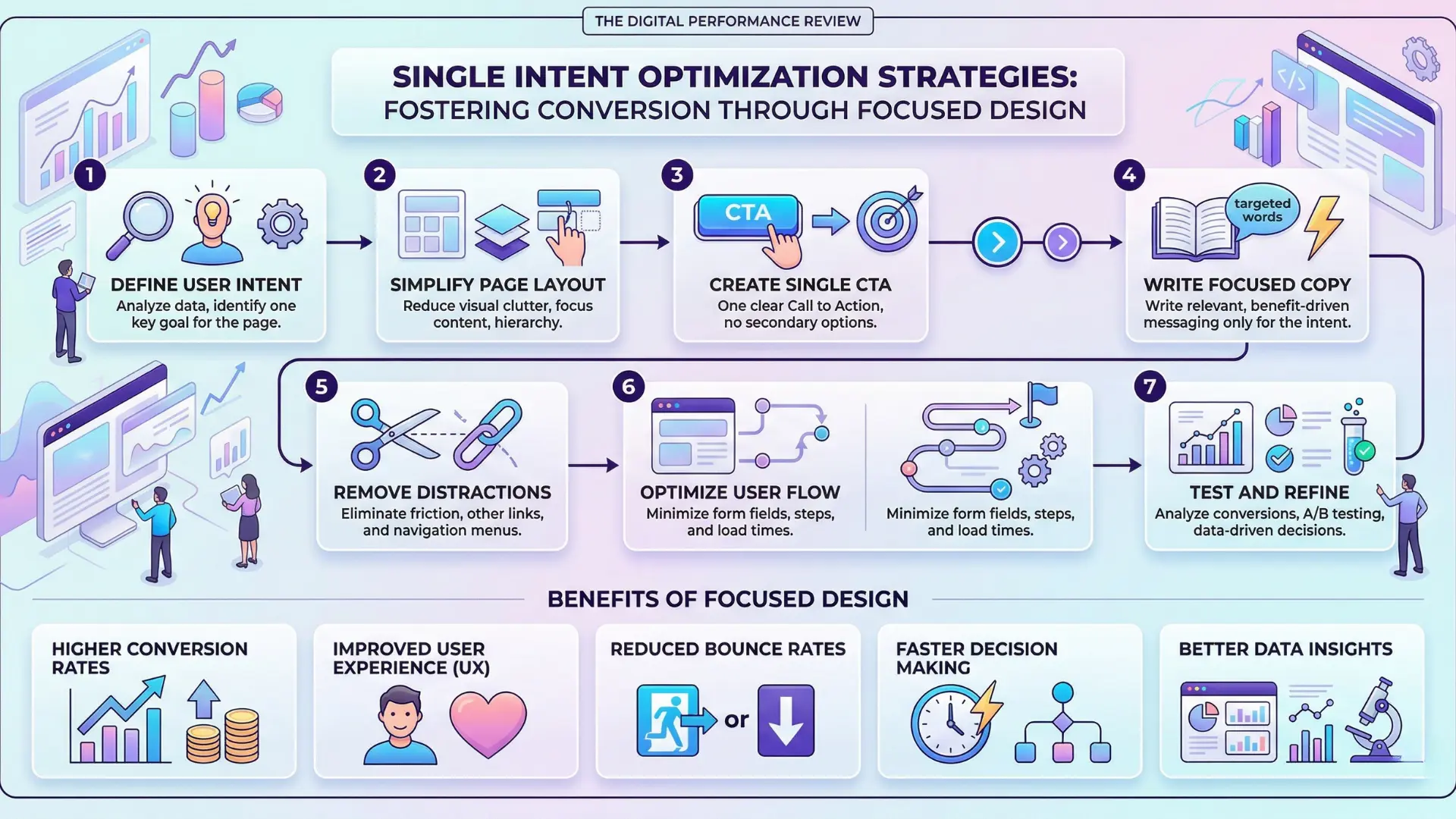
We’ve observed that when landing page vs website intent overlap, secondary CTAs siphon off your best prospects.
Every additional “door” (signup, learn more, compare, download) quietly pushes people away.
Decision environments work only if they shape clear, singular outcomes – for both user and business.
Keyword cannibalization can also occur if multiple pages compete for the same intent – reinforcing the one-page-one-intent approach.
You have one shot to frame a choice.
Competing calls-to-action or fuzzy next steps?
That’s why pages competing each other often produce post‑traffic conversion failure reasons.
Are you giving your visitors a clear decision, or are you asking them to choose their own adventure with no map?
The only fix: embrace true intent containment and build pages where purpose is unmistakably singular. Everything else is noise.

Decision-door clusters: routing into diagnostic paths
Multi-intent pages feel like walking into a room with four hosts talking over each other.
There’s no psychological anchor.
The dominant frame is the one big idea or outcome the page lives and breathes.
Without it, the brain loses confidence and defaults to indecision.
One persistent myth: “Let’s give the user all their options upfront – they’ll appreciate the transparency”.
In practice, this floods working memory, triggers hesitation, and kills heat.
People crave momentum, not menus.
What happens once you select a clear decision anchor?
Bounce rates drop.
Session durations rise.
On a recent campaign, shifting to a single focused outcome per page produced a visible lift in quality conversions (not just more, but better-fit leads who stayed longer and took deliberate action).
Deciding what not to say is often the hardest work.
That’s the discipline required.
Picture each page as a funnel, not a buffet – the difference is night and day.
The structural shift is this: design every page to function first as an intent container.
Only then does visual polish or interactive design have room to actually drive measurable business outcomes.
When flow is constrained and the dominant frame is enforced, decision friction fades fast – and so does intent collision.
On to the clusters that diagnose where leaks still lurk.
Too many exit paths
Picture this: Your homepage loads, and the average visitor faces 18 clickable choices above the fold.
Which door do they pick?
Now, imagine your own team trying to track which path matters. Feels a bit like putting a dozen signposts in Times Square, then wondering why nobody finds the subway.
One client’s SaaS site bled 36% of mid-funnel traffic straight to resource pages – almost no conversions, just swirl.
Why does this happen?
Because every new link feels like opportunity (or appeases an internal stakeholder).
In reality, too many options create friction and decision paralysis.
Our eyes dart, focus scatters, and intent fades.
What would happen if you removed even half of those exits?
Hint: more prospects finally make it to a quote or trial.
Strategic exit reduction is usually the simplest lever for improving post‑traffic conversion rates – no design overhaul needed.
Most won’t believe until they see the chart change.
Competing intents
Ever seen a landing page selling two different products – or mixing webinar sign‑ups with free trial CTAs?
The result: split attention, weaker decisions.
In a recent audit, pages built for “solution comparison” triggered a 44% higher bounce rate, simply because buyers didn’t know which step to take next.
Single-purpose pages nearly always outperform mixed intent website pages.
It’s like putting both a breakfast menu and a dinner menu in front of a late‑night guest.
Are you expecting them to order, postpone, or just leave?
If your landing pages compete, their true enemy isn’t a competitor’s site – it’s their own internal confusion.
Think of intent containment as putting the right key in the right lock.
Multi-intent pages become keys with too many notches: they fit nowhere perfectly.
The best move is ruthless focus.
Use a framework like the Eisenhower Matrix, but for website intent: urgent conversion versus nice-to-have learning, never both on one tile.
Redesign doesn’t help when intent is unclear
Here’s a widely held myth: “A fresh design will fix our post‑traffic performance”.
Reality hits hard – redesigns often change colors, fonts, layouts, and… conversion rates stay flat.
If intent was split or vague before, a new look just puts lipstick on the confusion.
Once, a healthcare client spent six months on visual upgrades, but conversion rates didn’t budge.
It was only when we stripped pages down to one core action that results jumped.
Clarity beats cleverness.
Never confuse brand polish with intent precision.
Redesigned pages that still leak intent will keep missing targets, no matter how slick the UX.
Does your team measure the number of intent signals per page – or do they just count how pretty the buttons are?
Decision door clarity is the shortcut here: Funnel users through the right doors, and watch intent collision on websites quietly disappear.

Scientific context and sources
The sources below provide foundational context for how decision-making, attention, and performance dynamics evolve under scaling and constraint conditions.
- Intent and Decision-Making
“Individuals’ Decisions in the Presence of Multiple Goals” – B. G. C. Dellaert et al. – Journal of Choice Modelling
This paper formalizes how humans make decisions when pursuing multiple goals simultaneously. It shows that competing intents require prioritization and trade-offs, which directly affects decision outcomes and behavior.
https://link.springer.com/article/10.1007/s40547-017-0071-1 - Feature Overload
“An Inference-Based Architecture for Intent and Affordance Saturation in Decision-Making” – W. E. L. Ilboudo, S. C. Tanaka – arXiv / computational neuroscience
Introduces a formal model of decision paralysis. When too many options or goals are equally viable, the system fails to converge, leading to hesitation or inaction (“intent saturation”).
https://arxiv.org/abs/2512.23144 - User Behavior (Task Complexity and Performance)
“Graded Decisions in the Human Brain” – T. Xie et al. – Nature Communications
Demonstrates that decisions are not binary but accumulate gradually. More complex or ambiguous tasks require longer evidence accumulation, increasing friction in user behavior.
https://www.nature.com/articles/s41467-024-48342-w - Behavior Models (Replacement for Fogg Model with scientific grounding)
“A Survey of Multi-Objective Sequential Decision-Making” – D. M. Roijers et al. – Artificial Intelligence / Decision Theory
Explains how agents handle multiple competing objectives. Shows that when objectives cannot be reduced to a single goal, decision systems must approximate or simplify, often leading to suboptimal or delayed actions.
https://arxiv.org/abs/1402.0590 - Fogg Behavior Model
“Fogg Behavior Model: A summary of the original work” – B.J. Fogg – Stanford University
Describes the model that evaluates how motivation, ability, and prompts influence user actions, directly relating to intent collision.
https://dl.acm.org/doi/10.1145/1541948.1541999
Questions You Might Ponder
What is intent collision on websites?
Intent collision occurs when a web page targets multiple user intents simultaneously, leading to confusion and decreased user action. It disrupts clarity, creating a negative impact on conversions as users struggle to find appropriate next steps.
How does design affect user intent?
While design elements like aesthetics impact user experience, they can’t resolve intent collision. If a page presents mixed intents, even the best design can’t prevent user confusion, leading to dropped conversions.
What are the signs of intent collision on a website?
Signs include high exit rates, low conversions, and increased bounce rates, as users feel overwhelmed by conflicting calls to action. A unifying call to action is often lacking, preventing users from making decisions.
How can I optimize pages for single intents?
To optimize for single intents, clearly define user goals for each page. Utilize frameworks like the Fogg Behavior Model to hone in on user behavior and ensure all elements of the page work toward a singular conversion outcome.
Why are landing pages more effective than websites?
Landing pages are designed for specific actions, providing streamlined user pathways. Unlike websites with multiple goals, landing pages reduce decision fatigue by focusing on one clear conversion objective, leading to higher engagement rates.