What You’ll Learn
website speed SEO impact
Key Takeaways
- Website speed SEO impact is mostly friction, not „rankings magic”. Speed decides whether users reach value and whether systems get stable behavior signals.
- Perceived latency drives exits before content can work. When progress feels slow, engagement drops, and strong relevance or authority cannot „express” through behavior.
- Speed problems distort evaluation signals over time. Volatile performance changes session patterns, weakens trust signals, and stops SEO improvements from compounding.
- Use separation to avoid misdiagnosis. Speed keeps sessions alive, UX makes content understandable, and decision design drives action – different constraints, different fixes.
A site that loads one second slower can lose demand even if rankings stay the same.
Website loading speed is the time it takes for a page to feel usable to a human and predictable to a search system. Speed is not a growth strategy. It can block every other strategy from compounding.
We have seen companies invest six months into content and authority, then wonder why engagement stayed flat because friction stopped users before they reached the value. SEO cannot express relevance and authority when latency triggers exits and shallow sessions, even if the page technically ranks.
This page explains the mechanism of speed as friction. No developer playbooks. No tuning for dashboards.
It separates SEO impact from UX aesthetics and decision design so you know where the real constraint lives.
Speed does not replace relevance, but friction can erase its effect.
That distinction changes how you diagnose growth stalls.

- test
- test
- test
- test
- test
- test
- test
- test
- test
- test
Not This – This
Many teams think speed is a design issue. It is not.
Not: „Make the site prettier”.
This: Reduce interaction friction that causes exits before value is experienced.
A glossy interface does nothing if users leave before the first meaningful element appears. We worked with a B2B SaaS client whose redesign improved visuals dramatically, yet average session duration dropped by 18 percent because heavier scripts delayed the first usable moment.
Not: „Chase performance scores”.
This: Remove latency patterns that distort behavior and weaken evaluation.
A high score can still feel slow. A lower score can still perform. What matters is whether users move forward without hesitation, not what a dashboard displays.
Not: „A developer checklist”.
This: A model for deciding whether speed is the bottleneck or a distraction.
One retail client assumed speed was the issue because competitors were faster. The real constraint was weak category intent mapping. Once corrected, qualified leads rose 27 percent without major performance changes.
The shift is subtle but powerful. Speed is about friction, not cosmetics or vanity metrics.

What „Loading Speed” Means
Speed is not a stopwatch metric. It is a perception shift.
Friction is any delay that makes a user hesitate before they get value.
Perceived latency is the moment a user decides the page is usable. It is the gap between intent and first meaningful progress. The difference between staring at a blank screen and seeing something that feels actionable.
Picture a door that opens halfway. You can see inside, but you hesitate. That pause is friction.
In one enterprise review, the hero image appeared in 1.8 seconds, but the primary content block loaded after 3.4 seconds. Users scrolled, paused, then left. Engagement depth dropped by 22 percent on that template alone.
That hesitation compounds.
Evaluation latency is the delay between a page loading and the system receiving stable signals that it worked.
It depends on consistency across devices and traffic conditions. If performance fluctuates, behavior signals fluctuate as well.
Search systems read patterns, not promises. If sessions stay short, the page can look unstable even when content is strong.
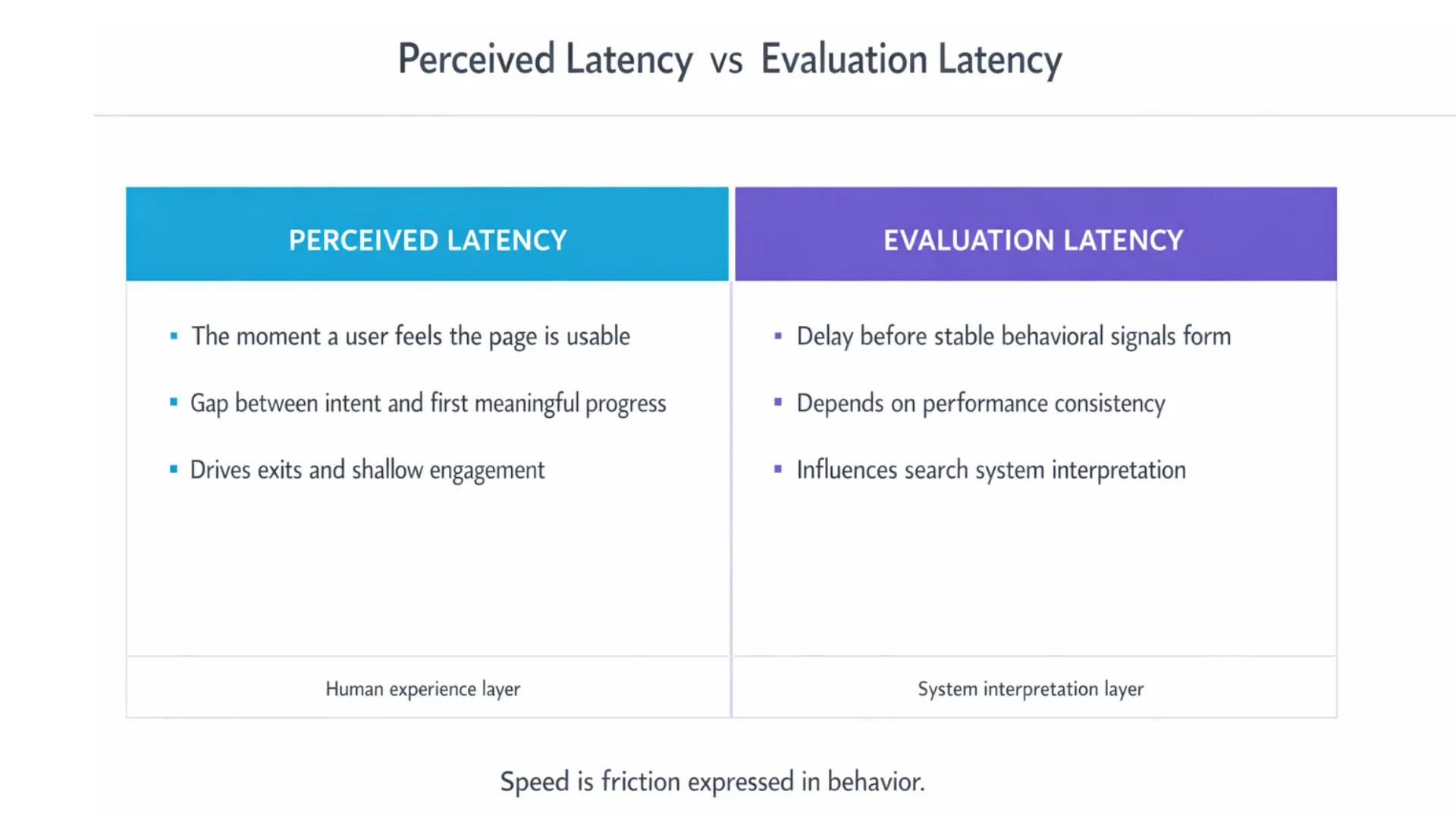
This is about friction behavior, not performance engineering.
The difference between fast and slow is rarely dramatic. It is subtle hesitation repeated thousands of times.

Why Slow Sites Bleed Opportunity
Most losses happen before you notice them.
Latency changes behavior.
Behavior changes signals.
Signals change outcomes.
Frustration is quiet. Exits happen fast. A delay of even one second at the start can lower interaction rates sharply, especially on mobile where patience is thin.
High-intent sessions drop before the answer appears. We saw this with a financial services client. Rankings were stable. Traffic was rising. Yet form submissions fell 14 percent over two months because key comparison tables loaded late on mobile connections.
Trust fades quietly.
When visits are short, systems may interpret that as dissatisfaction. Even if your content is accurate and detailed, reduced interaction depth weakens the behavioral evidence that the page solved the query.
The distortion is subtle.
Volatile performance adds another layer. If load time swings with traffic, behavior shifts, and evaluation shifts with it. Stability often matters more than peak speed.
Then compounding breaks.
Content updates show no lift because fewer users reach the core message. Authority gains do not translate into outcomes because sessions collapse early.
You improve inputs. Outcomes stay flat.
That is friction at work.

Borders – What Speed Affects, and What It Does Not
Speed changes access to value. It does not change the value itself.
Within the SEO system, speed affects whether users reach and engage with the primary content. If the first meaningful block appears late, fewer people interact deeply, and behavioral signals weaken over time.
It also affects signal stability. If performance swings during traffic spikes or after deployments, session patterns shift, and evaluation becomes inconsistent.
And it affects high-intent decision moments. If a pricing page hesitates before showing the core offer, attention leaks before action happens.
But speed does not affect relevance. If the page does not match the query, faster loading will not fix that mismatch.
Speed does not create authority. If competitors have stronger external trust signals, performance gains alone will not close that gap.
And speed does not fix persuasion. Clear messaging and offer structure still determine whether someone decides to act.
One ecommerce client cut load time by nearly a second and saw engagement rise, yet revenue stayed flat because product positioning was weak. The bottleneck was persuasion, not friction.
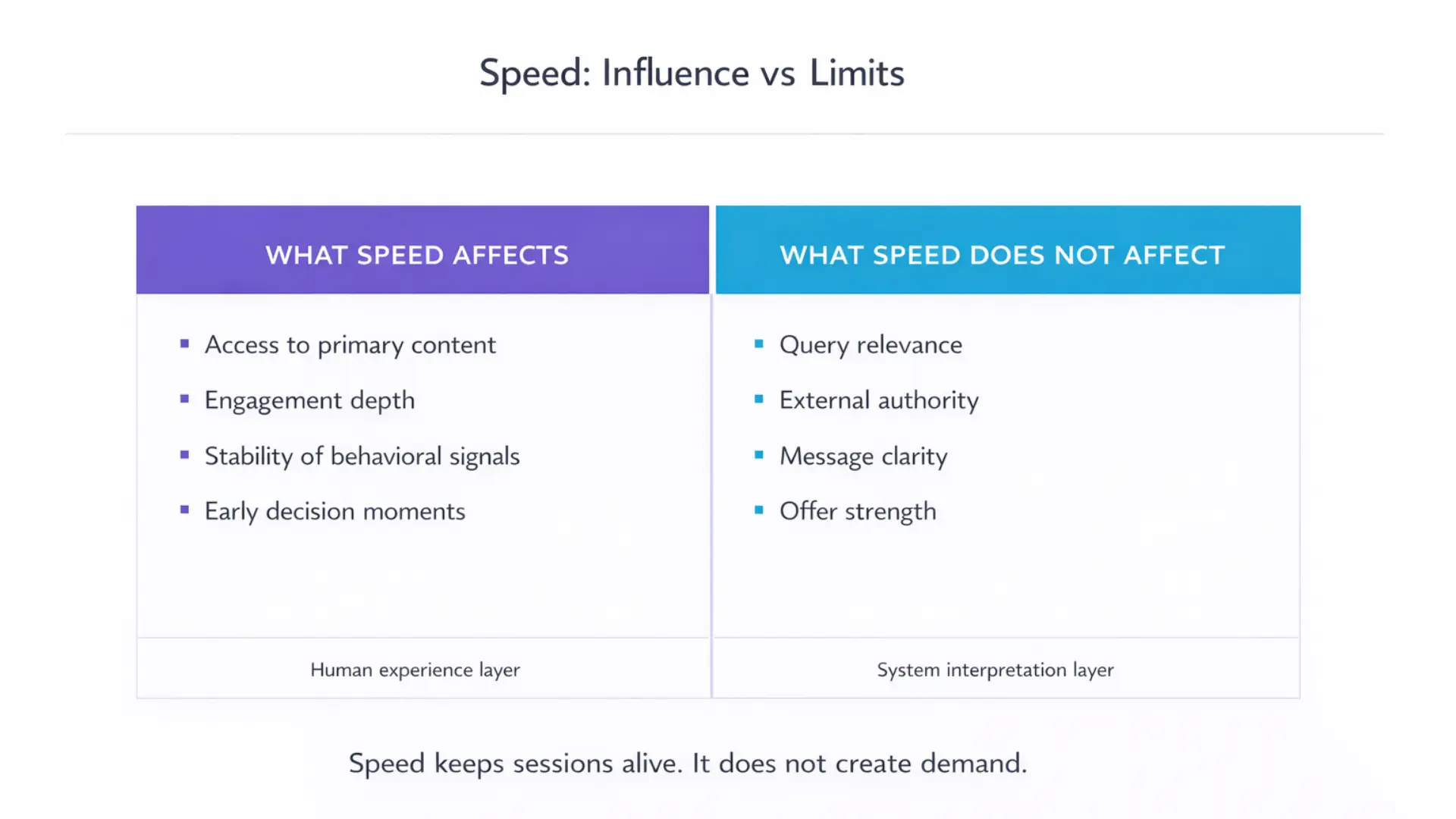
Speed influences exposure and engagement. It does not replace strategy.
Understanding that boundary prevents wasted effort.

SEO vs UX vs CRO – Where Speed Actually Sits
Speed sits at the gate.
As SEO friction, it determines whether a session survives long enough to be evaluated through behavior. If users exit before meaningful interaction, relevance and authority never get expressed in measurable signals.
Think of it like a phone call that drops before the first sentence finishes. The message may be perfect. It never lands.
| If the problem is… | You will usually see… | It points to… |
| Speed friction | Exits early, shallow interaction, uneven mobile behavior | Loading behavior blocking evaluation |
| UX clarity | Users scroll, hesitate, and miss the key content | Comprehension and structure problems |
| Decision design | Users understand but do not act | Offer, trust, or flow constraints |
UX is different.
UX is comprehension. The page loads, but users cannot find what they need or understand the structure. They scroll in circles. They hesitate because clarity is missing.
CRO is different again.
CRO shapes the decision. Users understand the offer but do not act because pricing, positioning, or trust elements are weak.
In one B2B engagement, we improved load stability on a lead-gen template and saw bounce rate fall by 11 percent. The next constraint was message clarity, not load behavior. The page loaded fine; the value proposition was unclear.
Speed decides whether the session survives long enough for UX and CRO to matter.
If the gate fails, nothing downstream can compensate.

The Friction Map – What Kind of „Slow” Actually Hurts
Not all slow feels the same.
Start friction is the first hesitation. Nothing meaningful appears quickly enough to signal progress. The screen feels static. Users wonder if something broke.
In one review, a SaaS homepage showed navigation instantly but delayed the core headline. Users saw the frame, not the message. Scroll depth dropped 19 percent on that version.
Then comes content friction.
The page begins to render, but the primary content arrives late. The comparison table, pricing block, or key argument loads after the user has already judged the page as slow.
Value delayed is value discounted.
Interaction friction is subtler. The page is visible, but actions feel delayed or unstable. Buttons respond with lag. Filters reload unpredictably. Forms freeze for a split second that feels longer than it is.
That micro-pause erodes confidence.
There is also stability friction.
Even if load speed looks acceptable, layout shifts or inconsistent performance break trust. A page that moves under the cursor feels unreliable, especially on mobile.
These patterns overlap. They stack.
The issue is rarely „slow” in isolation. It is friction at specific moments that interrupts momentum.
And momentum is what keeps users moving forward.

Real Failure Modes This Creates
The symptoms rarely point to speed directly.
„We have traffic, but users do not stay”.
Sessions spike after campaigns or content pushes, yet average time on page stays flat or drops.
„We rebuilt the site and rankings became unstable”.
Nothing obvious changed in content, but visibility fluctuates after each release.
„Mobile performance feels worse than desktop data suggests”.
Desktop sessions look healthy. Mobile bounce rate is 20 to 30 percent higher on the same pages.
„We publish improvements, but outcomes do not change”.
New guides go live. Links grow. Engagement metrics barely move.
We saw this pattern with a marketplace platform. Traffic increased 34 percent over a quarter. Revenue grew just 6 percent. Mobile checkout introduced interaction lag after a redesign. Users reached the cart, then hesitated and left.
The issue was not demand. It was friction at the moment of action.
These failure modes feel strategic. They often start with latency.

Decision Map – Is Speed Likely the Bottleneck?
Before investing in performance changes, ask a harder question.
Is friction blocking expression, or is something else broken?
Look for these signals:
- Exits concentrate in the first seconds on high-intent pages
- Mobile engagement drops far below desktop
- The same template underperforms across many topics
- Results swing after deploys or traffic spikes
Speed is likely a primary blocker when high-intent pages underperform despite clear relevance and strong positioning. Users arrive with intent, yet engagement depth remains shallow and exit rates cluster around the first few seconds.
It is also suspect when mobile outcomes lag far behind desktop performance, especially if templates feel heavier on smaller devices. That pattern often points to latency or instability rather than messaging.
Watch for inconsistency. If performance fluctuates during peak traffic or right after deployments, behavioral signals shift with it. In one case, a SaaS platform saw form-start rates swing 15 percent week to week, matching infrastructure strain during marketing pushes.
But speed is likely not the main constraint when sessions are long and users consume content deeply, yet decisions stall. That suggests persuasion or offer clarity issues.
It is also unlikely the root cause when users reach the core content but do not find what they expected. That points to relevance or positioning gaps.
And if pages are not reliably indexed or visible in search, the problem sits earlier in the foundation. Access and stability come first in the broader SEO capability model.
Imagine removing friction and seeing engagement rise immediately. That is the signal that speed was the gatekeeper.
If nothing changes after performance improves, the constraint lives elsewhere.
Speed either blocks expression or it does not.
Speed is the gate, not the message.
If the gate fails, everything upstream looks weaker than it is.

Scientific context and sources
The sources below provide foundational research on perceived latency, human response to delay, and how speed influences behavioral signals in digital systems. They ground the mechanisms described above without prescribing tools or tactics.
- Millisecond delays and user behavior
Speed Matters – Google Research (Brutlag, 2009)
Experimental evidence showing that even small artificial delays measurably reduce search usage and interaction rates.
https://research.google/blog/speed-matters/ - Perceived performance and user experience
Perceived Performance – Mozilla Developer Network (MDN)
Defines perceived performance and explains why visual progress and stability affect user confidence more than raw load metrics.
https://developer.mozilla.org/en-US/docs/Learn_web_development/Extensions/Performance/Perceived_performance - Page experience and evaluation context
Page Experience Overview – Google Search Central
Describes how page experience signals interact with broader search evaluation rather than acting as isolated ranking factors.
https://developers.google.com/search/docs/appearance/page-experience
Questions You Might Ponder
How does website speed actually affect SEO?
Website speed matters because it shapes user experience signals that search engines use to evaluate quality. Slow pages tend to drive higher bounce rates and weaker engagement, which can indirectly hurt visibility and rankings. Faster performance correlates with better user retention and stronger SEO interpretation.
How slow is „too slow” before it harms engagement?
Data shows that around 53 % of mobile visitors abandon sites that take longer than about three seconds to load, and longer delays raise bounce rates. This quick abandonment weakens behavior signals and can limit both user satisfaction and SEO outcomes.
Is page speed a direct Google ranking factor?
Yes. Google considers page speed as part of its ranking signals, especially through metrics like Core Web Vitals. Speed might not be the top signal, but it affects crawl efficiency and user engagement, making it an important SEO factor.
Why is mobile page speed more important than desktop?
Google uses mobile-first indexing, meaning it evaluates the mobile version of a page before desktop. Because mobile networks and devices vary widely, slow mobile performance often leads to higher exits and weaker engagement signals that search systems use.
What user behavior changes when a page loads slowly?
Slower load times increase bounce rates, shorten session durations, and reduce interaction depth. These behaviors send weaker satisfaction signals to search engines, making it harder for relevance and authority to be recognized even if content quality is high.