What You’ll Learn
trust and risk in search ranking
Key Takeaways
- Trust and risk in search ranking is gate-based – higher-risk topics face stricter trust thresholds before relevance can compete.
- Quality evaluation is shaped by the Search Quality Rater Guidelines and E-E-A-T, which inform ranking systems without directly setting rankings.
- YMYL topics (health, finance, safety, major life decisions) trigger risk-weighted visibility, so technically sound pages can be suppressed if credibility signals are weak.
- Before executing SEO, validate trust prerequisites (clear entity, visible credentials, external confirmation) so growth efforts don’t scale low-trust signals.
Most teams assume SEO is about keywords and links.
That’s wrong when trust matters more than relevance.
For some topics, Google doesn’t just assess quality.
It applies a safety filter based on potential harm.
Low-trust pages about healthcare or money drop in visibility even when they are technically sound, because the system prefers sources it can rely on.
Imagine search as a runway light system.
Green lights mean relevance is enough.
Red lights mean trust and credibility decide whether you’re even considered.
This isn’t a metaphor – it reflects how quality evaluation shapes exposure at scale.
Here’s what surprises executive teams:
Being factually correct isn’t enough on high-impact queries.
Higher-risk topics face higher thresholds for credibility.
Most pages never clear this filter because teams treat SEO as a mechanical checklist.
They only notice risk-weighted visibility after rankings drop post-redesign or repositioning.
Search doesn’t just match intent.
It also tries to avoid harm, and that changes how SEO works.
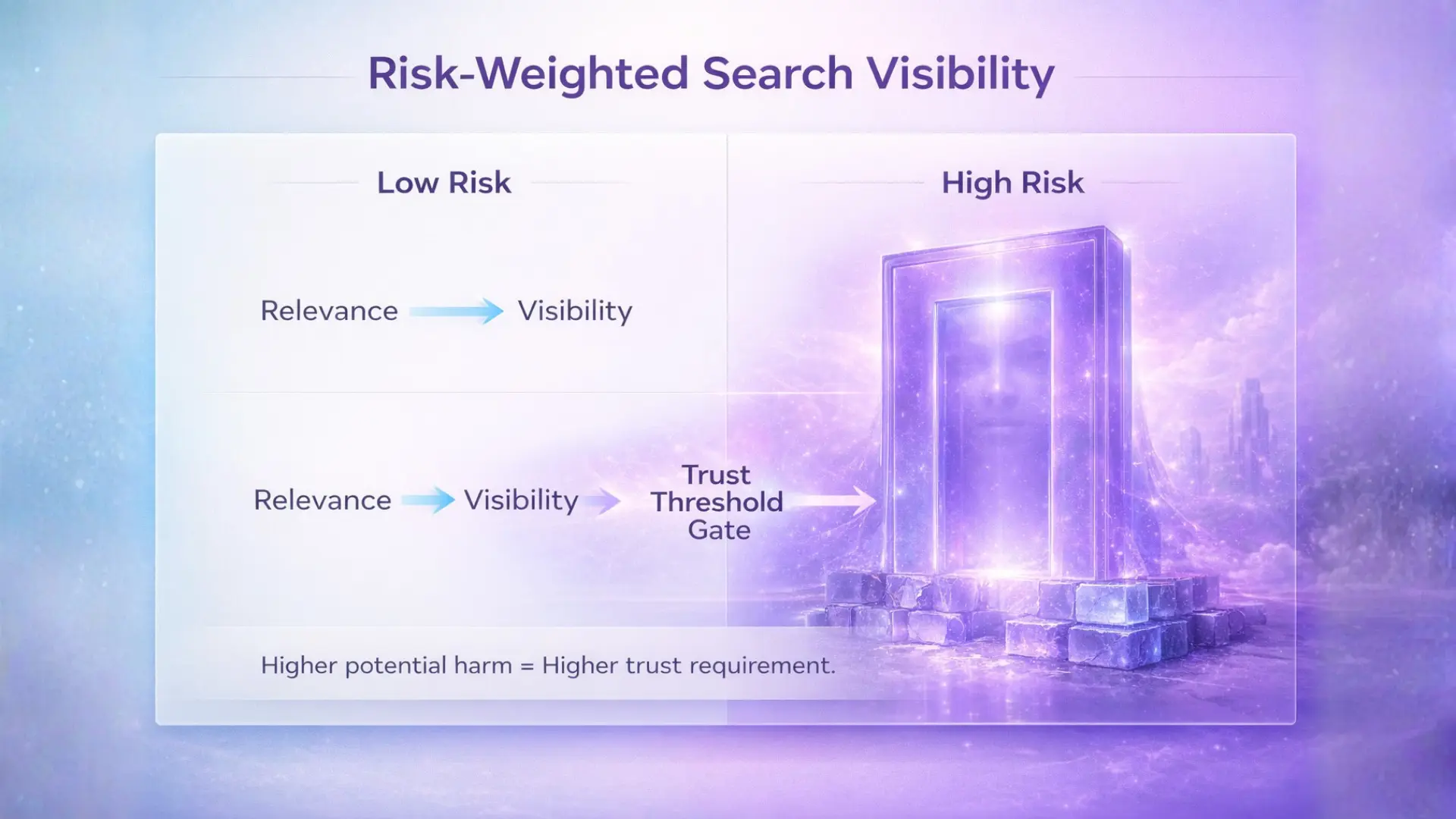
Search systems apply stricter trust thresholds when the cost of being wrong is high.
Risk-weighted visibility means the same level of relevance can produce different exposure when stakes change.
High-risk topics require stronger proof of credibility before rankings stabilize.

What Trust and Risk Mean in Modern Search
Two pages can target the same query.
One ranks.
The other disappears.
The difference is often not content depth – it’s whether the system considers the source safe to show.
Search engines do not treat every topic equally.
When a topic can affect health, money, safety, or public stability, visibility passes through an additional filter, and that filter can block you even when your page matches intent well.
Let’s define this clearly.
Trust threshold means the minimum level of credibility a source must show before it can compete for visibility.
If the topic carries higher potential harm, that threshold rises.
Risk in search means the potential negative impact if incorrect or misleading information ranks highly.
Higher risk leads to stricter evaluation.
We saw this with a healthcare client.
Their articles were medically accurate.
Engagement was solid.
But they stalled below page one for competitive treatment queries, because the domain did not look as verifiable as the institutions around it.
The issue wasn’t keyword targeting.
It was insufficient domain-level credibility signals compared to established institutions.
After restructuring author attribution, strengthening entity consistency, and clarifying institutional signals, rankings improved within 90 days.
Same content.
Different trust posture.
Think of it like airport security.
A domestic flight and an international border crossing are both travel, but the screening intensity changes based on perceived risk, and search systems apply a similar bias.
This is where many teams misread the problem.
They assume visibility loss equals content weakness.
But in risk-sensitive areas, content quality is only one layer of evaluation.
Another example.
A financial advisory firm published detailed retirement guides.
Traffic grew for informational terms.
But for „best investment strategy for retirees”, they never crossed into top positions.
Competitors ranking above them had clearer author credentials, stronger institutional references, and more consistent third-party citations.
Relevance was comparable.
Trust signals were not.
So ask yourself:
Are we losing because our content is weaker?
Or because the system does not yet classify us as safe enough for this topic?
Relevance opens the door.
Trust decides if you are allowed to stay in the room.
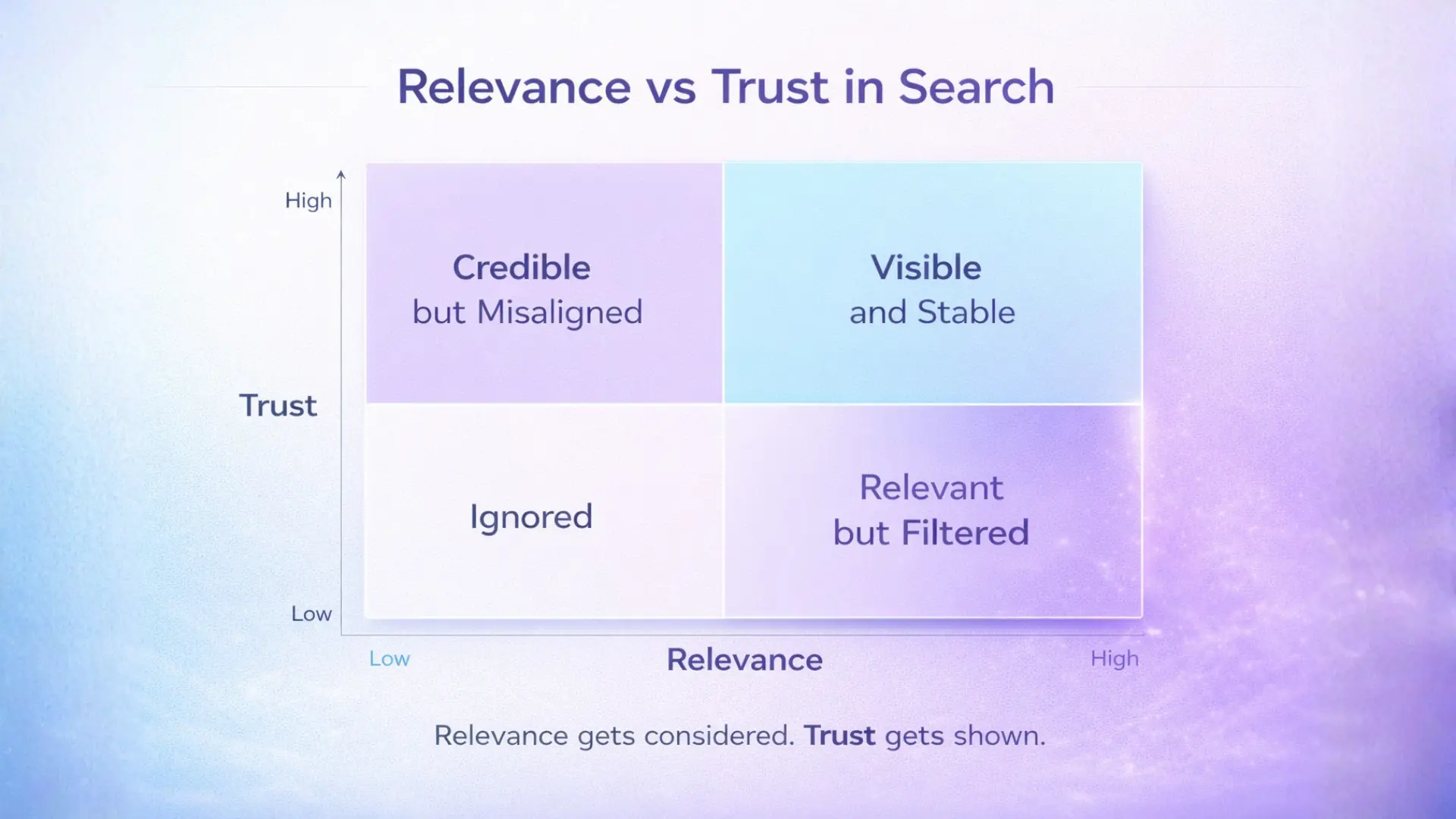
Trust and risk act as invisible filters in modern search.
Next, we’ll map how search quality gets evaluated.

How Search Quality Is Evaluated
Search rankings don’t start with code.
They start with judgment.
Human judgment.
Before algorithms scale decisions, Google trains human quality raters on what „high quality” looks like.
Those raters follow a documented framework that defines how content should be assessed, especially for sensitive topics.
The framework is called the Search Quality Rater Guidelines.
It does not directly rank pages.
It helps Google improve ranking systems by showing what quality patterns look like in practice.
Raters do not set rankings, but their guidelines shape how systems learn what quality should look like
Inside that framework sits a concept executives should know: E-E-A-T.
It stands for Experience, Expertise, Authoritativeness, and Trustworthiness.
This is not a ranking factor you toggle.
It is a credibility model used to evaluate whether a source appears reliable for a given subject.
Experience means the content creator has first-hand knowledge.
Expertise means they demonstrate subject competence.
Authoritativeness reflects recognition from others.
Trustworthiness ties it all together through accuracy, transparency, and consistency.
Here is the critical distinction.
Relevance answers the question, „Does this page match the query?”
E-E-A-T answers, „Should this source be trusted with this topic?”
In lower-risk areas, relevance can dominate.
In higher-risk areas, credibility signals gain weight, and that changes who survives the ranking filter.
We saw this during a major site migration for a legal services firm.
Traffic held steady for general educational terms.
But pages tied to urgent legal decisions dropped by 38% within six weeks, even though content and structure were unchanged.
The reason became clear after analysis.
Post-migration, structured author data and organizational clarity were partially lost, weakening visible expertise signals.
Once restored, visibility gradually recovered.
This pattern repeats across industries.
It is rarely about a single ranking factor.
It is about how the system interprets credibility signals relative to topic sensitivity.
Imagine two restaurants with identical menus.
One displays health inspection certificates at the entrance.
The other does not.
When the stakes feel higher, diners choose the one that proves compliance.
Search engines behave in a similar way.
When risk increases, visible proof matters more.
This is where many leadership teams misdiagnose decline.
They assume ranking volatility equals technical decay.
But in sensitive verticals, subtle credibility gaps can shift exposure without any obvious content flaw.
Quality evaluation frameworks set the baseline for visibility.
Next, we’ll define what qualifies as high-risk topics and why those thresholds tighten further.

What High-Risk (YMYL) Topics Are
Some topics carry weight.
Not emotional weight.
Real-world consequences.
Google classifies certain subjects as YMYL – Your Money or Your Life.
That label applies to content that can influence a person’s health, financial stability, safety, or major life decisions.
The definition is simple.
If someone could be harmed by following inaccurate advice, the topic enters a higher scrutiny category.
Health treatment guidance.
Investment strategies.
Legal advice.
Addiction recovery options.
Each can affect outcomes that matter beyond a screen.
Here’s the part many teams miss.
YMYL does not mean „competitive keyword”.
It means „the system has to avoid harmful mistakes at scale”.
That is why scrutiny increases.
When potential harm goes up, search engines reduce false positives by favoring sources that look verifiable, stable, and accountable, because showing the wrong answer is worse than showing fewer answers.
This is also why thresholds differ by topic.
As risk rises, the minimum credibility required to compete rises with it, even if the page matches intent perfectly.
In lower-risk spaces, Google can tolerate imperfect sources.
In higher-risk spaces, tolerance narrows, and visibility compresses toward sources that look institutionally stable.
We saw this with a wellness brand entering a mental health adjacent topic.
Their traffic for lifestyle content grew steadily.
But for treatment-oriented queries, they remained invisible despite publishing 40 long-form articles over six months.
The issue was not topical coverage.
It was perceived legitimacy compared to licensed providers and established organizations.
Another case involved a fintech startup.
Their product comparison pages ranked quickly.
But pages that touched retirement planning stalled for nearly a year, until external validation signals strengthened through partnerships and expert attributions.
YMYL categories typically include:
- Medical and health information
- Financial and investment guidance
- Legal advice and civil rights topics
- Safety and emergency instructions
- Major life decision guidance
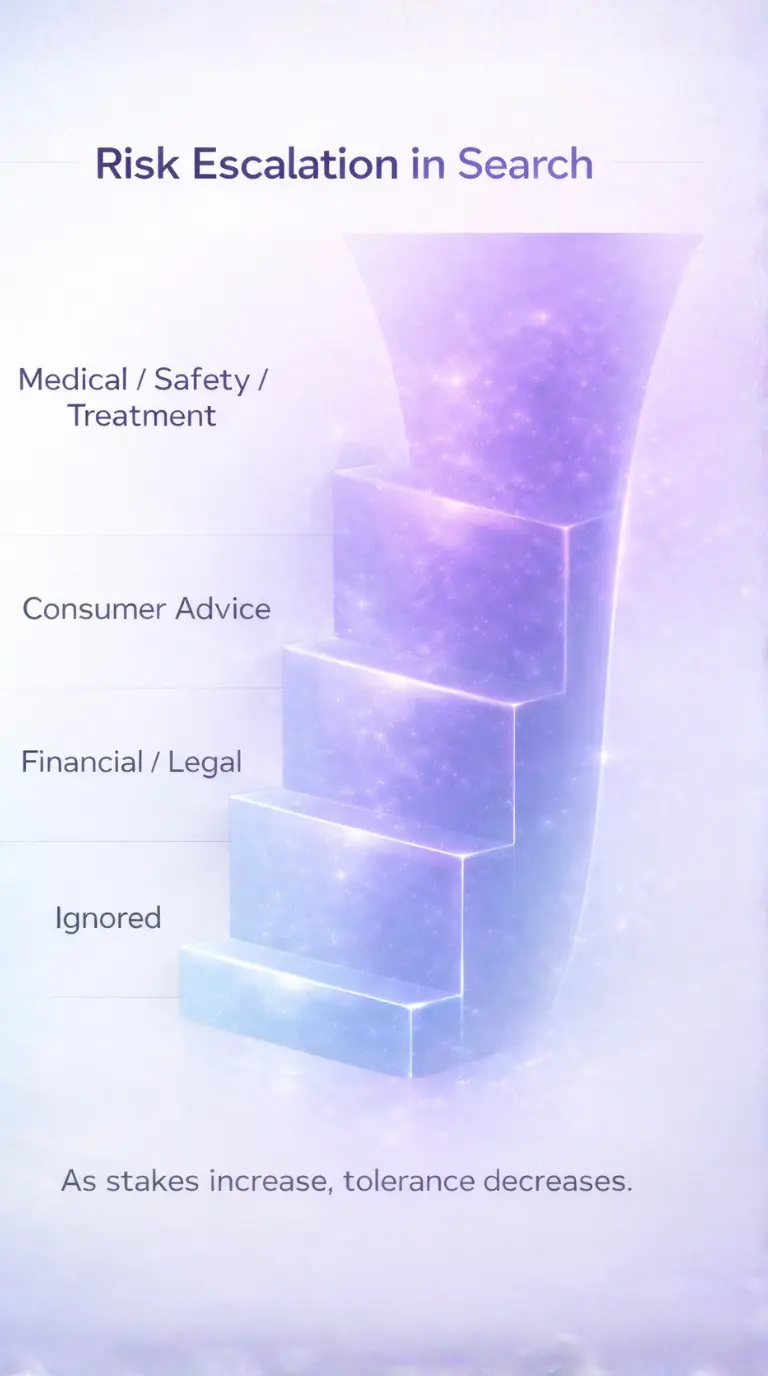
The higher the potential impact, the higher the trust bar.
Picture two search results side by side.
One is a personal blog explaining tax deductions.
The other is a certified accounting firm with named experts and citations.
For low-risk informational queries, both may compete.
For high-stakes queries, the blog quietly fades.
This is not bias.
It is risk control at scale.
YMYL is about consequence, not keyword difficulty.
Next, we’ll look at why trust signals carry even more weight once risk rises.

Why Trust Signals Matter More Under Risk
As stakes increase, the algorithm becomes conservative
It favors stability.
It prefers sources that look accountable.
This is where E-E-A-T stops being abstract.
Experience, Expertise, Authoritativeness, and Trustworthiness begin to influence exposure more heavily when the topic carries consequences.
Under low-risk conditions, relevance can win.
Under high-risk conditions, credibility can override relevance.
That is the shift most teams underestimate.
Here’s the operational difference.
| Lower Risk Query | Higher Risk Query |
| Relevance weighted heavily | Credibility weighted heavily |
| Broader source tolerance | Narrow source tolerance |
| New entrants can compete faster | Institutional stability favored |
In quality evaluation, expertise signals reduce „wrong answer” risk.
Authority signals reduce „unknown source” risk.
Trustworthiness signals reduce „misleading source” risk.
We saw this with a behavioral health client.
Their educational articles ranked quickly.
But for treatment-related queries, established clinics dominated even with thinner content.
The deciding factor was institutional trust signals, not page optimization.
Another example involved a B2B cybersecurity firm.
They produced technically excellent breach-response guides.
For informational queries, visibility grew within weeks.
For compliance-heavy queries, growth stalled until certifications, case studies, and third-party validations were more visible across the domain.
The pattern is consistent.
When consequences increase, the system prefers signals that indicate accountability.
Think of it like hiring a surgeon.
You may read two articles explaining the same procedure.
But if the procedure is serious, you will choose the one written by a board-certified specialist affiliated with a recognized hospital.
Search engines mirror that instinct at scale.
This is where generic optimization advice falls short.
You can refine headings.
You can improve internal links.
But if the credibility layer is weak, the page remains filtered in high-risk categories.
When risk increases, trust signals become decisive.
Next, we’ll look at why common SEO playbooks fail in risk-sensitive queries.

Why Generic SEO Advice Breaks for Risk-Sensitive Queries
Most SEO advice assumes the game is linear.
Find keywords.
Publish content.
Improve internal links.
That works in low-risk categories.
It fails when credibility becomes the gate.
The myth is simple:
„If the content is better, we will rank”.
In high-risk queries, better content without stronger trust signals rarely moves the needle.
We saw this with a multi-location healthcare provider.
They doubled content output in six months.
Traffic increased 22% overall.
But treatment-intent queries remained flat because the domain did not demonstrate enough visible authority compared to hospital networks.
The issue was not volume.
It was classification.
Search systems do not only evaluate the page.
They evaluate the source behind it.
When risk is high, the system asks a different question:
„Is this entity reliable enough for this topic?”
Basic on-page optimization cannot answer that.
Meta descriptions do not fix it.
Heading structure does not solve it.
Even long-form content does not compensate for weak credibility signals.
When trust is low, the system reduces exposure even when relevance is strong.
Another example involved a financial services startup.
Their content team executed textbook SEO.
Technical health was strong.
Yet they stayed below page one for retirement-planning terms for nearly nine months.
After formalizing author credentials, clarifying regulatory standing, and strengthening third-party validation, rankings began to shift within one quarter.
The content barely changed.
The trust posture did.
Think of it like applying for a bank loan.
A polished application helps.
But without a proven credit history, approval is unlikely.
Generic SEO advice optimizes presentation.
Risk-sensitive queries require institutional proof.
Teams keep improving pages while the system waits for stronger evidence of credibility.
Publishing more content does not clear a trust threshold.
Next, we’ll look at what needs to be evaluated before execution begins.

Implications Before Execution
Before you touch content, pause.
Before you plan production, diagnose.
Execution without credibility clarity wastes quarters.
Most teams jump straight to tactics.
New landing pages.
More long-form guides.
Aggressive keyword expansion.
But if the topic sits in a higher-risk category, the first question is different:
Do we currently clear the trust threshold for this subject?
Start with three diagnostic lenses:
- Entity clarity – Is it obvious who stands behind this content?
- Credential visibility – Are expertise signals explicit and verifiable?
- External validation – Does the wider web confirm your authority?
If one of those is weak, scaling content multiplies noise.
It does not increase exposure.
We saw this with an addiction treatment network expanding into new regions.
They launched 120 localized pages in four months.
Indexation was healthy.
Rankings were not.
The issue surfaced quickly.
Licensing information was buried.
Clinical leadership profiles lacked depth.
External citations were inconsistent.
After restructuring trust signals across the domain and clarifying regulatory standing, visibility improved within 60 days on high-intent treatment queries.
The pages did not change much.
The trust posture did.
Imagine building a high-rise.
You can add floors quickly.
But if the foundation is weak, the building height does not increase safely.
Search behaves the same way.
This is why trust diagnosis must precede scale.
It’s not about slowing growth.
It’s about choosing the correct lever first.
Execution should follow credibility.
When trust thresholds are clear, scale becomes predictable.
For the broader model of how discovery, indexing, matching, and trust interact, revisit our SEO capability.
Here is a real-world case where trust rules change in addiction treatment SEO.

Scientific context and sources
The sources below describe how modern search systems evaluate trust, risk, and credibility signals, particularly in high-impact or harm-sensitive domains. They provide first-party documentation and foundational research supporting the mechanisms explained above.
- Quality evaluation and E-E-A-T framework
Search Quality Rater Guidelines – Google Search Central
Explains how raters assess Experience, Expertise, Authoritativeness, and Trustworthiness, and how these principles inform ranking system improvements in sensitive topics.
https://developers.google.com/search/blog/2023/11/search-quality-rater-guidelines-update - Risk and „Your Money or Your Life” (YMYL) classification
Your Money or Your Life (YMYL) and E-E-A-T – Google Search Central Documentation
Defines high-impact content categories and describes why higher standards apply when information can affect health, safety, or financial stability.
https://developers.google.com/search/docs/fundamentals/creating-helpful-content - Reducing harmful misinformation in search systems
The Role of AI in Information Quality and Safety – Google Research
Discusses large-scale systems designed to reduce harmful or misleading information exposure in ranking environments.
https://research.google/programs-and-events/ai-for-privacy-safety-and-security/ - Algorithmic ranking and credibility assessment
PageRank Citation Ranking: Bringing Order to the Web – Brin & Page (Stanford University)
Foundational research explaining how authority signals and link structures influence trust inference in ranking systems.
http://ilpubs.stanford.edu:8090/422/1/1999-66.pdf
Questions You Might Ponder
What does YMYL actually mean in SEO?
YMYL stands for „Your Money or Your Life”. It refers to topics where incorrect information could harm health, finances, safety, or major life decisions. Google quality guidelines apply stricter credibility and E-E-A-T expectations to YMYL content so that higher-risk topics are held to higher trust standards.
Why is my health/finance/legal content not ranking even though it’s high quality?
In YMYL areas, accuracy is necessary but not enough. Google looks for strong trust signals – clear author credentials, institutional backing, authoritative citations, and consistent external validation. Without these, even factually solid content may be de-prioritized in favor of well-recognized, verifiable sources.
What is E-E-A-T and how does it affect YMYL rankings?
E-E-A-T means Experience, Expertise, Authoritativeness, and Trustworthiness. It’s a framework used in Google’s Search Quality Rater Guidelines to assess credibility, especially for high-impact topics. While not a direct ranking factor, strong E-E-A-T helps content clear trust thresholds that relevance alone can’t.
Which topics are considered high-risk or YMYL by Google?
High-risk or YMYL topics include medical and health advice, financial and investment guidance, legal and civic information, safety guidance, and decisions affecting well-being or public stability. These subjects have higher scrutiny because misinformation could cause real harm.
How can I improve trust signals so my site can rank in YMYL niches?
Focus on visible credibility: include author bios with credentials, institutional details, transparent sourcing, citations from trusted authorities, secure site signals, and consistent external mentions or links. Demonstrating real experience and verifiable expertise strengthens trust beyond relevance alone.