What You’ll Learn
seo vs local search
Key Takeaways
- SEO vs Local Search are different ranking systems – SEO ranks web pages in the organic results, while Local Search ranks business entities in the Map Pack and Google Maps.
- Local intent decides what Google shows first – many service queries trigger the Map Pack above organic results, and organic listings can still localize by location.
- SEO does not control proximity-based visibility – organic ranking signals (content, links, technical access) do not change distance, Google Business Profile signals, or local prominence.
- Measure and budget by system, not by label – separate Map Pack performance from organic SEO, or you will misattribute outcomes and misjudge spend.
A company can rank #1 organically and still be invisible three blocks away.
We have seen it happen more than once. A national B2B services firm owned high-intent keywords across the country. Yet in the same week, local competitors took the Map Pack in that city.
That gap is the simplest proof of the organic SEO vs local SEO differences.
It was not a content issue. It was not a link issue. It was a system issue.
SEO vs Local Search is not a tactic debate. It is a ranking system distinction.
Organic SEO ranks pages, while Local Search ranks businesses in a location context.
SEO governs the organic results – the blue links.
Local Search governs the Map Pack (also called the Local Pack) and Google Maps.
The Map Pack is the set of local business listings shown with a map above or near the organic results.
They use different signals and triggers. Treating them as one creates false expectations and misdirected investment.
If you need the broader model of how SEO fits inside your acquisition system, start with the core SEO capability framework.
Here, we draw the line.
Organic visibility and local visibility are related, but they are not the same game.
Not: Google Maps is SEO.
This: Maps uses Local Search rules, while SEO governs organic results.
Next, let’s separate the two systems clearly.

Organic SEO vs Local Search: Two distinct ranking systems
Most executives assume there is one Google algorithm.
There are many.
When someone searches, Google decides which ranking system to activate. That decision depends on intent and location context. The outcome changes the rules completely.
A. Organic SEO – traditional search
Organic SEO ranks web pages for broad queries.
It evaluates relevance, authority, and technical integrity.
Relevance means your content matches the search intent.
Authority means other sites reference you with links.
Technical integrity means Google can crawl and understand your pages.
We worked with a SaaS company that ranked top three for „fleet compliance software” nationwide. Traffic grew 42 percent in four months. Leads followed.
But when prospects searched „fleet compliance software Dallas”, they did not appear in the map results at all.
Their organic strength did not extend into local placement.
Organic SEO is site-centric. It scores pages and domains across geography. It does not factor physical distance to the searcher as a primary variable.
That distinction shapes everything.
That is why SEO often doesn’t fix map pack rankings, even when organic improves.
B. Local Search – geographically constrained
Local Search activates when Google detects local intent.
Intent can be explicit, like „accountant in Boston”.
Or implicit, like „dentist” searched from a mobile phone downtown.
Local Search ranks business entities, not just web pages.
It uses proximity and Google Business Profile data as core signals.
Google Business Profile is part of Local Search, not organic SEO. Your website can support it, but it does not control it.
Proximity means physical distance from the searcher. That variable can override traditional authority in map results.
A regional law firm we advised had modest domain authority. They still dominated the Map Pack within a 10-mile radius because their business profile, reviews, and location alignment matched the query context.
Local Search is entity-centric. It scores businesses in a defined geographic frame.
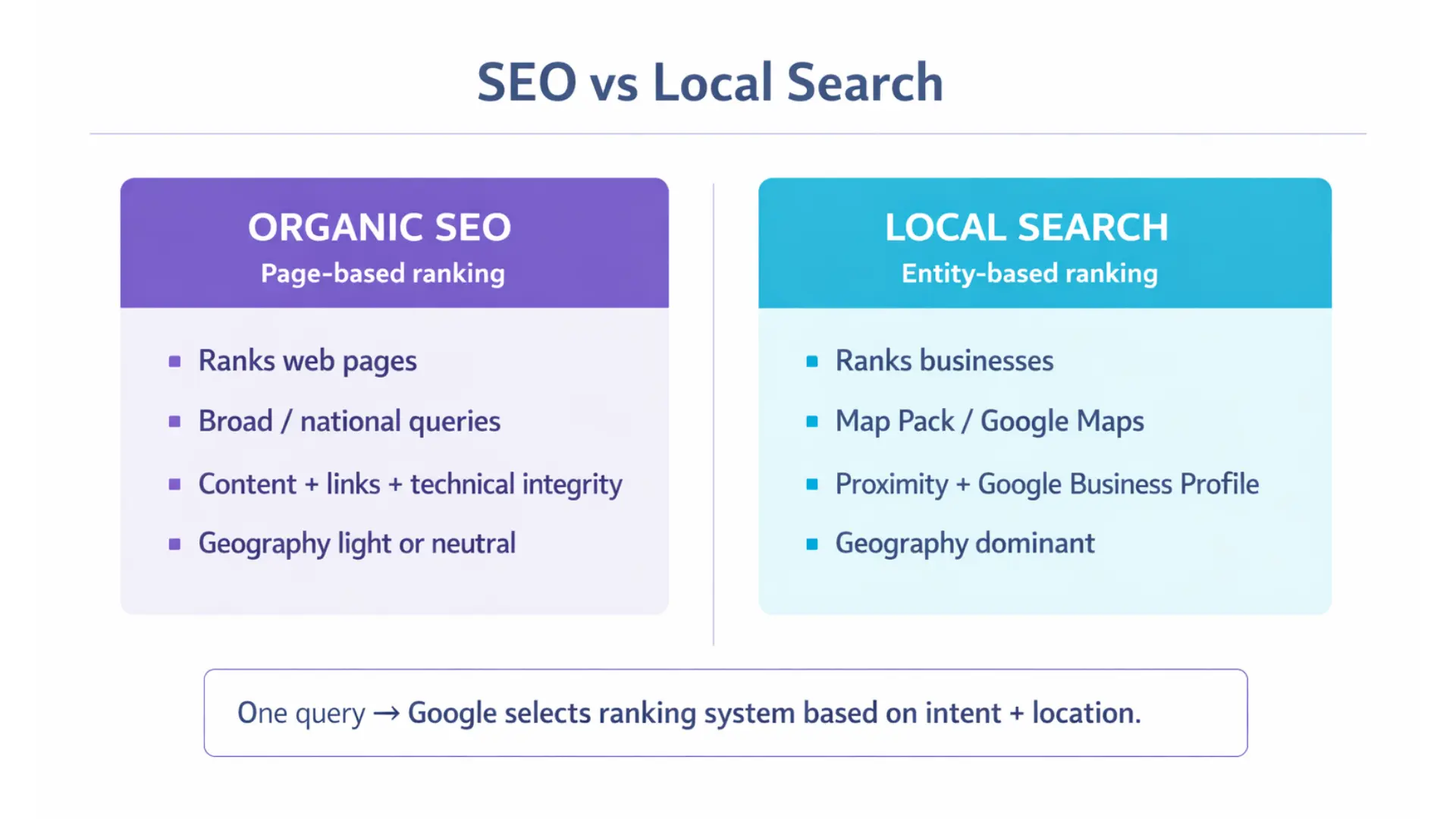
Two systems. Two scoring logics. One search box.
Before debating tactics, you must identify which system your revenue depends on.
Next, we examine how user intent decides which system appears.

How local intent vs broad intent search changes the result
Google does not start with your website.
It starts with the query and the context.
Two people can type the same words.
They can see different results.
Location, device, and search history can tilt the outcome.
Here’s the clean split: local intent vs broad intent search.
Explicit local intent includes a place.
„Accountant in Boston”.
„Emergency plumber 02139”.
Implicit local intent has no place word.
But Google infers it from the category.
„Dentist”. „HVAC repair”. „Coffee shop”.
Broad intent stays non-local.
It looks like research.
It often triggers the organic SERP first.
Now the visible consequence.
Local intent tends to surface the Map Pack vs organic SERP pattern.
The Map Pack can sit above the blue links.
Even the organic results can shift by location (localized organic), especially for service categories.
That placement changes clicks, calls, and expectations.
We saw this with a multi-location healthcare brand. They ranked top five organically for a service term. Then a new cluster of „near me” searches showed up in query data within 30 days. Organic impressions stayed flat. Calls from Maps rose 28 percent, even though the website barely changed.
Same demand. Different trigger. Different system.
A simple way to picture it: it’s like airport security lines.
Organic SEO is the main terminal queue.
Local Search is the fast lane that opens only for certain passengers.
You can be „approved” in one line and still wait in the other.
When revenue depends on calls and visits, the trigger often matters more than average rank.
Next, we draw the boundary of what organic SEO can influence.

What organic SEO can change
Organic SEO evaluates pages.
It scores relevance, authority, and structure.
Relevance means the content answers the query clearly.
Authority means other trusted sites link to you.
Structure means search engines can crawl, index, and interpret your pages.
These are organic ranking signals.
They determine position in the organic SERP.
They do not evaluate how close you are to the searcher.
That is the point where SEO influence stops.
We worked with a B2B logistics firm that rebuilt its content architecture. Within five months, organic impressions increased 61 percent. Average ranking improved by 9 positions across core terms.
Yet their visibility in the Map Pack did not move.
That outcome surprised the board. It should not have.
Organic SEO strengthens your website as a digital asset. It improves how Google evaluates your pages against broad intent queries.
It does not rewrite your physical coordinates.
Imagine two companies with equal content depth and similar link authority. One sits two miles from the searcher. The other sits twenty. In organic results, both can compete. In Local Search, distance can override comparable authority.
Organic SEO builds reach across geography.
It does not control proximity-based ranking.
If your revenue model relies on footfall, bookings, or service-area calls, organic strength alone may not move the lever you care about.
Now let’s define what Local Search actually evaluates.

What Local Search can change
Local Search evaluates businesses.
It ranks entities tied to a physical or service area presence.
The core frame is simple: Local Search ranking factors differ from organic ranking signals.
First, proximity or distance signals.
Proximity means how physically close your business is to the searcher at the moment of the query. That variable can outweigh authority in map results.
Second, Google Business Profile data.
Your category selection, business name consistency, hours, and location accuracy all inform how Google understands your entity.
Third, prominence in local context.
Reviews, ratings, and references across local directories reinforce that you are active and relevant in that area.
We worked with a regional home services client operating in three cities. Their domain authority lagged behind national competitors. Yet in their core service radius, they dominated the Map Pack because their Google Business Profile was complete, reviews exceeded 300 per location, and their address matched all major directories.
Their website traffic stayed steady. Their call volume increased 34 percent in 90 days.
Local Search does not primarily ask, „Which page is strongest?”
It asks, „Which nearby business best fits this local intent?”
That shift from page evaluation to entity evaluation changes expectations.
If organic SEO strengthens your site, Local Search strengthens your local presence.
Now we put both systems side by side.

Organic ranking signals vs Local ranking signals
When leaders mix these systems, reporting gets confusing.
The signals look similar on the surface.
They behave differently in practice.
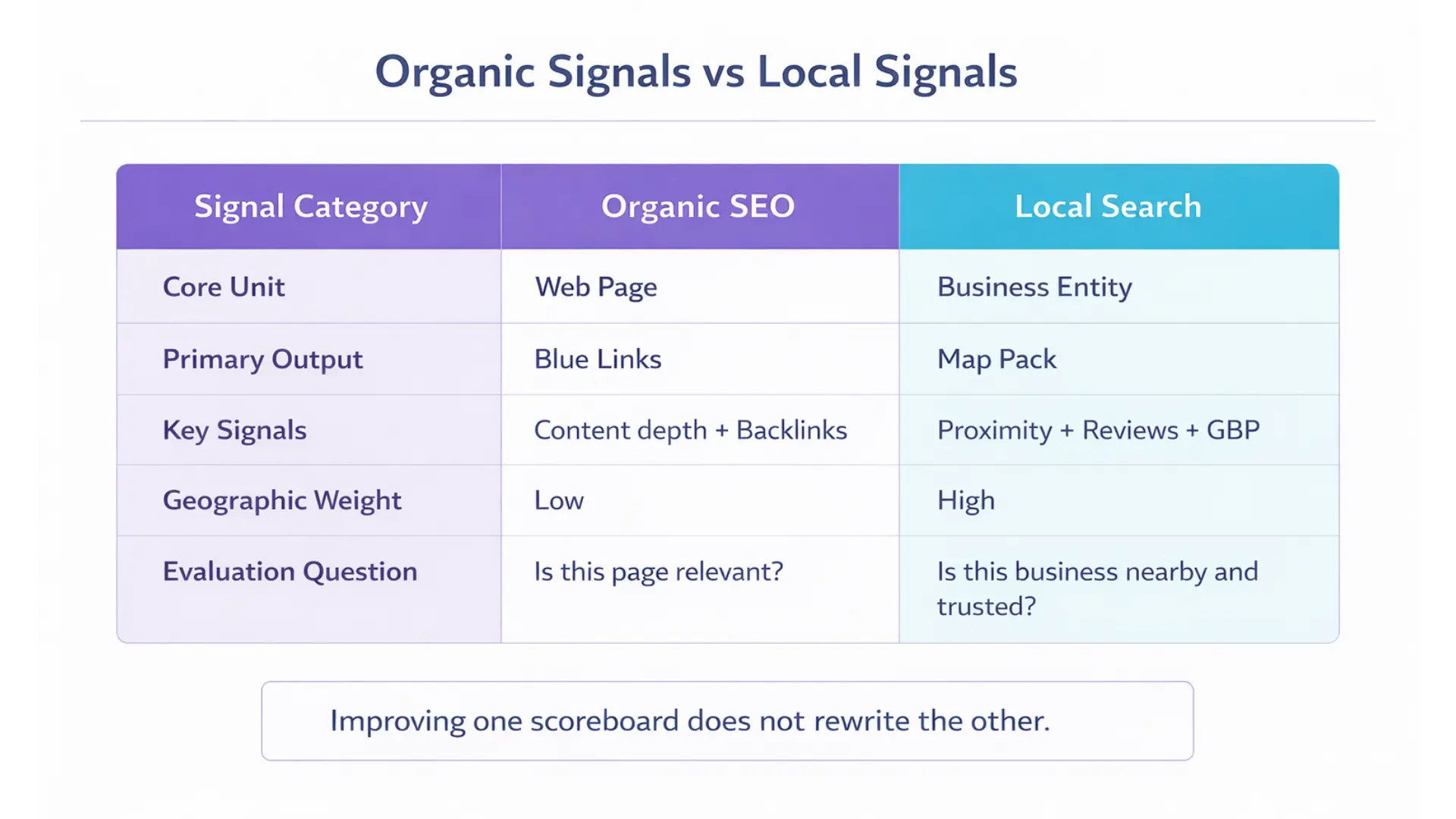
Here is the clean comparison.
| Signal Category | Organic SEO | Local Search |
| Core focus | Page relevance and links | Proximity + Google Business Profile data |
| Main target | Broad, universal queries | Geo-bounded, local intent queries |
| Primary output | Blue links in the organic SERP | Map Pack and Google Maps listings |
| Authority inputs | Backlinks, topical depth, trust | Reviews, ratings, local citations |
| Geography weight | Low | High and query-dependent |
Organic SEO scores web pages.
Local Search scores business entities in a defined geographic frame.
One evaluates digital authority across markets.
The other evaluates local fit at the moment of search.
We once audited a retail client with strong backlink growth. Their referring domains increased 70 percent year over year. Organic traffic rose steadily.
Map Pack visibility stayed flat.
The executive team assumed link growth would lift everything. It did not, because backlinks are strong organic ranking signals, but proximity and local relevance dominate Local Search ranking factors.
This is where the myth breaks.
SEO does not automatically fix Map Pack rankings.
Improving one scoring model does not rewrite the other.
Imagine two scoreboards in the same stadium.
Same crowd. Same brand.
Different rules, different points.
If you want predictable growth, you must know which scoreboard drives revenue.
Next, we address the most common misconceptions that distort expectations.

Common misunderstandings about organic vs local results
The confusion usually sounds reasonable.
„If we improve SEO, our Map Pack rankings should rise”.
„If we rank organically, local visibility will follow”.
„Distance shouldn’t matter if our content is stronger”.
Each statement blends two systems into one.
Here is the myth in plain language.
Strong organic SEO does not guarantee Map Pack visibility.
Organic SEO strengthens your site.
Local Search evaluates your business in a geographic context.
We worked with a multi-location medical group that doubled its organic traffic in six months. Content expanded. Backlinks improved. Technical errors dropped to near zero.
Their map rankings in two cities did not move.
The leadership team assumed something was broken. It wasn’t. The organic ranking signals improved. The local entity signals did not change.
Another client had the opposite pattern. Reviews surged from 80 to 240 per location in under a year. Their Map Pack impressions climbed 37 percent.
Organic positions barely shifted.
Two improvements. Two different outcomes.
Distance also matters more than most executives expect.
In Local Search, proximity is a direct variable. In organic results, distance is often irrelevant. That single difference explains many reporting disputes between marketing and operations.
If your internal dashboards mix Map Pack and organic SERP performance into one „SEO” bucket, you will misread the data.
Before reallocating budget, ask a simple question.
Which system is driving revenue for this query?
Next, we translate that into real-world scenarios you may recognize.

Real scenarios: When you see map pack but no organic rank
Let’s make this concrete.
Three patterns show up again and again in board meetings.
Scenario A: „We rank organically but not locally”.
You search your core term.
You see your site in the top three organic results.
But the Map Pack shows three competitors.
This usually means your organic ranking signals are strong, but your Local Search ranking factors are weaker in that geography.
We saw this with a B2B consulting firm entering a new city. Their content authority transferred nationally. Organic positions appeared within weeks.
Their Map Pack visibility stayed near zero for four months.
They had no local reviews. Their Google Business Profile was recently created. Proximity worked against them compared to long-established competitors.
Same keyword. Different scoreboard.
Scenario B: „We appear in the Map Pack but not in top organic positions”.
This often happens with service businesses.
Their reviews are strong.
Their location is central.
Their Google Business Profile is complete.
They win the Map Pack.
Yet their website struggles to rank for broader informational or commercial queries because content depth and backlinks lag behind.
One home services client generated 68 percent of calls from Maps. Their organic traffic was modest. When they expanded content around high-intent service variations, organic leads increased 23 percent in five months without changing their local dominance.
Local strength does not equal organic authority.
Scenario C: „SEO improvements didn’t change our maps visibility”.
This is the most common frustration.
Teams invest in technical fixes, content expansion, and link outreach. Rankings rise. Traffic grows.
Map Pack impressions stay flat.
That outcome usually means the work targeted the organic SERP, not the local entity layer. Google Business Profile signals, review volume and sentiment, and physical proximity did not change.
The question then shifts.
Which layer actually feeds your revenue engine?
When you can answer that clearly, budget conversations become simpler.
Now we define when Local Search becomes the primary lever.

When Local Search matters more than organic SEO
Some businesses win with reach.
Others win with proximity.
If your revenue depends on walk-ins, bookings, or service-area calls, Local Search often carries more weight than national organic rankings.
Picture a dental clinic.
A #1 organic ranking for „how to treat gum pain” can drive traffic from anywhere. It builds authority. It supports brand recall.
But when someone types „dentist near me” at 8:30 AM, the Map Pack decides who gets the call.
In one regional retail case, 72 percent of tracked conversions came from users who interacted with Google Business Profile elements – calls, directions, or map clicks. Organic traffic was healthy, but it drove fewer immediate store visits.
The leadership team shifted focus.
They did not abandon organic SEO. They recalibrated priority based on query intent and revenue source.
Here is the practical lens.
If most high-intent searches in your category include location modifiers or trigger local intent implicitly, Local Search becomes the dominant acquisition layer.
If your market is national or purely digital, organic SEO will carry more of the load.
Many organizations need both.
But the weighting must reflect demand behavior, not internal preference.
When Local Search is the primary lever, expectations around SEO need adjustment.
From here, the question broadens.
How does SEO interact with other growth channels and capabilities inside your marketing system?
That’s where the next layer begins in the broader SEO in the marketing ecosystem.

Where organic visibility ends and Local begins
You can improve content.
You can earn links.
You can repair technical gaps.
Those actions strengthen organic positions in the SERP.
They do not change where your building stands.
SEO vs Local Search is a boundary issue.
If you measure both under one ‘SEO’ label, you will misattribute results and misjudge spend.
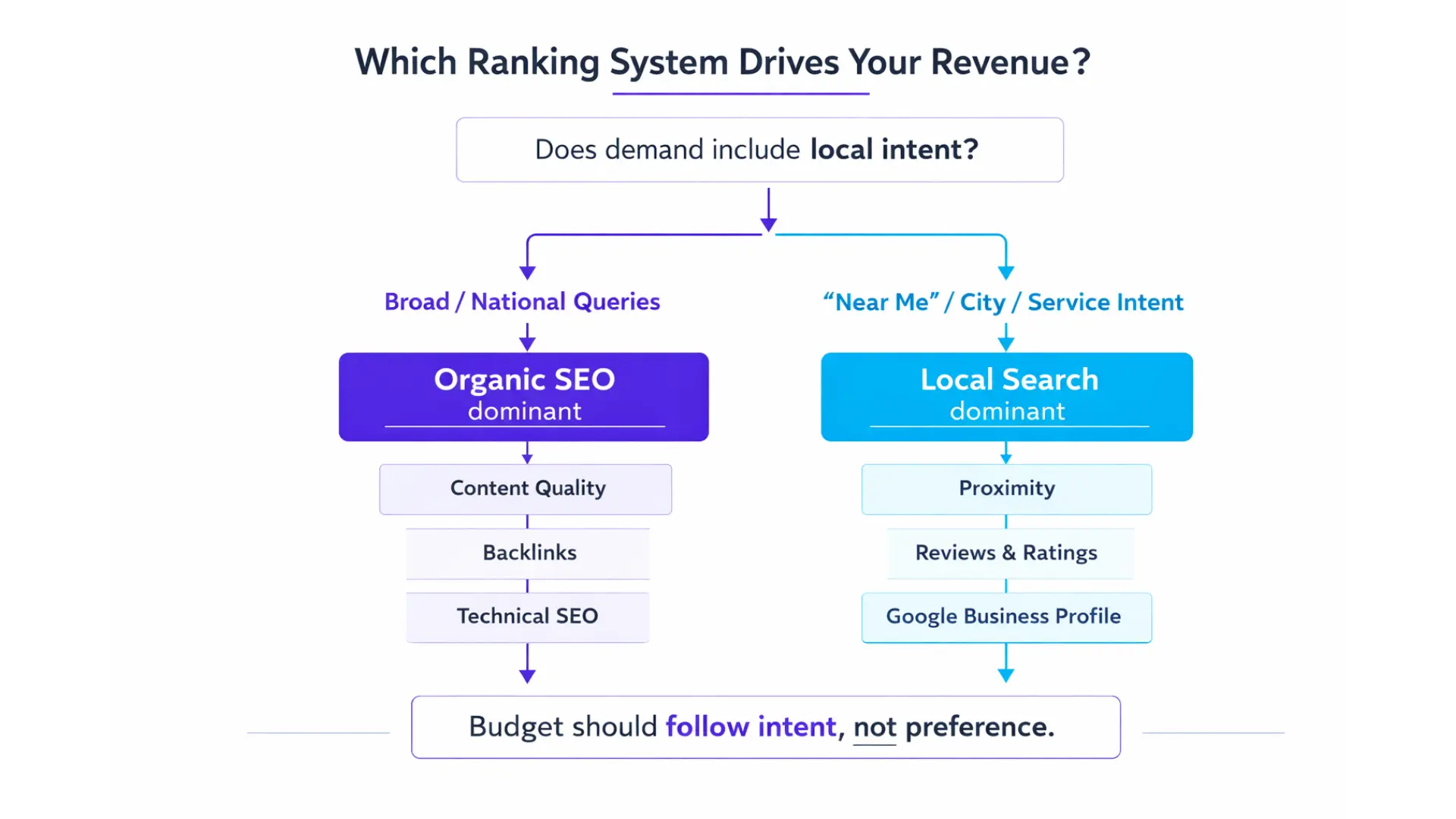
Organic SEO evaluates web pages across markets.
Local Search evaluates business entities within a geographic frame.
One system drives reach.
The other drives proximity-based demand.
When reporting blends Map Pack and organic performance into one metric, confusion follows. When expectations are set correctly, investment decisions become cleaner.
Imagine your dashboard tomorrow.
Separate organic SERP visibility from Map Pack performance. Track them independently. Tie each to revenue.
If you want the broader boundary map for what SEO is not, continue to SEO in the marketing ecosystem.
Clarity changes the conversation.
Next, you decide which system owns the outcome.

Scientific context and sources
The sources below describe how modern search systems combine textual relevance with geographic proximity, entity signals, and intent detection. They provide foundational context for the ranking system distinctions explained above.
- Geographic relevance in search systems
Spatial Keyword Search on Web Data – Cong, Jensen, Wu – Proceedings of the VLDB Endowment (2009)
Explains how search systems integrate spatial proximity and textual relevance when ranking geographically constrained results. Demonstrates why location can override traditional authority in spatial search contexts.
https://www.vldb.org/pvldb/2/vldb09-677.pdf - Geographic Information Retrieval foundations
Geographic Information Retrieval – Jones, Purves – International Journal of Geographical Information Science (2008)
Describes how search engines interpret place names, infer geographic intent, and adjust results based on spatial context, even when queries do not explicitly include location terms.
https://www.tandfonline.com/doi/full/10.1080/13658810701626343 - Local intent detection and location-based ranking
Determining Geographic Relevance in Search Queries – Google Patent (WO2008109257A1)
Details mechanisms for inferring user location and applying geographic bias to search results, supporting the distinction between organic and proximity-based ranking systems.
https://patents.google.com/patent/WO2008109257A1 - Local ranking principles (first-party documentation)
How local ranking works – Google Business Profile Help
Describes Google’s official framework for local ranking based on relevance, distance, and prominence, clarifying how Map Pack visibility differs from organic SEO evaluation.
https://support.google.com/business/answer/7091
Questions You Might Ponder
What’s the difference between organic SEO and local SEO?
Organic SEO focuses on ranking your website in traditional search results for broad, non-location-specific queries. Local SEO targets visibility in geographically relevant results like the Map Pack and Google Maps by emphasizing proximity, business profile data, reviews, and local citations. Both serve distinct intent and ranking systems.
Why do I rank organically but not in the Google Map Pack?
Ranking well organically doesn’t guarantee Map Pack placement because local search uses distinct signals. The Map Pack prioritizes proximity, business relevance, and prominence (like reviews and profile completeness), while organic rankings are driven by content quality, links, and technical SEO, which don’t reflect local presence.
What factors actually influence Map Pack rankings?
Map Pack rankings are driven by relevance (how well your business fits the query), proximity (distance from the searcher), and prominence (reviews, ratings, citations, and profile signals). These differ from organic ranking factors like backlinks and content authority and are essential for local intent queries.
Can improving my website’s SEO help my local rankings too?
A strong organic SEO strategy builds content authority and relevance that indirectly supports visibility, but Map Pack rankings still depend on dedicated local signals like a fully optimized Google Business Profile, local citations, and review velocity. Organic improvements alone do not replace local ranking factors.
How should I measure SEO vs Local Search performance separately?
Measure organic SEO with metrics like non-branded ranking positions, site traffic, and conversions from traditional search results. Measure Local Search with Map Pack impressions, business profile actions (calls, direction requests), and local clicks. Tracking them separately clarifies which system is driving specific business outcomes.