What You’ll Learn
seo vs ppc vs ai search
Key Takeaways
- SEO is demand capture, not sales. It improves discovery, matching, and trust so you show up for relevant searches and AI assistants, but it does not control pricing, offer strength, sales follow-through, or conversion rate.
- More organic traffic can reduce lead quality. Ranking gains often broaden intent and bring earlier-stage visitors; if the page job and funnel step don’t match that intent, sessions rise while leads, close rate, or revenue stalls.
- Conversion outcomes belong to CRO and experience design. When visibility is healthy but results lag, the constraint is usually friction, unclear positioning, weak proof, or UX-SEO can deliver qualified visits, but persuasion happens after the click.
- SEO vs PPC vs AI search are different systems. PPC buys immediate placement for time-bound demand, SEO compounds visibility over months, and AI search can compress clicks while rewarding citable structure and authority signals – separate reporting first, then blend insights once roles are clear.
Organic search can lift revenue while conversions drop.
We saw it last quarter.
A B2B services site gained 41% more organic sessions in 8 weeks.
Lead volume fell 9% in the same window.
Nothing “broke.”
The system did exactly what it was asked to do.
It just wasn’t asked the right thing.
SEO captures qualified demand by making your content discoverable in search engines and AI assistants.
SEO creates visibility and qualified demand, but outcomes depend on other systems.
It changes whether you show up.
It does not change whether people say yes.
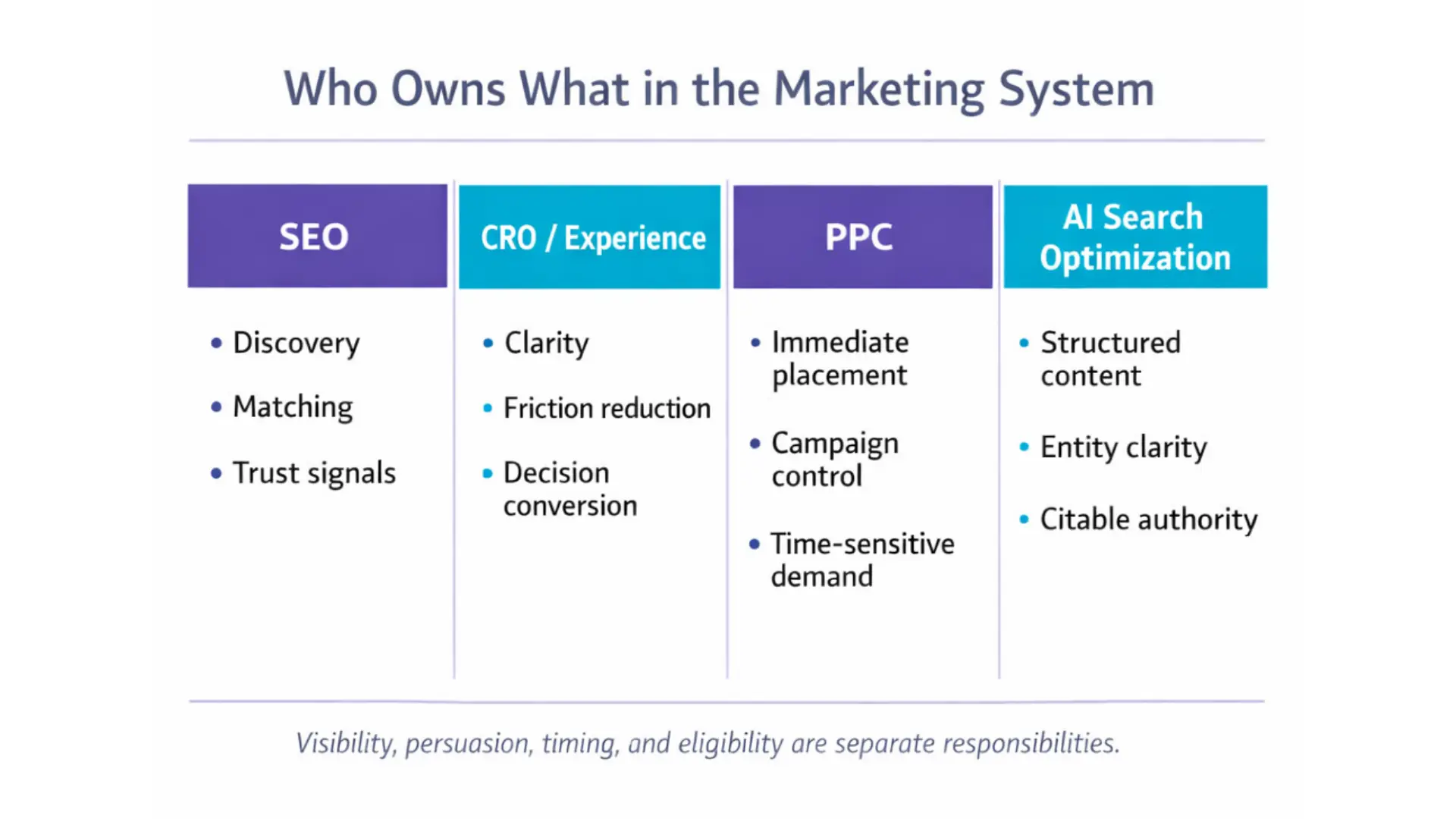
SEO controls eligibility and visibility.
It improves discovery, matching, and trust signals.
SEO does not control persuasion.
It does not control offer strength or sales follow-through.
It does not control conversion rate.
That responsibility sits elsewhere.
SEO is not a sales system.
| Question you’re trying to answer | Owner system | What SEO can contribute |
| “Why aren’t we visible?” | SEO | Discovery, matching, trust signals |
| “Why don’t visits turn into leads?” | CRO / experience | Qualified traffic only |
| “Why do we need results next month?” | PPC | Landing page relevance signals |
| “Why are clicks dropping but impressions rising?” | AI search optimization | Citable structure and authority signals |
Not: SEO will fix sales.
This: SEO fixes visibility.
Not: More traffic means more revenue.
This: Better intent match means more revenue.
Not: Rankings are the outcome.
This: Outcomes happen after the click.
That sounds obvious.
Then you look at how teams report.
If rankings rise and pipeline stays flat, where does blame go?
Usually straight back to SEO.
That reflex gets expensive fast.
Here’s the open loop most teams miss:
the same SEO win can create a conversion problem.
Because SEO can widen reach.
And widening reach changes who arrives.
In one SaaS account, a single page jumped from position 9 to 2.
Clicks rose 73% in 30 days.
Sales calls got noisier, not better.
The page started attracting “curious researchers.”
Not buyers.
The intent mix shifted under the surface, like the smell of a room changing before you notice.
A simple analogy helps here.
SEO is the airport arrivals board.
It can bring more people to your gate, faster, from more places.
It can’t make them want your destination.
Myth: “If SEO is good, conversions follow.”
Reality: SEO is a visibility engine, not a persuasion engine.
Imagine your best offer, perfectly priced.
Now imagine it behind a foggy glass door.
SEO wipes the glass.
But if the room inside is confusing, people still step back.
One more pattern from real work.
We audited a lead-gen site where organic traffic looked strong.
Yet form fills were stuck for 6 months.
The issue was not keywords.
It was friction.
A long form, vague promise, and a page that felt cold (even with strong rankings).
We use one simple check before anyone debates channels: a funnel stage map.
It’s a plain grid: query intent -> page job -> next decision.
If those three don’t match, traffic becomes noise.
If you want the full system definition, start at the main SEO capability hub.
So what is this page for?
To draw the border cleanly.
To stop outcome misattribution before it spreads.
SEO earns attention.
The rest of the business earns the decision.
Next, let’s separate demand you capture from demand you create.

Demand capture vs. demand creation
SEO is the only channel where success can look like failure.
You rank higher.
Traffic goes up.
And the sales team still says, “Nothing changed.”
That’s not a contradiction.
That’s a scope problem.
SEO catches existing demand.
It does not manufacture it.
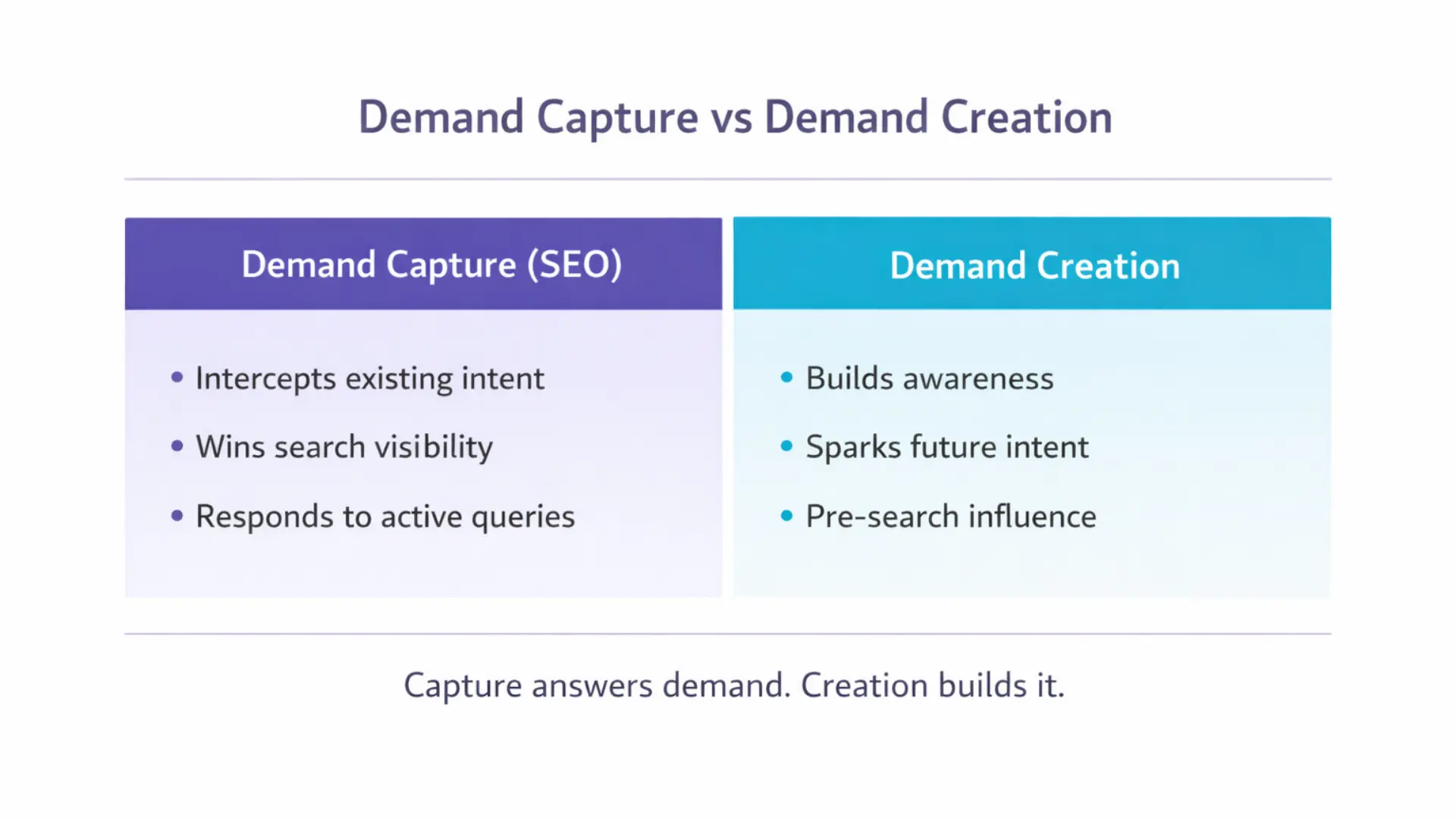
Picture a city at night.
Search is the streetlights already on.
SEO is how clearly your sign shows under them.
Demand creation is different.
It’s the billboard that makes someone think, “Wait… I need that.”
It’s the podcast clip that sticks in your head.
It’s paid distribution that puts an idea in front of the right person before they ever search.
When teams mix these, they start measuring the wrong thing.
They expect SEO to “create appetite.”
Then they get frustrated when it only captures it.
We saw this with a B2B SaaS team running heavy paid distribution.
They called it “SEO support.”
Organic sessions rose 28% over 10 weeks.
The catch?
Most of that lift was branded and problem-awareness queries they created upstream.
SEO didn’t create that demand.
It harvested what other channels sparked.
Here’s the part that stings.
If you treat demand creation like demand capture, you panic too early.
You cut the channels that are warming the market.
And if you treat demand capture like demand creation, you wait too long.
You publish content for people who aren’t searching yet.
You can feel it in the boardroom.
The air gets tight.
Everyone talks past each other using the same numbers.
A clean way to separate it is simple.
Ask one question: “Was this person already looking for a solution?”
If yes, SEO can capture that moment.
If no, something else needs to create the moment.
Is your pipeline slow because nobody knows you?
Or because people can’t find you when they already want it?
That one split changes everything.
It also prevents false expectations from spreading into forecasts.
SEO is a demand capture layer.
Demand creation sits outside SEO.
Next, let’s talk about the gap that causes most confusion: traffic vs outcomes.

Visibility vs. persuasion: why traffic does not guarantee outcomes
The fastest way to lower conversion rate is to improve SEO.
We’ve seen it happen.
Rankings rise.
Sessions surge.
Sales teams start complaining.
Because when visibility expands, audience mix shifts – and most dashboards never show the shift clearly.
SEO increases discoverability.
It increases relevance in search results.
It increases the likelihood of a click.
It stops at the click.
Last year, we worked with a B2B engineering firm.
Organic traffic grew 68% in five months.
Qualified leads dropped 14%.
The board assumed poor sales execution.
The issue was intent dilution.
The company started ranking for early-stage research terms.
More students.
More junior engineers.
Fewer decision-makers.
Imagine opening a wider door.
More people walk in.
Fewer are ready to buy.
That’s the hidden trade-off.
Here’s the myth: more traffic equals more revenue.
That only works when traffic intent matches buying stage.
Search intent is simple.
It means the reason someone typed the query.
And intent has levels: learn, compare, decide.
If your page speaks to “learn” while asking for “buy,” visitors retreat quietly.
No anger.
No complaint.
Just silence in your CRM.
We audited a SaaS company with 120,000 monthly organic sessions.
Demo bookings were stuck at 0.6% for six months.
Heatmaps showed scroll depth under 20%.
That means four out of five visitors barely read past the fold.
The copy educated well.
The visitor wanted proof and risk reduction.
Have you ever looked at rising impressions and thought, “Why isn’t this converting?”
The data isn’t lying.
It’s incomplete.
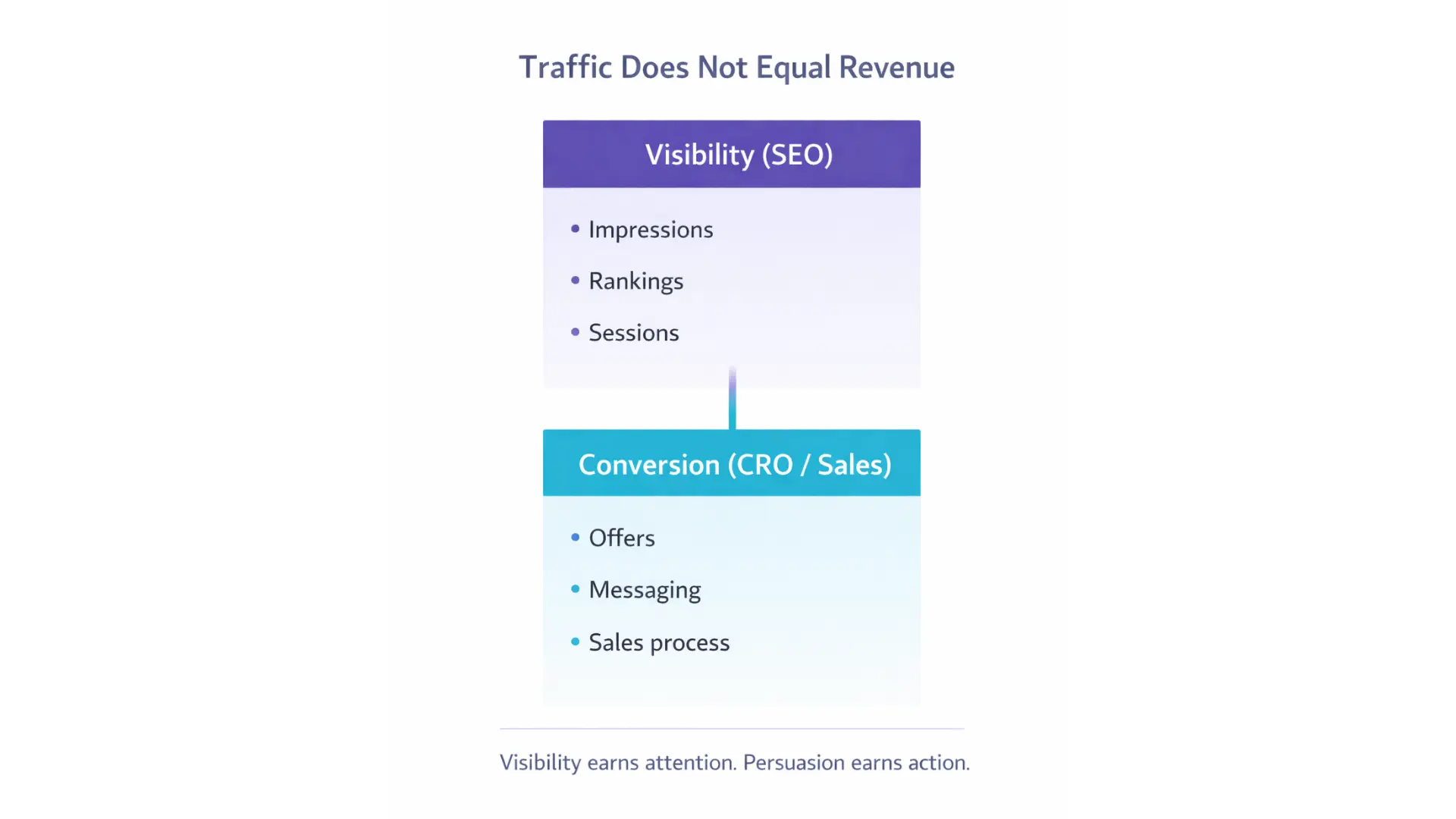
SEO earns the right to be seen.
Persuasion earns the right to be chosen.
Imagine your homepage like a reception desk.
SEO brings more guests into the lobby.
Conversion happens when someone greets them with clarity and confidence.
When teams blame SEO for low close rates, they blur roles.
That confusion spreads into budgets, forecasts, and morale.
Traffic is visibility.
Revenue is persuasion plus trust.
Next, we define exactly where conversion responsibility begins.

Where conversion responsibility begins: handoff to CRO and experience design
Conversion rate usually drops before revenue does.
That sounds backwards.
It isn’t.
When visibility expands, weaker pages get exposed.
More people see the friction that was always there.
Conversion optimisation is simple.
It means increasing the percentage of visitors who take the next intended action.
It focuses on clarity, trust, and reducing effort.
SEO brings people in.
CRO makes staying feel safe.
We worked with a mid-market SaaS firm last year.
Organic traffic was stable at 48,000 sessions per month.
Demo conversion sat at 0.9%.
The team wanted more keywords.
We ran session recordings instead.
The issue was obvious within minutes.
Pricing was hidden.
Case studies were generic.
The form asked for too much, too soon.
After we removed major friction points, conversion rose from 0.9% to 1.7% in 6 weeks.
Traffic stayed the same.
That single shift produced 38% more demos without a single ranking change.
Another example.
An industrial supplier blamed SEO for “low-quality leads.”
We mapped queries to funnel stages.
Top-ranking pages answered early research questions.
The sales team expected ready buyers.
The mismatch created friction on both sides.
Imagine a hotel lobby with bright lights and clear signage.
Guests feel calm.
Now imagine the same lobby dim, cluttered, and silent.
SEO controls who enters the building.
CRO controls what happens inside.
This is where roles must stay clean.
Leads.
Sales.
Pipeline velocity.
Those belong to conversion design, offer strength, and sales process.
SEO cannot fix a confusing value proposition.
It cannot repair pricing anxiety.
It cannot compensate for weak follow-up.
Have you ever pushed for “more traffic” when what you needed was “less friction”?
That reflex is common.
It’s also expensive.
Visibility and conversion are different responsibilities.
If you mix them too early, you misread both.
SEO earns attention.
CRO earns action.
Next, we compare SEO with PPC and examine where timing changes the equation.

SEO vs PPC: different problems, timing and resources
The most expensive PPC campaign we reviewed was profitable.
The SEO program beside it was not.
That shocked the leadership team.
They believed “free traffic” should always win.
Cost structure changes the math.
SEO compounds over time.
PPC activates instantly.
They solve different timing problems.
PPC buys visibility by paying for placement.
In one B2B software account, paid search launched on Monday.
Leads came in by Wednesday.
Cost per lead was high, but pipeline moved.
The SEO program took 4 months to lift priority pages.
Once it did, cost per acquisition dropped 37% over the next quarter.
Different tempo. Different role.
PPC captures ready intent.
It shows up above the fold.
It can target tightly and test fast.
SEO builds durable presence.
It earns clicks without paying per impression.
It grows authority that compounds month after month.
Here’s where confusion creeps in.
If you expect SEO to perform like PPC in week two, you panic.
If you expect PPC to scale without budget pressure, you overspend.
We once audited a company that paused paid campaigns because “SEO is improving.”
Pipeline dipped 22% in 6 weeks.
Organic rankings were rising.
But PPC had been covering high-intent bottom-of-funnel terms.
Remove that coverage and visibility shrinks exactly where buyers act.
Imagine two engines.
One is electric.
Instant torque, high consumption.
The other is a diesel generator.
Slower ignition, long endurance.
Both power growth.
But you don’t measure them by the same clock.
Here’s the myth: SEO replaces PPC once rankings improve.
Reality: they answer different timing needs and different risk tolerances.
PPC addresses immediate visibility needs.
SEO builds longer-term presence.
Treat PPC and SEO as separate systems.
Blend results only after roles are clear.
SEO earns steady ground.
PPC buys immediate ground.
Next, we examine how AI search changes the surface entirely.

SEO vs AI search: overlap and limits
Your page can rank first and still get zero clicks.
That used to be rare.
Now it happens daily.
AI assistants summarize answers directly on the results page.
Users read.
They move on.
No visit.
No session.
No chance to persuade.
That doesn’t mean SEO is obsolete.
It means the surface changed.
Search engines now act like editors.
They extract, compress, and cite.
They choose which sources to reference.
In one B2B advisory account, rankings held steady for 6 core terms.
Traffic dropped 18% over 3 months.
AI summaries had started answering the question fully.
We didn’t lose relevance.
We lost click dependency.
AI systems decide what to surface and how to summarize it.
SEO influences eligibility, not presentation.
Entity signals are simple.
They are consistent references to who you are and what you are known for.
If the system cannot clearly identify your expertise, it won’t reference you.
And if it references someone else, visibility shifts silently.
Imagine writing the perfect executive brief.
Then imagine someone else quoting it in their board memo.
Your insight travels.
Your traffic may not.
That is the new trade-off.
Here’s the myth: AI search replaces SEO.
AI changes distribution, not the need for authority.
SEO creates the structured, authoritative content AI pulls from.
We adjusted one client’s content architecture to front-load direct answers.
Within 8 weeks, brand mentions in AI responses increased.
Organic sessions stayed flat, but assisted conversions rose 21%.
The signal moved upstream.
Have you noticed impressions rising while clicks stagnate?
That pattern is often AI compression at work.
If AI visibility is a priority, treat it as its own capability.
SEO cannot control how AI displays your content.
Next, we address what happens when all these levers blur together.

Risks of mixing levers and misattribution
Most reporting problems start with one sentence:
“Marketing isn’t working.”
That sentence usually hides three different issues.
Visibility.
Conversion.
Channel mix.
When you bundle SEO, PPC, CRO, and AI into one scoreboard, the numbers blur.
We reviewed a growth report for a B2B services firm.
Organic traffic up 32%.
Paid spend down 18%.
Revenue flat.
Leadership blamed SEO.
Sales blamed lead quality.
Finance cut budget.
The real issue?
Bottom-of-funnel PPC terms were paused.
High-intent traffic disappeared quietly.
Another case.
A SaaS client saw AI citations increase across industry queries.
Branded search rose 14% in 10 weeks.
Pipeline stayed flat.
They assumed AI “wasn’t converting.”
In reality, those AI mentions were driving awareness.
But landing pages weren’t built for comparison-stage visitors.
When roles blur, accountability collapses.
Here’s the trap:
- High traffic blamed for poor sales.
- PPC cost mistaken for inefficiency.
- AI impressions confused with organic growth.
Three different signals.
One messy narrative.
Imagine trying to tune a piano while three people press keys randomly.
You don’t know which note caused the noise.
That’s what mixed diagnostics feel like.
Separate the responsibilities before you compare results.
Otherwise every number becomes a story, not a signal.
One myth deserves a clean break: integrated reporting means merged accountability.
It doesn’t.
Clarity comes before integration.
Otherwise, you punish the wrong lever and repeat the same mistake next quarter.
Traffic is one system.
Persuasion is another.
Budget allocation is a third.
When you define each clearly, performance conversations calm down.
SEO should not carry PPC’s burden.
PPC should not compensate for weak pages.
AI visibility should not be confused with conversion.
Clean borders create clean decisions.
And clean decisions protect growth in tight markets.
Now the final question remains: when should you activate adjacent capabilities?

When to engage adjacent capabilities
The fastest way to waste budget is to ask one channel to fix another channel’s problem.
We’ve seen companies push SEO to “increase sales.”
Push PPC to “build authority.”
Push AI content to “drive pipeline.”
Each lever has a job.
Confuse the job, and expectations collapse.
If your issue is low visibility for non-branded queries, that’s an SEO question.
If your issue is strong traffic but weak form conversion, that’s a conversion design problem.
If you need immediate demand next month, paid media answers that clock.
Imagine a storefront and a sales floor.
SEO gets people to the door.
Conversion design gets them to commit.
Paid media can move faster when time is tight.
We worked with a technology services firm that thought they “needed more SEO.”
Organic impressions were rising steadily.
What they actually needed was stronger proof and clearer differentiation.
After revising messaging and restructuring the offer, close rates improved 24% in one quarter.
Traffic stayed stable.
Another example.
A client reduced paid search because rankings improved.
Three months later, sales calls dropped sharply.
High-intent terms had been covered by ads, not organic pages.
Channels are complementary.
They are not interchangeable.
Here’s the simple rule.
If the problem is discoverability, the owner is SEO.
If the problem is decision friction, the owner is CRO.
If the problem is immediate placement, the owner is PPC.
If the problem is answer-engine visibility, the owner is AI optimization.
SEO captures demand.
It does not convert it.
If outcomes are weak, look beyond visibility.
That is the boundary.

Scientific context and sources
The sources below provide foundational context for how search systems interpret intent, how visibility differs from persuasion, and how decision friction affects conversion outcomes. They support the system boundaries described above.
- Search intent and query understanding
A taxonomy of web search – Andrei Broder – IBM Research (2002)
Introduces the informational, navigational, and transactional query model, which formalized how intent shapes search system behavior and outcome expectations.
https://sigir.org/files/forum/F2002/broder.pdf - Cognitive load and decision friction
Cognitive Load Theory – Sweller J. – Psychology of Learning and Motivation (1988)
Explains how mental effort affects decision-making performance, reinforcing why traffic does not automatically translate into action.
https://www.sciencedirect.com/science/chapter/bookseries/abs/pii/B9780123876911000028?via%3Dihub - AI answer generation and retrieval grounding
Retrieval-Augmented Generation for Knowledge-Intensive NLP Tasks – Lewis et al. – NeurIPS (2020)
Describes how modern AI systems retrieve and synthesize information from authoritative sources, clarifying why visibility eligibility differs from presentation control.
https://arxiv.org/abs/2005.11401
Questions You Might Ponder
Why doesn’t increased organic traffic automatically lead to more leads?
More organic traffic expands reach, but it often shifts visitor intent. Rankings can bring in early-stage researchers who are not ready to buy, so conversion rate drops even as sessions rise. Leads improve when the page’s job matches query intent and the path to action is low-friction and clear.
What’s the difference between demand capture and demand creation?
Demand capture (SEO) wins existing intent – it helps you show up when people are already searching for a solution, vendor, or category. Demand creation builds intent before search – through distribution, PR, and paid awareness. Mixing them causes misattribution: you expect SEO to “create demand” and misread results when it only captures it.
How long does SEO take to work compared with PPC?
SEO typically takes weeks to months because it depends on crawling, indexing, evaluation, and trust signals compounding over time. PPC can produce visibility immediately because you pay for placement. SEO tends to reduce long-term acquisition cost; PPC covers immediate demand or short time windows. They solve different timing constraints.
How is SEO different from CRO (Conversion Rate Optimization)?
SEO improves discoverability and qualified visits. CRO improves the percentage of those visitors who take the next step – demo, form fill, purchase. Rankings cannot fix unclear positioning, weak proof, confusing UX, or high effort forms. When traffic is healthy but leads lag, the constraint is usually conversion design, not SEO visibility.
Is SEO still relevant now that AI search answers questions directly?
Yes. AI systems summarize and cite sources based on relevance, structure, authority, and entity clarity. SEO increases your eligibility to be referenced by AI assistants and search features, even if clicks decline. The goal shifts from “rank and click” to “be findable, quotable, and trusted” across search and AI surfaces.