What You’ll Learn
on-page SEO factors
Key Takeaways
- On-page SEO factors are about interpretation, not effort.
Search engines rank pages that communicate one clear topic through structure, context, and consistency – not pages with more keywords or content volume. - Relevance, structure, and boundaries decide trust.
Pages perform when intent is singular, sections are clearly ordered, and the topic scope is obvious from start to finish. - A small set of signals carries most meaning.
Title + H1 alignment, heading hierarchy, thematic coherence, internal context, URL structure, and metadata work together to explain what a page is about. - On-page SEO has a hard limit.
It helps pages compete when relevance is close, but it cannot create authority or demand – that requires topic-level depth beyond a single page.
More than half of pages that never rank are technically “fine”.
They load fast. They read well. They still get ignored.
The problem is not effort.
It is interpretation.
On-page SEO (definition): page-internal signals that help search engines classify a page and match it to intent.
Not: keyword placement as the main lever.
Instead: one topic made obvious through structure, language, and internal context.
On-page SEO is the layer where a page explains itself to search systems.
If that explanation is blurred, no amount of publishing fixes it.
This page does not list actions or fixes.
It separates page-level clarity from topic-level authority.
It explains how search systems decide what a page means and when that meaning is strong enough to trust. If your problem is that content exists but visibility does not, start with the SEO framework.

What on-page SEO actually is
Most pages do not fail because they lack “SEO”.
They fail because Google cannot tell what they are about.
Even strong writing can stay invisible.
On-page SEO is the way a page communicates meaning to search engines.
It is not a bag of tricks.
It is the signal layer that shapes classification.
Think of Google like a fast triage nurse.
It scans for the main issue first.
If the signals feel mixed, it moves on.
Here’s the myth: “On-page SEO is adding keywords”.
The truth is less obvious.
A page ranks when it sends one clear theme, in a clean structure, with no internal conflict.
I’ve seen this play out on real sites.
One B2B client published 3 posts per week for 6 months.
Traffic stayed flat.
We changed nothing about frequency.
We rewired page focus and structure, and impressions rose 38% in 7 weeks.
Another case was simpler.
A service page had great copy and testimonials.
But it covered three services at once.
After we split the meaning into one page per intent, rankings stabilized within about 30 days.
Imagine your page as a store shelf label.
If the label says “snacks, batteries, and socks”, shoppers hesitate.
Search engines do the same.
So on-page SEO is not “more effort”.
It is fewer meanings per page, stated more clearly.
That is what gets a page into the right result set.
On-page SEO is clarity under pressure.
Now look at what the system checks before it trusts a page.

What search systems look for on a page
Search engines do not read pages like people do.
They scan for signals that reduce uncertainty.
The first signal is relevance.
Not keyword overlap.
Relevance to a specific intent.
A useful lens here is intent matching: the query, the page, and the expected outcome.
Intent means the reason behind the query.
Is the user trying to decide, compare, or understand one thing?
Pages that mix intents slow interpretation.
Then comes structure.
Headings, sections, and order act like road signs.
They tell the system what is central and what is supporting.
When structure is weak, meaning spreads.
The page talks about many things, lightly.
Search engines prefer fewer ideas, clearly separated.
Context boundaries matter more than most teams expect.
A page should feel like it knows where it starts and where it stops.
That boundary makes classification easier.
There is also the human layer.
Scroll depth, quick exits, and repeated returns shape confidence.
These are not ranking buttons, but they affect interpretability over time.
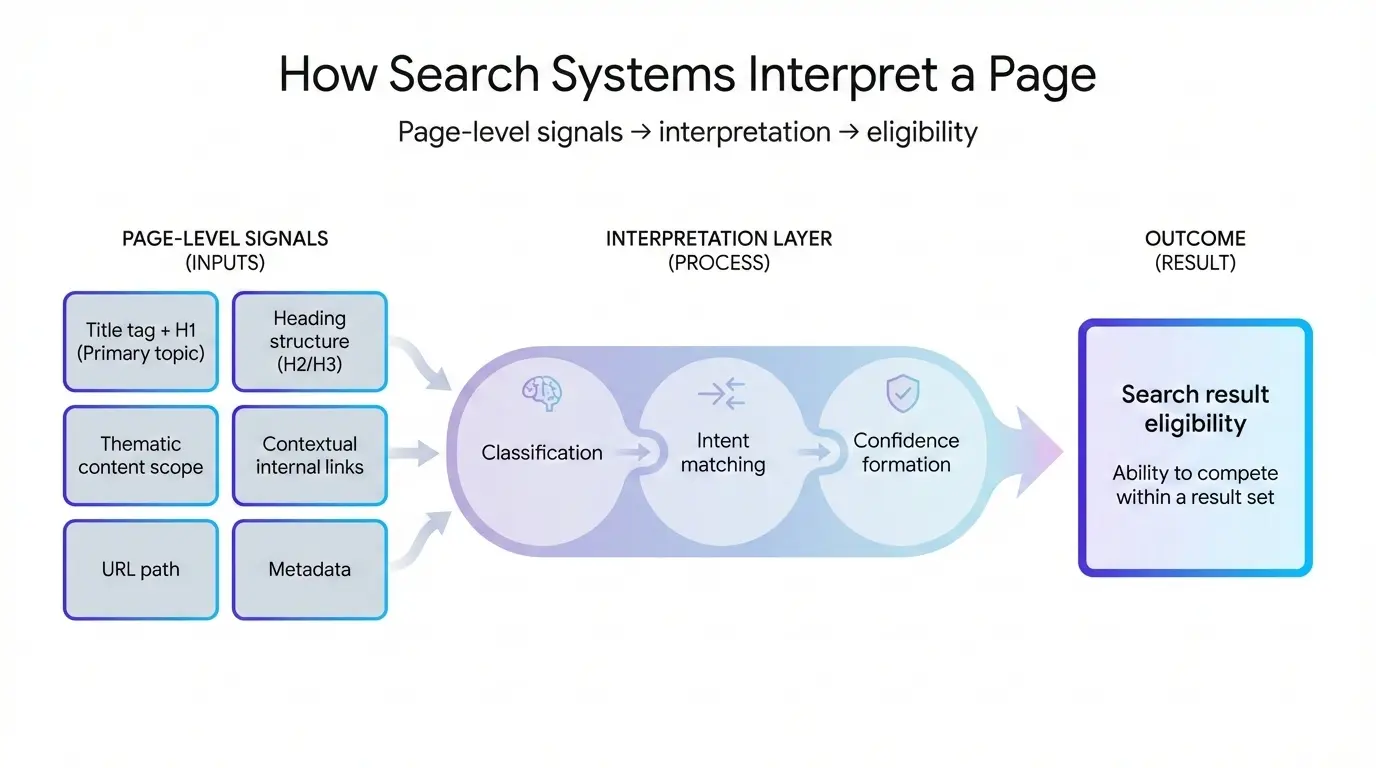
I’ve seen two pages with similar text perform very differently.
The winning one felt calmer to read.
Cleaner sections. Fewer detours. Less filler.
Imagine sorting mail at high speed.
Clear labels go to the right pile fast.
Messy envelopes slow everything down.
So search engines look for meaning, order, and limits.
When those are present, the page becomes easy to place.
Search systems reward pages that explain themselves quickly and cleanly.
Here are the signals that carry those cues.

Core on-page signals that convey meaning
Search systems rely on a small set of signals inside the page.
Not tactics.
Signals.
Each signal answers one question: What is this page about, exactly?
Below is the full set that actually carries meaning.
On-page signal – what it communicates
| On-page signal | What it communicates |
| Title tag + H1 | Primary topic in one line |
| H2/H3 structure | Subtopics and their order |
| Thematic coherence | What the page includes and excludes |
| Contextual internal links | Relationship to nearby topics |
| URL path | Position in site hierarchy |
| Metadata | Supporting cue for topic confirmation |
Primary topic signal – title tag and H1
These define the page’s main subject.
They work together, not separately.
When they point to different ideas, interpretation slows.
In one client case, the title framed a problem while the H1 framed a feature.
Impressions plateaued for months.
Once both named the same problem, visibility rose within two crawls.
Semantic structure – H2 and H3 headings
Headings break the topic into parts.
They show how ideas relate.
They also show what is subordinate.
This is where many pages fail quietly.
Too many equal-level ideas make the page feel scattered.
Thematic coherence of content
This is depth without sprawl.
The page stays inside one topic boundary.
A useful concept here is information scent.
It means the page keeps confirming the same topic with every section.
Search systems track that consistency over time.
Internal contextual connections
Links inside content signal relationships.
They work only when the surrounding text explains why the link exists.
We removed five random internal links from one article.
Nothing else changed.
The page stopped drifting across queries within three weeks.
URL structure and semantic path
The URL tells the system where the page sits.
Hierarchy reduces guesswork.
A flat or confusing path does not block ranking.
It adds friction to understanding.
Metadata as supporting cues
Meta descriptions do not rank pages.
They still help confirm meaning.
When metadata contradicts the page, trust weakens.
A simple analogy helps here.
Think of these signals as a shipping label.
Address, category, contents, and notes must agree.
When they do, routing is fast.
On-page meaning comes from a small set of signals working together.
Some of the most common ‘signals’ are not signals at all.

Common misinterpretations of on-page signals
Many teams think they are sending signals.
They are often sending noise.
The most common mistake is keyword loading.
Repeating a phrase does not sharpen meaning.
It blurs it.
Search systems read patterns, not counts.
When the same term appears everywhere, importance becomes unclear.
The page feels anxious, not focused.
Another false signal is decoration.
Icons, badges, animations, and long intros look impressive.
They rarely explain the topic.
I’ve seen pages redesigned three times in a year.
Each version looked better.
Rankings stayed flat because meaning never changed.
Internal links are often misused too.
Links added for navigation do not explain relationships.
Without context, they confuse classification.
One client had a “related resources” block on every page.
Same links. Same order.
After removing it, topical signals tightened within weeks.
Here’s a quieter myth.
Longer pages are not clearer pages.
Clarity comes from boundaries, not word count.
A page that tries to cover everything signals nothing specific.
Search systems hesitate when scope is fuzzy.
Picture a radio with static.
Turning the volume up does not help.
Tuning the frequency does.
Noise looks like effort, but clarity looks like confidence.
There is also a hard limit to what on-page can solve.

When on-page factors matter – and when they don’t
On-page signals matter most when relevance is close.
Several pages could fit the same query.
The system needs a reason to choose one.
In that situation, clarity wins.
Clean topic focus.
Clear structure.
No internal conflict.
We often see this with comparison or problem-led searches.
Two vendors say similar things.
The page that explains itself faster pulls ahead.
I’ve watched pages move from page two to page one without new links.
No new content either.
Just tighter meaning and fewer mixed signals.
Past that point, on-page stops moving the needle.
On-page work cannot create demand.
It cannot manufacture authority across a topic.
If a site has ten pages on ten different subjects, none will compound.
Each page may be clear.
The system still lacks confidence at the topic level.
This is where teams get stuck.
They keep refining pages.
Nothing changes.
The page is no longer the problem.
The absence of topic ownership is.
Imagine a single, well-labeled book in a library.
It is clear and readable.
If it sits alone on the shelf, it still looks minor.
That is when on-page signals stop helping.
The system needs to see depth across related pages.
This is the handoff point.
When pages are clear but still lose, the issue is no longer the page.
The next layer is topical authority and content overlap.
On-page SEO helps pages compete, not categories.
Owning a topic is the next constraint, not writing another page.

Scientific context and sources
The sources below describe how modern search systems interpret pages through structure, relevance, and classification rather than surface keyword use. They provide first-party and foundational context for the mechanisms described above.
- How search engines interpret and classify pages
How Google Search works – Google Search Central
Describes crawling, indexing, classification, and relevance matching, including how page structure and content signals are used to understand topic focus.
https://developers.google.com/search/docs/fundamentals/how-search-works - Relevance and intent matching in information retrieval
Introduction to Information Retrieval – Manning, Raghavan, Schütze – Cambridge University Press
Foundational IR concepts explaining how systems determine topical relevance, term relationships, and document classification beyond simple keyword matching.
https://nlp.stanford.edu/IR-book/ - Information scent and interpretability over time
Information Foraging Theory – Pirolli P., Card S. – Psychological Review (1999)
Introduces the concept of information scent, explaining how consistency and structural cues support ongoing relevance assessment in both humans and systems.
https://doi.org/10.1037/0033-295X.106.4.643 - Structured content and search understanding
Search Quality Evaluator Guidelines – Google
Explains how clarity, structure, and topical focus affect perceived relevance and quality, reinforcing the role of page-level interpretability.
https://developers.google.com/search/blog/2023/11/search-quality-rater-guidelines-update
Questions You Might Ponder
What is on-page SEO, exactly?
On-page SEO is the process of making a single page easy for search engines to classify and match to intent. It focuses on signals you control on the page itself: topic focus, headings, content structure, internal links, URL clarity, and metadata, rather than backlinks or external authority.
Which on-page elements matter most for rankings?
The strongest on-page signals are a clear title tag and H1, logical H2 and H3 structure, tightly focused topical content, contextual internal links, descriptive URLs, and consistent metadata. These elements help search systems interpret relevance and intent far more than keyword repetition or cosmetic design changes.
How is on-page SEO different from off-page SEO?
On-page SEO clarifies what a specific page is about so it can rank for the right queries. Off-page SEO builds trust and authority outside the page through links, brand mentions, and references. One improves relevance at the page level, the other builds credibility at the site and topic level.
How long does it take for on-page SEO changes to work?
On-page changes can influence rankings within weeks once pages are crawled and reprocessed, especially when relevance is close. Early movement is often unstable. More consistent gains in traffic and rankings usually appear over three to six months, depending on competition and the site’s existing authority.
Can strong on-page SEO alone get me to the top of Google?
Strong on-page SEO can move pages higher when competing results have similar authority. However, it cannot replace topical depth, backlinks, and brand signals. Long-term top rankings typically require both clear page-level signals and broader authority built across a cluster of related content.