What You’ll Learn
off-page seo
Key Takeaways
- Off-page SEO decides outcomes when on-page relevance is similar, because search engines rank sources based on external trust signals.
- Off-page SEO signals come from three buckets: backlinks, brand mentions, and indirect cues that repeat credibility across the web.
- Off-page strength is context and consistency, not link volume – manipulation creates unstable signals that get discounted over time.
- When a market is competitive and intent is high, Off-page SEO becomes the tie-breaker that separates „good pages” from „trusted brands”.
Most companies think rankings are decided on the page.
They are not.
In competitive markets, external signals often outweigh on-page improvements, even when the content is objectively stronger.
We have audited sites that improved structure, speed, and clarity, yet saw zero movement for months.
Then one respected industry publication mentioned them.
Rankings shifted within weeks.
Search engines do not rank pages in isolation, which is why our SEO capability separates relevance from trust.
They rank sources.
And sources are evaluated by how the rest of the web reacts to them.
Off-page SEO is how search engines confirm credibility beyond your own site.
If your competitors publish similar content, what actually breaks the tie – and why do some brands seem to start higher?
Imagine Google as a risk-averse editor. It prefers quoting the voice already cited elsewhere rather than the one speaking alone.
You will see how search systems infer trust beyond your domain, and why external confirmation decides who appears when intent is high.
Off-page SEO is not link volume.
It is consistent third-party validation from relevant sources.
Noise fades fast. Confirmation compounds.

Why search systems look beyond your site
Off-page signals are observations outside your domain.
The core types are links, mentions, and repeated association with a topic.
Search engines use them to estimate credibility and reduce ranking risk.
This is why strong pages can still stay invisible.
Two pages can answer the same query equally well, yet only one gets shown first.
Search engines separate relevance from credibility. Relevance matches intent. Credibility reduces risk.
Modern ranking systems use probabilistic models. In simple terms, they calculate which result is most likely to satisfy users without causing regret.
That calculation does not stop at your HTML.
It expands outward.
Who links to you?
Who references you?
Who places your name next to the topic?
We worked with a B2B software firm that invested nine months into content production. Traffic grew 18 percent. Leads did not move. Their competitors had fewer pages, yet stronger external citations from niche industry sites. Once we secured five authoritative mentions in 90 days, qualified demo requests increased by 31 percent.
The page quality did not change.
Perception did.
Search engines look beyond your site because self-declared authority has no verification, so external confirmation acts as a credibility filter.
When you try to manufacture it, the signal breaks.
Think of a courtroom. Your site is testimony, and off-page signals are independent witnesses.
Without witnesses, the claim stands alone, and it rarely wins.
So when executives ask, „Why are we invisible even with strong content?”, the answer is often not structure or keywords.
It is trust.
Search systems evaluate how the wider web reacts to you before they decide how prominently to surface you.
That leads to the next question: what exactly belongs to on-page signals, and what belongs to off-page authority?

Off-page SEO vs on-page SEO – conceptual boundary
On-page SEO answers:
„Is this page relevant?”
Off-page SEO answers:
„Is this source credible?”
They solve different problems.
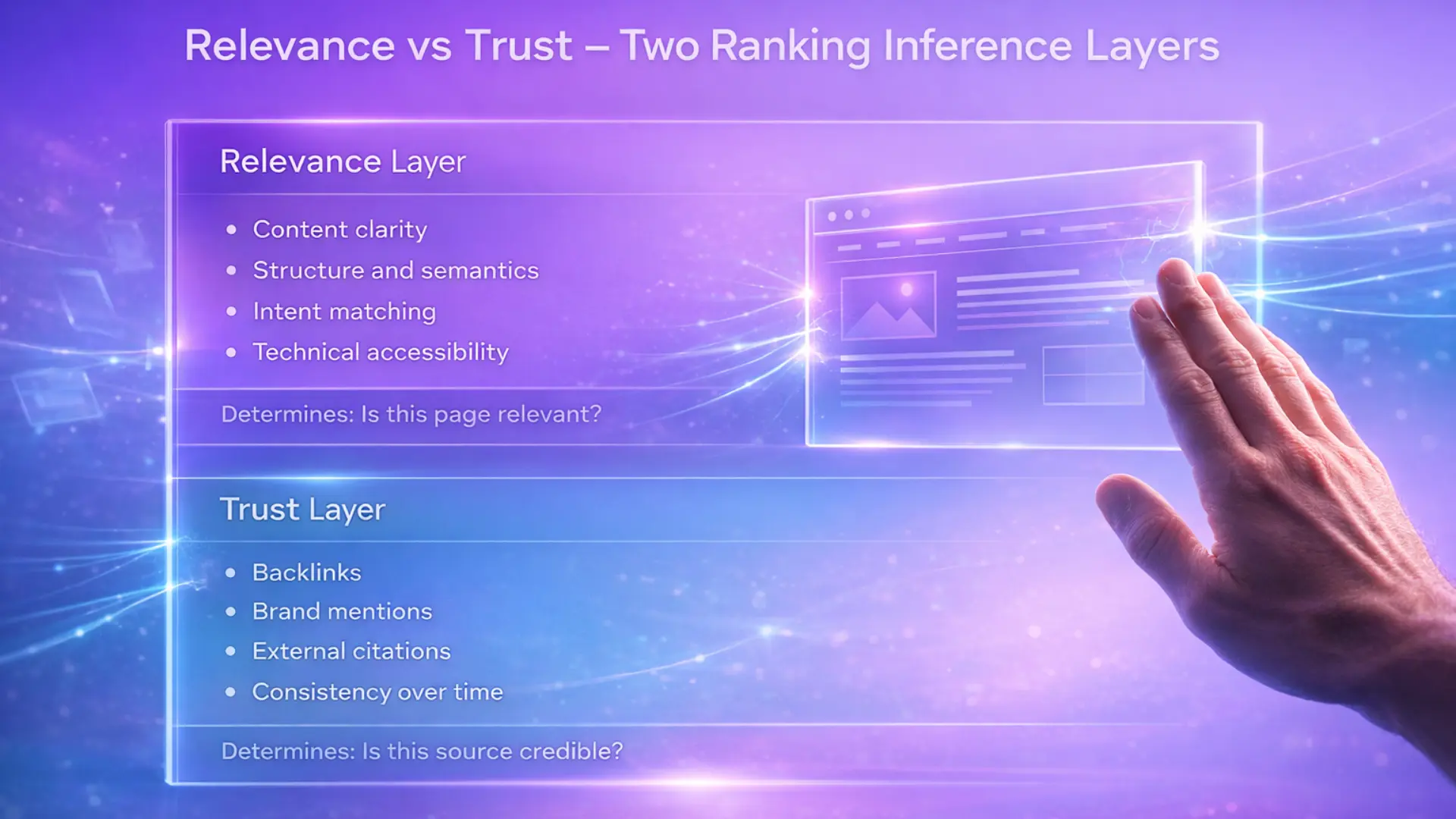
On-page tells the system what you claim.
Off-page tells the system what others corroborate.
On-page signals include structure, topical depth, internal linking, semantic clarity, and technical accessibility. These elements help search engines understand what your page is about and whether it matches user intent.
That is necessary.
It is not decisive in competitive queries.
We often see teams over-invest in page refinements. They rewrite pages, expand sections, and polish technical foundations. The page becomes cleaner. Rankings barely move because competitors have similar clarity and stronger external backing.
On-page improves understanding.
Off-page influences confidence.
Confidence determines who gets shown when several pages appear equally relevant.
Imagine two expert speakers at a conference.
Both explain the topic well.
One has been cited in major publications.
The other has not.
Who gets invited back?
Search engines behave the same way.
A myth worth correcting: more content does not compensate for weak authority. Publishing 50 additional articles will not outrank a trusted domain if the trust gap remains.
When executives assume SEO is „just content”, they are solving only half the equation.
Now we need to look at the specific external signals that shape this trust layer.

External signal types that inform trust
External trust does not come from one source.
It forms from repeated confirmation.
Search systems observe how your brand appears across the web, then estimate whether you are a credible source in a specific topic cluster.
| Off-page signal type | What it is | What it tells the system | What it is not |
| Backlinks | A third-party site links to your page | External citation and topical endorsement in context | A vote count or link volume contest |
| Brand mentions | Your brand is referenced with or without a link | Entity association and reputation signals around a topic | „Social buzz” that replaces authority |
| Indirect cues | Repeated visibility in credible places (events, podcasts, research citations) | Consistency and real-world presence that supports trust | A direct ranking lever on its own |
Backlinks as third-party confirmation
Backlinks work like citations, and context determines their weight.
In one manufacturing client case, we shifted from generic references to five trade publications with strong topical relevance. Within four months, their core product page moved from position 18 to position 6, and inbound RFQs increased by 27 percent.
The shift came from context, not volume.
Search systems evaluate who links to you, what topic they cover, and how closely their authority matches yours.
Brand mentions and reputation context
Not every signal includes a link.
Unlinked brand mentions still matter.
If industry articles consistently reference your brand in discussions about a topic, search engines learn that association through entity recognition – a method that identifies brands, people, and concepts as connected entities.
It builds topical credibility.
We have seen brands with modest backlink profiles rank strongly because their name repeatedly appeared in expert roundups and conference recaps.
Presence builds recognition.
Recognition builds trust.
Indirect external cues
Social visibility, podcast appearances, expert panels, and citations in research papers do not directly transfer „link equity”, but they reinforce your brand’s topical footprint across the web.
The pattern becomes visible.
The effect accumulates.
When these signals cluster around a defined subject area, the system interprets consistency.
That consistency reduces perceived ranking risk.
And this is where the conversation shifts.
Some brands seem to receive trust faster, even with fewer links or mentions.
That is usually brand authority, not a secret link tactic.
If that sounds familiar, read how systems assign baseline trust in brand authority in search.

Links as signals, not votes
A link is not a popularity badge.
It is a contextual reference.
Search engines analyze links using graph theory. In simple terms, they map relationships between pages and domains to see how authority flows across the web.
This is not about counting.
It is about weighting.
A single link from a highly relevant industry site can influence rankings more than fifty generic directory links.
We tested this with a fintech client.
They had 1,200 backlinks.
Most came from unrelated blogs.
We reduced low-trust references and earned three high-relevance editorial citations over six months.
Their primary service page moved from position 14 to position 4.
Revenue from organic traffic increased 38 percent in the following quarter.
The total link count decreased.
Performance improved.
Search systems interpret links based on:
- Topical relevance of the linking domain
- Context of the linking page
- Editorial intent
- Consistency over time
Imagine a medical study cited by random hobby blogs.
Now imagine the same study cited by established medical journals.
The number of citations might be equal.
The weight is not.
This is where many companies miscalculate.
They ask, „How many links do we need?”
The better question is, „Who is validating us, and in what context?”
Links operate as evidence.
Evidence must be credible.
And when credible signals cluster around a brand, search engines begin to treat that brand differently.
That transition moves beyond links alone and into something deeper.

Trust triangulation – how systems confirm credibility
One strong link can spark movement.
Repeated signals create stability.
Search systems look for convergence.
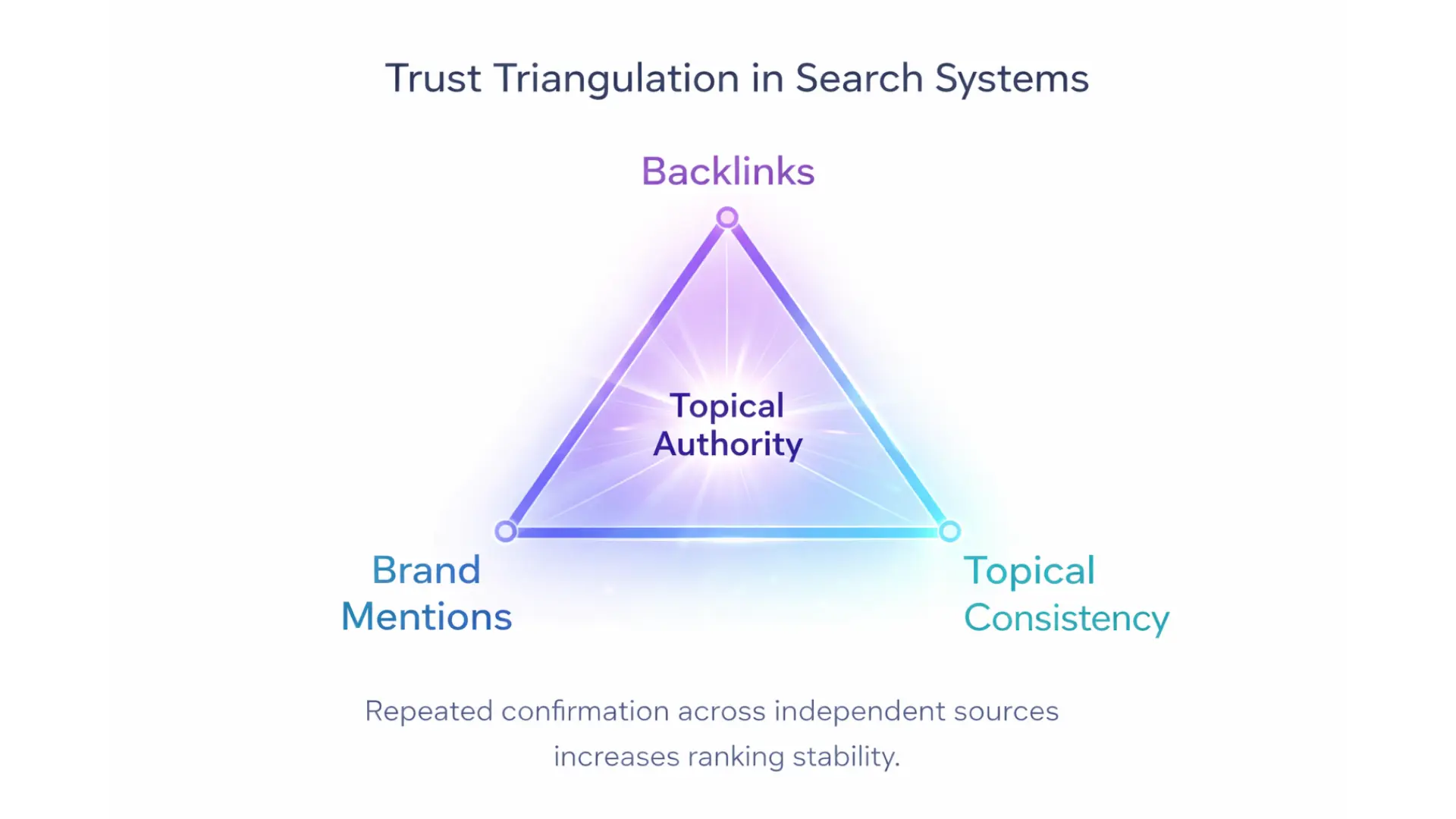
They compare multiple external signals and check whether they point to the same topical authority. When backlinks, mentions, and content themes reinforce each other, credibility compounds.
This is triangulation.
It means confirmation from different angles.
We saw this with a logistics client entering a new niche.
At first, they earned a few links from general business sites.
Rankings moved briefly, then stalled.
Six months later, they began appearing in supply chain roundups, podcast interviews, and trade association pages, all tied to the same keyword cluster.
Organic visibility for that niche grew 63 percent over nine months.
The difference was thematic consistency.
Signals aligned around a defined topic.
Search engines value patterns over spikes.
A sudden burst of links can look artificial.
A steady stream of relevant references builds historical confidence.
This is why time matters.
Authority accrues gradually when external signals reinforce each other without contradiction.
Picture three beams of light crossing at one point.
The intersection glows brighter.
That glow is perceived trust.
When multiple signals agree over time, rankings become harder to shake.

When off-page becomes decisive in ranking decisions
There is a threshold where relevance stops differentiating.
After that point, authority decides.
This happens in high-intent, competitive queries.
If five companies publish strong service pages targeting the same commercial keyword, technical quality quickly reaches parity. Word count, structure, and internal logic feel similar.
So what breaks the tie?
External trust density.
We worked with a legal services firm competing in a metro area.
Their service page was technically stronger than two higher-ranking competitors.
Yet those competitors had consistent citations from local business journals and bar association pages.
Once we secured three authoritative legal directory mentions and one regional publication feature over five months, rankings shifted from position 9 to position 3.
Inbound consultations increased 22 percent within the next quarter.
Nothing changed on-page.
The ranking decision flipped because authority signals crossed a credibility threshold.
Off-page becomes decisive when:
- Query intent is commercial
- Multiple pages satisfy relevance
- The system must minimize risk
In these scenarios, search engines prefer brands that appear repeatedly validated in the same topical or geographic context.
Think of it as a shortlist.
When everyone meets the baseline, the system chooses the safest option.
This explains why smaller firms struggle in established markets even with strong content.
They compete on clarity.
Their competitors compete on recognition.
Recognition wins more often.
But there is a catch.
If authority is manufactured instead of earned, the same systems that reward trust will eventually detect inconsistencies.
That is where manipulation begins to fail.

Why manipulation fails over time
Shortcuts can produce movement.
They rarely produce stability.
Search systems track patterns over time. They compare timing patterns, source relevance, and topical alignment to historical baselines across the web.
Artificial signals tend to cluster unnaturally.
You see spikes from unrelated sites, repeated phrasing, and links without any brand context.
The pattern feels manufactured, so the system discounts it.
We audited a SaaS company that purchased a large batch of backlinks through an agency. Rankings improved for three months. Then a core update rolled out. Traffic dropped 47 percent in two weeks, and recovery took close to a year of signal correction and reputation rebuilding.
The links were real.
The credibility was not.
Search engines do not penalize growth.
They penalize incoherence.
Earned signals accumulate gradually.
They come from topical proximity.
They match brand identity.
They persist.
Manufactured signals often lack narrative consistency. They do not appear alongside press mentions, expert commentary, or thematic reinforcement.
That mismatch weakens the trust model.
A simple analogy.
Imagine a resume filled with impressive references.
Now imagine every reference comes from unrelated industries with no connection to your field.
It raises suspicion.
Off-page authority works the same way.
Sustainable trust forms when external validation reflects genuine market presence. Anything else introduces risk into the ranking model.
And in competitive environments, systems prefer predictable sources over volatile ones.
External confirmation builds advantage.
Artificial noise erodes it.

Scientific context and sources
The sources below describe how search systems evaluate authority, link structure, entity relationships, and spam detection. They provide foundational context for the trust and external confirmation mechanisms described above.
- Link analysis and authority propagation
The PageRank Citation Ranking – Brin, S., Page, L. – Stanford University (1998)
Foundational paper introducing link graph analysis and weighted citation ranking, forming the theoretical basis for authority inference in search engines.
http://ilpubs.stanford.edu:8090/422/1/1999-66.pdf - Large-scale web search and probabilistic ranking
The Anatomy of a Large-Scale Hypertextual Web Search Engine – Brin, S., Page, L. – Computer Networks (1998)
Explains probabilistic ranking models, link structure evaluation, and large-scale indexing systems that underpin modern ranking architecture.
http://ilpubs.stanford.edu:8090/361/1/1998-8.pdf - Entity recognition and knowledge-based ranking
Introducing the Knowledge Graph – Singhal, A. – Google Research (2012)
Describes entity-based search, relationship mapping, and how search systems connect brands, concepts, and topics beyond simple keyword signals.
https://blog.google/products-and-platforms/products/search/introducing-knowledge-graph-things-not/ - Link spam detection and signal integrity
Spam Policies for Google Search – Google Search Central
Official documentation explaining how artificial link patterns and manipulative signals are identified and discounted.
https://developers.google.com/search/docs/essentials/spam-policies
Questions You Might Ponder
What is off-page SEO?
Off-page SEO refers to activities outside your website that help search engines judge your credibility and authority, such as backlinks, brand mentions, and external citations. These signals show that others reference and trust your content. Search engines use them to help rank pages when relevance alone isn’t enough to decide placement.
How are backlinks still important for SEO rankings?
Backlinks are references from other sites that signal trust to search engines. Quality and relevance matter more than sheer numbers — links from authoritative, topic-aligned sites carry greater influence. They act as third-party endorsements, helping search systems gauge credibility and improving your chances of ranking higher.
What is the difference between on-page and off-page SEO?
On-page SEO optimizes elements you control on your website, like content, HTML, and structure, to match search intent. Off-page SEO builds external trust, including backlinks and mentions, showing search engines that third parties value and reference your content. On-page gets crawled; off-page helps you rank when relevance ties exist.
Do brand mentions without links help SEO?
Yes. Brand mentions without links help search engines associate your brand with specific topics, reinforcing your authority and recognition across the web. These unlinked signals add to trust estimation, especially when they occur consistently in contextually relevant content, even if they don’t pass link equity directly.
Why do bought links or SEO manipulation eventually fail?
Search engines recognize unnatural patterns such as sudden spikes, irrelevant sources, or inconsistent link growth. These signals look artificial and fail to match organic credibility. Algorithms discount or devalue such signals over time, causing rankings to drop as search systems prioritize genuine, contextually consistent external validation.