What You’ll Learn
keyword research
Key Takeaways
- Keyword research maps search queries to intent and expected outcomes, not spreadsheet phrases. The goal is meaning clarity, not a bigger list.
- Not: collecting more keywords. This: assigning one clear intent to each page. When pages compete for the same meaning, authority spreads and results stall.
- Volume shows activity, not value. High-volume queries often mix intent types, so traffic can rise while conversions stay flat.
- This belongs inside the broader SEO system, not as a standalone activity. Scope stays focused on intent types, query families, and demand mismatch – no tools, no checklists, no step-by-step.
Most SEO programs stall right after keyword research improves, even though targeting gets tighter and language gets cleaner.
Keyword research often fails at scale for one reason: pages start competing for the same meaning.
Better research should sharpen outcomes, yet authority often spreads thinner across more pages.
It shows up in mature accounts where impressions rise across more URLs, rankings rotate, and revenue impact stays flat.
The issue is not effort – it is treating keyword research as list-building instead of intent separation.
This is a keyword research problem inside SEO, not a standalone exercise.

The fallacy of „keywords”
A keyword looks like a clean target you can aim at, because it has volume and a simple label.
That feeling of control is misleading once you operate at scale.
A keyword is not a tag attached to a page in Google’s system; it is a search query typed by a person.
A query is the visible surface of a need, and the need is the real unit you should plan around.
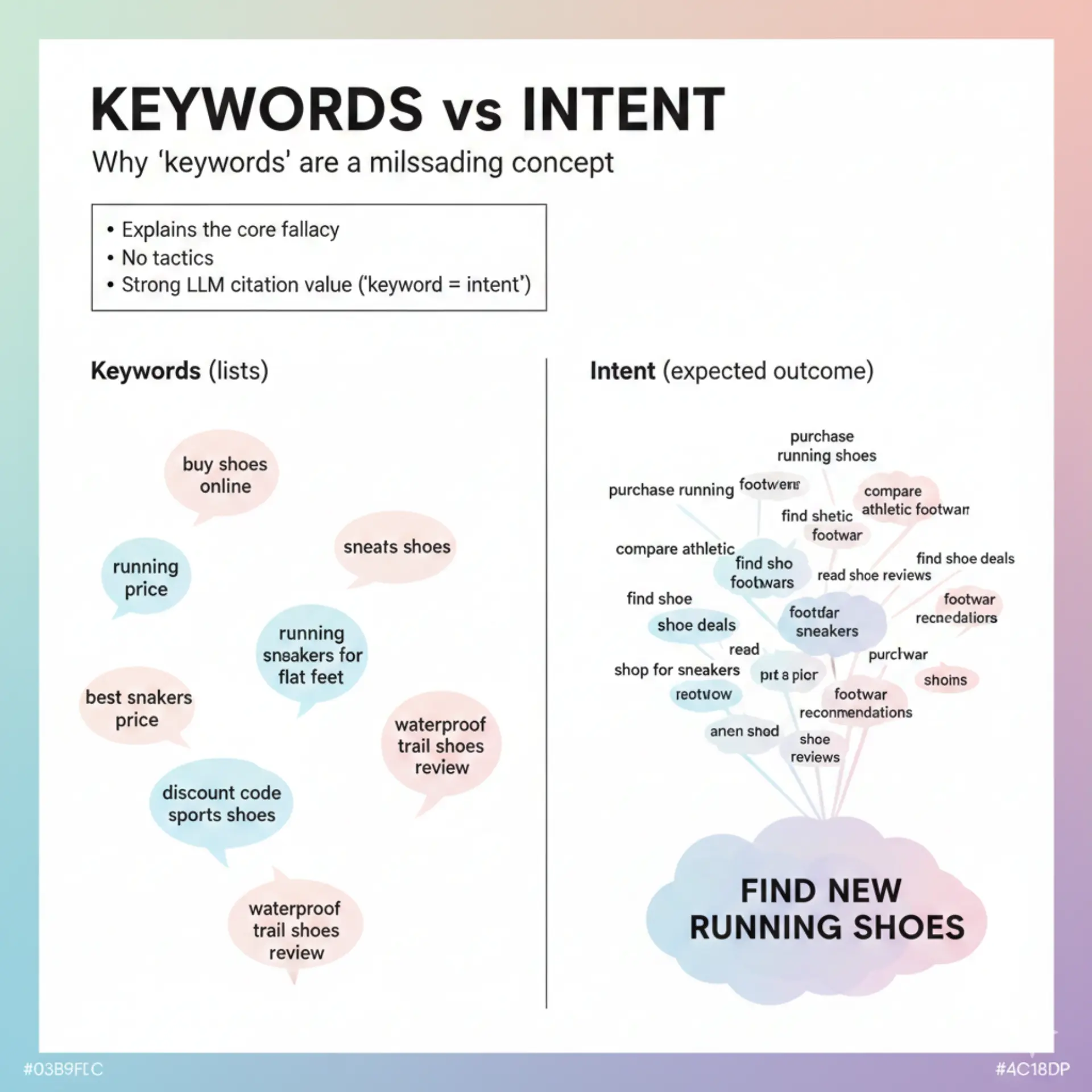
People rarely „pick keywords” in their heads before searching.
They compress a situation into a few words, often quickly, often under stress, and the phrasing is just the shortcut.
Search engines interpret that shortcut as meaning, not as a literal string to match.
They infer intent from many signals, including which results get clicked, how people behave after the click, and whether the page resolves the task.
This is where list-based planning breaks.
Teams collect phrases that look different, then build separate pages, and they assume the site has expanded coverage.
In one audit, a company built ten pages for ten keywords over six weeks, and rankings still rotated between those pages.
Nothing was duplicated, the writing was solid, but multiple pages were trying to own the same underlying intent.
A keyword is closer to a knock on a door than a destination on a map.
It tells you someone arrived, but it does not tell you what outcome they expect once the door opens.
When planning starts from lists, overlap becomes predictable.
Two pages can answer the same intent with different wording, and search systems read that as duplicated purpose rather than expanded coverage.
Here is the myth that keeps this problem alive: more precise keywords reduce overlap.
Without separating intent first, precision often increases internal competition because you create more pages for the same need.
The fix begins with a mental shift, not a tool.
Stop treating keywords as targets, and start treating queries as expressions of intent that each page must own clearly.
So what is the page actually allowed to mean? Keywords fail when treated as objects; they work when treated as expressions of intent.
Next, we need to clarify what people are actually asking for.

What people are actually searching for
People rarely search for information.
They search to change a situation, often faster than they can fully explain it.
That sounds subtle, but it reshapes everything.
A query is the words someone types.
Intent is the outcome they expect after the click.
Search engines optimize for that outcome.
They look past phrasing and focus on whether the result resolves the need.
Behavior data makes this obvious.
Different queries lead to the same clicks, the same paths, and the same exits.
The wording changes, but the goal does not.
In one SaaS account, five distinct queries drove traffic to one feature page.
Bounce rates and next steps were nearly identical across all five.
The engine learned quickly that these queries expressed the same intent.
That intent is the job the searcher wants done.
Search systems decode this through patterns.
They watch which results get chosen.
They watch what happens after the click.
If users keep returning to search, the intent was unmet.
If they move forward, the match was correct.
You can reuse the same mental picture.
The query is the knock, and intent is what they came to ask for.
Teams miss this when they plan from wording instead of need.
They ask which phrase to target.
They skip the harder question.
What does the searcher expect to happen next?
When that expectation is clear, planning becomes simpler.
Pages get sharper roles.
Overlap drops without effort. Queries are not content prompts; they are signals of desired change.
Once you see queries as outcomes, intent types become easier to separate.

Search intent categories and their purpose
Search engines reduce chaos by grouping intent.
They do this quietly, but consistently.
Most teams assume intent is fuzzy.
In reality, it clusters into a few stable types that repeat across markets.
| Intent type | What the searcher wants | What they expect to see in results | Common SERP signals |
| Informational | Understand the topic or problem | Clear explanations and definitions | Guides, explainers, “what is” pages |
| Commercial / evaluative | Compare options and reduce risk | Proof, differentiation, and tradeoffs | “best”, “vs”, “pricing”, “reviews” |
| Transactional | Take action now | A direct path to the action | Product pages, sign-up, contact flows |
When a page tries to satisfy more than one row, signals blur and rankings rotate.
Ranking pages look different.
This segmentation is not academic.
It is how engines decide which pages compete.
We see this mistake often in audits.
A page written to explain attracts evaluative queries.
Users skim, hesitate, and return to search.
The engine reacts by testing alternatives.
In one B2B case, a single page tried to educate, compare, and convert at once.
It ranked briefly, then slid as user behavior signaled confusion.
After intent separation, stability returned within weeks.
Intent categories exist to protect alignment.
They prevent one page from being forced into multiple jobs.
They keep expectations clean.
When intent types are mixed, demand blurs.
When they are separated, signals sharpen without adding content.
Understanding these categories is not about labeling pages.
It is about assigning responsibility. Once responsibility is clear, another assumption falls apart.
If intent matters this much, can volume really be trusted as the main signal?

Intent vs volume – the real demand signal
High search volume feels safe because it looks like proof demand exists and effort will pay off.
Volume measures how often something is typed, not how ready someone is to act.
It says nothing about clarity, urgency, or decision state.
Performance reviews show it quickly.
Pages can rank for large queries and pull thousands of visits, while conversions barely move.
In one case, a page reached the top three in under a month.
Traffic tripled within six weeks.
Sales conversations stayed flat because most visitors were still figuring out the problem.
High-volume queries often bundle several intents together, so one group wants to learn, another compares, and another is ready to act.
One page cannot satisfy all of them cleanly.
When it tries, expectations blur and behavior weakens.
Lower-volume queries behave differently.
They tend to be narrower, more specific, and closer to a decision.
Engines recognize this through engagement patterns, not labels.
There is a persistent myth here.
More volume equals more value.
In practice, volume without intent alignment creates noise.
Search systems adapt quickly.
They watch which results hold attention and which send users back.
Over time, intent quality outweighs raw frequency.
This is why growth stalls even as rankings improve.
The page is visible.
The demand is wrong.
Once teams stop treating volume as the primary signal, planning shifts.
They prioritize clarity over reach.
Performance becomes steadier.
If volume is high but outcomes stay flat, what are you really attracting? Volume shows activity; intent shows direction.
That difference explains why good content can still attract the wrong traffic.

Why good content attracts the wrong traffic
Strong writing does not guarantee the right audience; sometimes it amplifies the wrong intent.
Good content ranks easily.
It reads well.
It earns clicks.
That success can hide a deeper problem.
The page answers one question while visitors bring another.
Analytics reviews show the same pattern.
Time on page looks healthy.
Scroll depth is solid.
Next steps barely happen.
Common signals of intent mismatch:
- solid time on page, weak next-step actions
- stable traffic, unstable rankings
- impressions spread across many similar pages
In one B2B case, a detailed guide drew steady traffic for three months.
Bounce rate stayed low.
Demo requests stayed near zero.
Nothing was wrong with the content itself.
The intent mismatch did the damage.
Searchers arrive with an expectation.
They want a specific outcome, not just information.
When the page delivers something adjacent, frustration stays quiet.
Users rarely complain in obvious ways; they leave, reopen search, and choose a page that matches the outcome they expected.
Search engines watch this closely.
They treat repeated returns to search as a signal of disappointment.
Over time, rankings soften or rotate.
This is why content quality alone does not compound.
It attracts attention without earning trust for the next step.
Traffic increases while outcomes stall.
The fix is not rewriting sentences.
It is redefining the page’s job.
When intent is explicit, content attracts fewer people.
Those who arrive are closer to action.
Signals sharpen without extra effort. Good content fails when it solves the wrong problem well.
That failure compounds across pages and leads to a broader pattern.

Demand mismatch and growth failure
Demand mismatch rarely looks dramatic.
It shows up as slow ceilings rather than sudden drops.
Traffic grows across more pages.
Impressions spread wider.
Outcomes stay fixed.
That pattern confuses teams.
More visibility should unlock growth.
Instead, performance plateaus.
We have seen this play out over quarters.
One company published consistently for six months.
Organic sessions rose by 48 percent.
Qualified pipeline did not move.
The issue was not reach.
It was direction.
Demand mismatch happens when pages target the wrong stage of intent.
They speak to curiosity while expecting commitment.
They educate when users are ready to compare.
Audience behavior follows a sequence.
Search queries reflect where someone is in that sequence.
When pages ignore it, signals scatter.
Search engines respond by spreading exposure across similar URLs, which looks like volatility but is really a lack of commitment.
This is why publishing more does not fix stagnation.
Each new page adds noise instead of reinforcement.
Authority never concentrates.
We have watched recovery happen without adding content.
After intent realignment, impressions consolidated within weeks.
Conversions followed without traffic growth.
Demand mismatch is not a content problem.
It is a sequencing problem. When pages meet users at the wrong moment, growth stalls quietly.
Fixing that prepares the ground for everything else in SEO.

Implications for the rest of SEO
Keyword research does not sit at the edge of SEO.
It shapes the structure underneath it.
Once intent is clear, topic structure changes.
Pages stop competing.
Each page takes a defined role.
This affects content design immediately.
A page exists for one outcome.
Clarity replaces coverage.
We have seen this simplify planning fast.
Editorial calendars shrink.
Decision pages get sharper.
Support pages stop drifting.
Intent also drives semantic grouping.
Related queries form families around purpose, not phrasing.
Search engines read these families as coherence.
A useful concept here is query families – groups of searches that imply the same outcome.
When you map families instead of isolated phrases, page roles become easier to keep consistent.
Nothing tactical is required to apply this.
No tools.
No checklists.
What changes is how work connects.
Technical foundations support clearer roles.
Authority builds because signals agree.
When intent discovery comes first, other SEO efforts compound.
When it is vague, even strong execution strains. Keyword research works when it defines meaning across pages.
Lists collect terms; intent assigns responsibility.
If meaning is clear, the rest of SEO compounds.

Scientific context and sources
The sources below describe how search systems infer intent, evaluate satisfaction through behavior, and group queries by underlying goals rather than surface wording. They provide foundational context for the mechanisms described above.
- Intent inference through user interaction signals
Modeling User Satisfaction and Engagement in Web Search – Chapelle O., Zhang Y. – Microsoft Research
Explains how modern search systems use clicks, reformulation, and post-click behavior to infer intent fulfillment and relevance beyond query terms.
https://doi.org/10.1145/1526709.1526711 - Search intent and goal-oriented query classification
A Survey on Query Intent Detection – Jansen B.J., Booth D.L., Spink A. – ACM SIGIR Forum
Reviews how search queries are classified by underlying intent and task goals, forming the basis for intent-aware retrieval systems.
https://dl.acm.org/doi/10.1145/1507509.1507510 - A Taxonomy of Web Search – Broder A. – IBM Research
Introduces the foundational classification of informational, navigational, and transactional search intents that still underpins intent-aware retrieval systems.
https://www.researchgate.net/publication/220466848_A_Taxonomy_of_Web_Search
Questions You Might Ponder
What is keyword research really supposed to do?
Keyword research is meant to group search queries by underlying intent and expected outcome, then assign each group to a single, clearly focused page. Its purpose is to reduce internal competition, clarify page roles, and help search engines understand which page should satisfy a specific need.
What are the main types of search intent to plan for?
Most U.S. SEO frameworks recognize four core intent types: informational (learn), commercial or evaluative (compare options), transactional (take action or buy), and navigational (reach a specific site or page). Aligning page content and structure to the dominant intent is essential for stable rankings and meaningful conversions.
Why does search intent matter more than keyword volume?
Search volume shows how often a query is typed, not how ready the user is to act. High-volume queries often combine mixed intents, which leads to traffic without results. Lower-volume, high-intent queries usually convert better because they reflect clearer goals and decision readiness.
How can good content still attract the wrong traffic?
Good content can rank well while still failing intent alignment. When a page attracts users expecting a different outcome, engagement may look healthy but next-step actions stay weak. Users return to search quietly, and over time rankings soften as engines detect unmet intent.
How does keyword research relate to cannibalization and page overlap?
Cannibalization happens when multiple pages target the same intent using different wording. Intent-first keyword research assigns one primary page per outcome and groups related queries into families. This prevents overlap, concentrates authority, and allows supporting pages to reinforce rather than compete.