What You’ll Learn
brand authority seo
Key Takeaways
- Brand authority SEO is uncertainty reduction – it helps search systems confirm who you are and decide you are safe to rank, beyond page quality alone.
- It changes rankings through eligibility, scrutiny, and tie-breaks – stronger brand authority SEO gets you into harder queries, lowers evaluation friction, and wins when relevance is similar.
- It is not branding or a backlink score – brand authority SEO comes from consistent entity signals across the web (identity, third-party confirmation, demand signals), not logos or „authority metrics”.
- Diagnose it when good pages stall – if crawl and intent are fine but rankings cap or swing, treat it as a trust constraint that becomes stricter in higher-risk topics.
A smaller site can publish a better page and still lose.
It is rarely the content.
The system hesitates when it cannot confirm the source.
Brand authority in search is the reduction of uncertainty about who you are and whether you are safe to rank.
It is not popularity.
It is not a logo.
It is not visual identity.
It changes three things in search:
- Your eligibility for competitive queries
- The level of scrutiny applied to your pages
- Who wins when relevance is similar
It does not fix crawl issues.
It does not replace topic clarity.
It does not override intent mismatch.
Not: brand awareness campaigns.
Instead: consistent external confirmation of a recognizable entity.
On the main SEO capability page, we define SEO as discovery, matching, and trust. This page isolates one layer of that trust.
We are not going to discuss branding tactics.
This is about how search systems reduce risk, not how to craft brand messaging.
We are going to explain the mechanism.
Over the past three years, we have seen this pattern repeatedly. A client improves structure, intent alignment, and technical hygiene. Rankings move from position 48 to 14 in 90 days. Then they stall. Meanwhile, a recognized competitor with thinner pages holds position 3 without volatility.
The difference is rarely the page.
It is the perceived safety of the entity behind it.
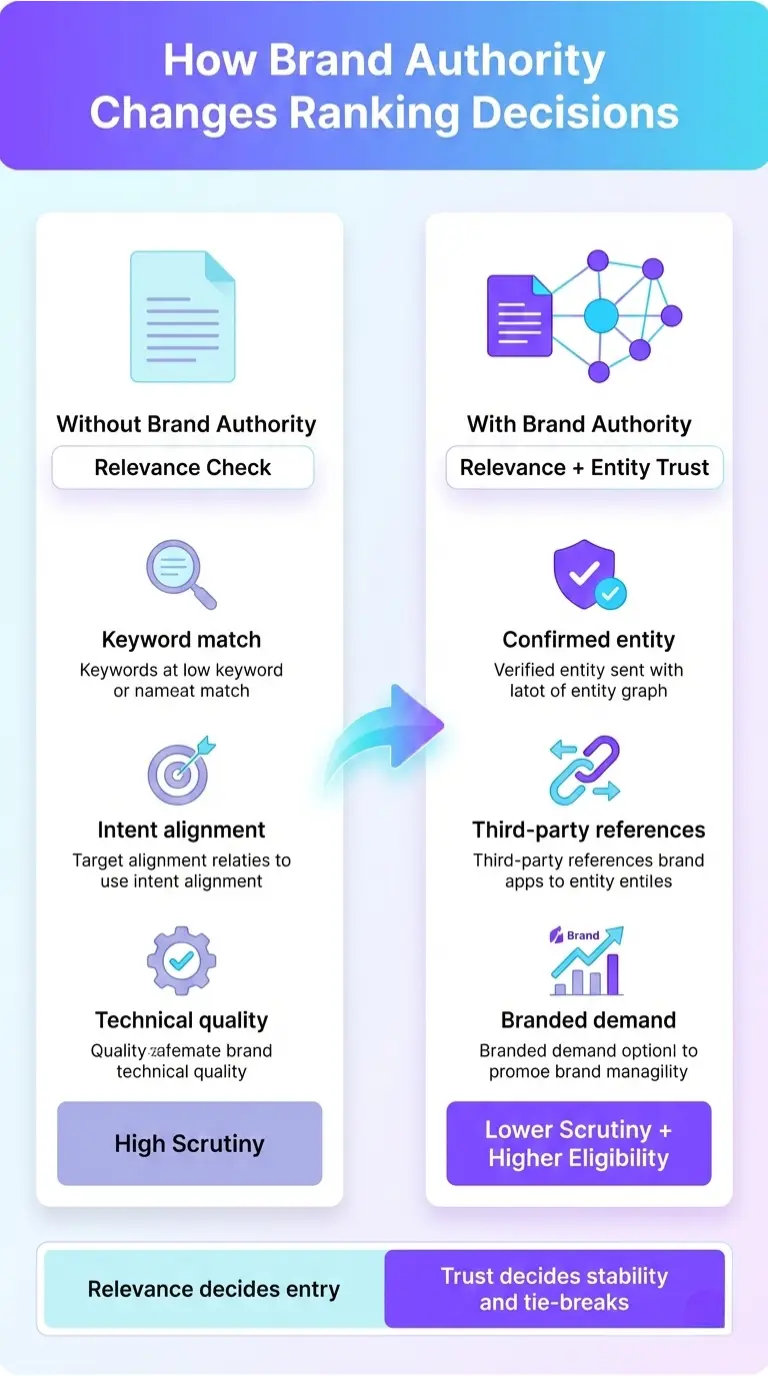
If you feel like your pages are „good enough” but still lose, this is likely the missing layer.
Is this really about the page, or about the source?
Brand authority lowers uncertainty about the source.
That single shift changes how your pages are judged.

Why Search Systems Prefer Certainty
Search ranking is a risk decision.
Every result shown is a bet.
A bet that the source is accurate.
A bet that users will not be disappointed.
A bet that the answer will not create harm.
Relevance gets you into consideration.
Certainty decides if you stay visible.
Modern ranking systems work like risk filters. They estimate probability of satisfaction based on signals, history, and consistency.
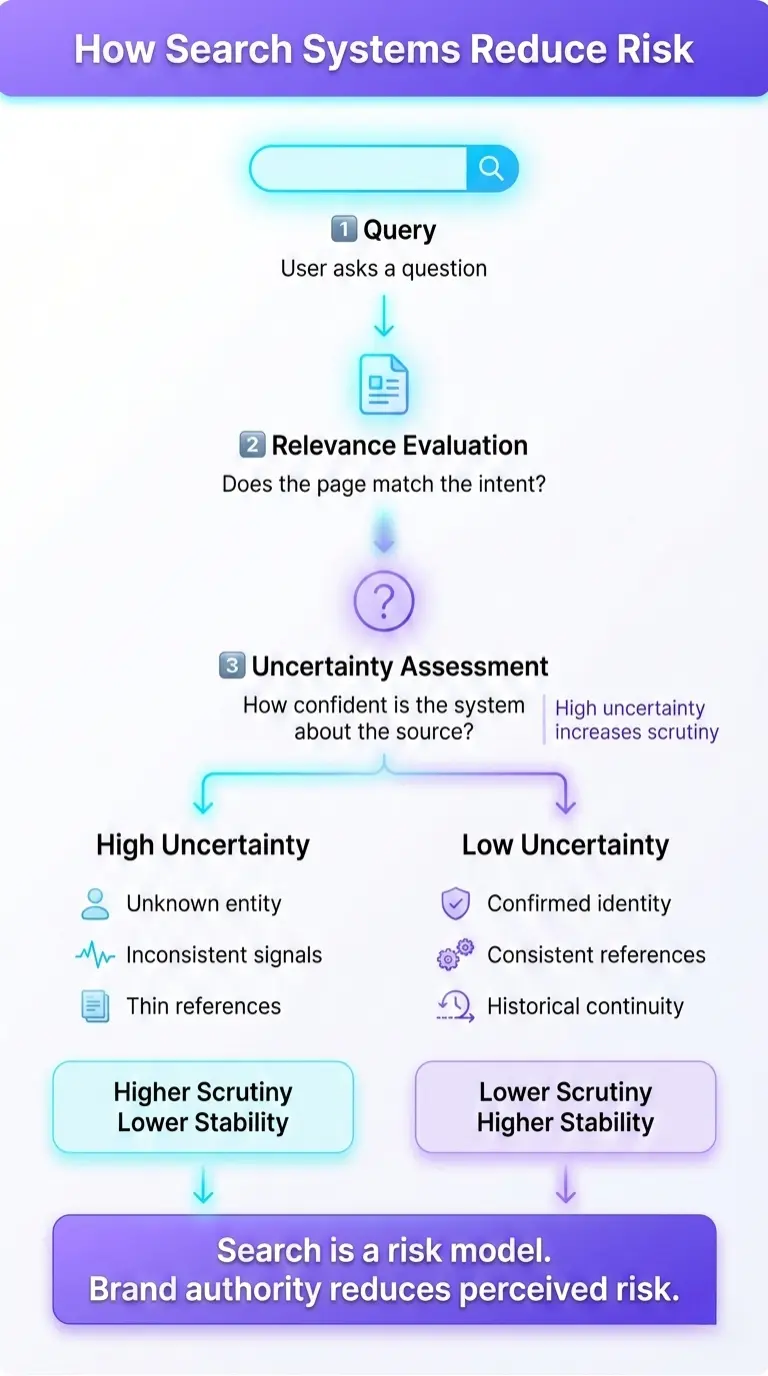
That estimation process is statistical, so it works in probabilities.
When probabilities are messy, scrutiny increases.
Where does that uncertainty come from?
- An unknown publisher with no history
- Inconsistent signals across the web
- Thin third-party references
- Sudden spikes in visibility without context
We once worked with a SaaS firm entering a competitive category. Technically strong site. Clear value. Strong UX. Yet rankings for core commercial queries hovered between 11 and 18 for six months.
Competitors had similar content depth.
But they had ten years of citations, brand searches, and conference mentions.
The algorithm did not „like them more”.
It trusted them more.
And trust lowers perceived risk.
This effect becomes stronger when results are summarized by AI systems. When answers are synthesized, not just listed, systems lean toward sources that are stable, recognizable, and historically consistent.
The more abstract the query, the higher the uncertainty.
And when uncertainty rises, familiarity wins.
Imagine that two identical reports sit on a table. Which one do you quote in a board meeting?
Search engines make the same choice.
Certainty reduces friction.
Reduced friction increases visibility.
Ranking systems reward sources that feel safer to show.
So the next question is simple: what counts as a ‘brand’ to the system?

What „Brand” Means to an Algorithm
To an algorithm, a brand is an entity.
An entity is a clearly identifiable „who”.
It is not a slogan.
It is not a campaign.
It is a consistent, recognized source across contexts.
Search systems build entity graphs (think of them as identity maps).
A graph is a network of connected facts.
Each node represents a known object, company, or person.
If your company appears in multiple reliable contexts with the same identity, that identity becomes easier to confirm.
That confirmation reduces uncertainty.
In practice, brand evidence falls into four signal groups:
- Entity consistency – same name, same domain, same associations across platforms
- Third-party confirmation – mentions, citations, references outside your site
- Link-based authority – contextual links that associate you with a topic
- Demand signals – users searching your name and returning directly
These signals do not work alone.
They reinforce each other.
We saw this clearly with a B2B services client. Their backlinks were average. Nothing impressive. Yet their branded search volume doubled within 12 months after repeated podcast appearances and partner integrations.
Their non-branded rankings rose 18% during the same period.
The site structure did not change.
The entity did.
Here is the myth: brand authority is just domain authority with better PR.
That is incorrect.
Domain authority is a third-party metric.
Brand authority is an inferred trust state.
Brand authority = how safe the source feels.
Domain authority = link strength signals.
Topical authority = depth and consistency on a subject.
| Term | What it is | What it changes in rankings |
| Brand authority | Entity recognition + trust context | Scrutiny level, tie-breaks, eligibility |
| Domain authority | Link-based strength signals | Ability to compete on authority-weighted queries |
| Topical authority | Coverage depth and consistency | Relevance confidence within a topic set |
One measures link strength.
The other estimates recognition and reliability across contexts.
They overlap.
They are not the same.
When systems detect stable identity, consistent references, and repeat user behavior, the entity becomes easier to rank because it is easier to trust.
Brand authority is not a popularity contest.
It is a consistency pattern.
To the system, a brand is a confirmed entity.
Now let’s look at how consistency compounds.

How Consistency Builds Authority
Authority compounds quietly.
It does not spike.
It accumulates.
Search systems compare signals over time. They look for patterns that repeat without contradiction.
When the same entity appears in multiple trusted places with aligned descriptions, the probability of authenticity increases.
That probability shift is small.
But it stacks.
We worked with a consulting firm that rebranded three times in five years. Three names. Two domains. Mixed citations. Old interviews under a previous identity.
Rankings never stabilized.
After consolidating naming, updating third-party references, and aligning profiles across 40+ surfaces, volatility dropped within four months. Core rankings improved 12-15% without new content.
Nothing new was published.
Contradictions were removed.
Consistency works like interest on a deposit. Small confirmations accrue over time, and the balance grows without dramatic moves.
Three forces drive this accumulation:
- Cross-signal reinforcement
- Absence of contradiction
- Historical continuity
Cross-signal reinforcement means independent confirmations point to the same entity. If a company is referenced by partners, events, industry databases, and users in similar language, those signals amplify each other.
Absence of contradiction is equally powerful. Mixed branding, outdated claims, or inconsistent positioning introduce friction. Friction increases scrutiny.
History lowers friction.
Time itself becomes a signal when behavior remains stable. A five-year track record of coherent presence is harder to fake than a six-month spike.
Consistency is quiet proof.
Consistency becomes proof the system can reuse.
Now let’s look at what happens without that proof.

Why Unknown Sites Face Higher Scrutiny
Unknown does not mean low quality.
It means unproven.
Search systems apply a higher proof threshold when the entity lacks history, references, or recognizable signals.
The content may be strong.
The intent may be correct.
The technical setup may be clean.
Still, the scrutiny level is higher.
Think of it as credit scoring. A borrower with a ten-year repayment history gets approval faster than a new applicant, even if income is similar.
The same dynamic applies here.
We saw this with a fintech startup entering a regulated niche. Their product page was clearer than the market leader’s. Faster load time. Better UX. Stronger data tables.
Yet they hovered on page two for nine months.
Why?
Because the system had limited evidence about them.
Unknown sites usually face four friction points:
- Inconsistent naming or fragmented identity
- Weak third-party footprint
- Content that resembles many others
- Claims that lack external corroboration
None of these mean the business is weak.
They mean the system cannot confirm stability.
Higher scrutiny means slower ranking gains. It also means greater volatility during updates, because thin entities are easier to reassess.
This is often misread as „algorithm penalty”.
In reality, it is insufficient certainty.
Once external confirmation and historical consistency improved, that same fintech client moved from positions 14-18 to top 5 within three update cycles.
The page did not change.
The entity did.
Unknown entities must prove more.
And proof requires coherence across signals.
Unknown sources can rank, but scrutiny is higher.
Then trust breaks the tie.

When Brand Outweighs Page Quality
There are moments when the better page loses.
Two pages match intent.
Both are technically sound.
Both answer the question clearly.
Yet the stronger brand ranks higher.
This usually happens in tie-break situations.
When two sources look equal, the known entity wins.
Relevance is similar, so the system leans on trust signals to reduce risk.
That preference is subtle.
But it is measurable.
We tested this with a B2B software client competing against an established vendor. Content depth was comparable. Word count within 5%. Internal linking equalized. Page speed optimized.
Still, the established brand ranked above them across 23 commercial keywords.
Click-through rates were also higher for the known name, even when positioned second.
User behavior reinforced the authority signal.
Another pattern appears in higher-risk queries. Financial advice. Health topics. Legal guidance. The system favors recognizable entities because the cost of error is higher.
Perceived safety increases weight.
Here is the myth: better content always wins.
It does not.
Better content wins when trust is equal.
When trust is unequal, trust often prevails.
Imagine two restaurants side by side. Both have similar menus. One is familiar and has been there for years. The other opened last month. Even with better plating, the new one receives fewer reservations.
Search systems mirror that behavior.
Brand strength can offset minor page flaws. It does not excuse weak relevance, but it can tilt close decisions.
When rankings feel unfair, it is often a trust imbalance.
When relevance is close, trust often decides.
Next, we’ll make the diagnosis observable.

Diagnosing a Brand-Authority Problem
Sometimes the issue is not your content.
It is your perceived credibility.
The challenge is separating brand weakness from technical or intent problems without guessing.
Look at patterns, not isolated keywords.
If your pages improve in quality yet stall between positions 8 and 18 across competitive queries, that is a signal. If competitors with similar depth hold stable top positions, that is another signal.
Volatility after updates can also reveal it.
We worked with a mid-market B2B firm whose rankings improved after every content refresh, then slipped back within weeks. The technical layer was sound. Internal links were clean. Search Console showed strong impressions.
The missing layer was external confirmation.
Another indicator is weak lift from on-page optimization. If title rewrites, structured data, and content upgrades move lower-volume queries but fail to move core commercial terms, the constraint is likely authority.
Brand authority is the constraint when good pages keep stalling.
Now eliminate what it is not:
- Not a crawl or indexation issue
- Not an intent mismatch
- Not simply „publish more”
If relevance is strong but rankings stall, suspect trust.
If rankings move but won’t hold, suspect fragility.
If signals exist but don’t connect, suspect entity confusion.
If those are clean, and the ceiling persists, you are likely facing a trust deficit.
Treat contradictory signals as fragility.
Treat absent signals as authority gaps.
Treat disconnected signals as entity confusion.
One useful lens here is the E-E-A-T framework. It is shorthand for Experience, Expertise, Authoritativeness, and Trustworthiness. It is not a scoring metric. It is a pattern recognition model.
When external proof is thin, the model cannot confirm reliability.
And without confirmation, visibility caps.
Brand authority issues feel invisible. But the symptoms are consistent.
A trust ceiling shows up as repeatable patterns.
Next, we’ll measure patterns without chasing one number.

How to Measure Brand Authority Without Turning It Into a Vanity Metric
Brand authority is inferred.
It is not a single number.
If someone shows you one score and calls it authority, that is a shortcut.
You need signal clusters.
Four measurement categories give a realistic picture:
- Recognition
Are people searching your brand name directly?
Is branded query volume rising over 6-12 months?
In one SaaS case, branded searches increased 42% year over year. Non-branded commercial rankings improved 17% during the same period, without major content expansion.
Demand preceded visibility.
- Confirmation
How often are you mentioned by third parties in relevant contexts?
Are those mentions coherent and topically aligned?
Mentions from unrelated directories add little. Contextual references from industry sources shift perception more.
- Stability
Do your rankings hold during core updates?
Or do they swing heavily each quarter?
Stability signals accumulated trust. Volatility often signals thin entity strength.
- Conversion confidence
Are users returning directly?
Is direct traffic rising?
Are assisted conversions increasing in multi-touch paths?
These behavioral patterns reinforce entity recognition.
Now the trap.
Do not over-trust third-party „authority scores”.
They are proxies.
They are not the algorithm.
A site can have a high link-based score and still lack coherent entity signals. We have seen domains with strong backlink profiles struggle because brand demand was flat and external references were fragmented.
Authority is multi-signal.
Imagine looking at a medical diagnosis through one lab test. You would not make a decision from a single number.
Search systems do not either.
Measure patterns over time.
Look for coherence across categories.
Authority shows up as patterns across multiple signals.
Now look at what changes in sensitive topics.

Where Trust Rules Tighten
In some queries, the tolerance for uncertainty drops sharply.
Health advice.
Financial decisions.
Legal exposure.
When the cost of misinformation rises, ranking systems become more conservative.
The weighting shifts.
External corroboration carries more influence.
Historical stability matters more.
Reputation signals are examined more closely.
We observed this with a client entering a medically adjacent space. Their educational content ranked well for low-risk queries. But when targeting high-intent treatment comparisons, visibility stalled despite strong on-page quality.
The barrier was not structure.
It was trust sensitivity.
When topics carry potential harm, systems demand stronger confirmation that the source is reliable and consistent over time. The entity must be clearly recognized, externally validated, and historically stable.
The same pattern appears in finance.
One fintech brand saw stable rankings for informational queries, yet struggled for transactional keywords tied to compliance-heavy topics. Once third-party references, certifications, and public profiles were unified and clarified, performance improved within two update cycles.
Stricter contexts amplify scrutiny.
Brand authority becomes more decisive.
If your market touches regulated or high-risk areas, the rules tighten. And when trust rules become stricter, the ranking threshold shifts from competitive to conservative.
Brand authority reduces uncertainty.
In sensitive contexts, that reduction determines eligibility.

Scientific context and sources
The sources below provide foundational context on probabilistic ranking, entity-based retrieval, and how modern search systems evaluate trust and uncertainty at scale.
- Probabilistic ranking and uncertainty modeling
Robertson, S. – „The Probability Ranking Principle in IR” – Journal of Documentation (1977)
Introduces the probability ranking principle, explaining how information retrieval systems rank results based on estimated likelihood of relevance under uncertainty.
https://doi.org/10.1108/eb026647 - Learning-to-rank systems in modern search
Liu, T.-Y. – „Learning to Rank for Information Retrieval” – Foundations and Trends in Information Retrieval
Describes how ranking systems use machine learning to estimate document quality, relevance, and confidence signals across large datasets.
https://www.microsoft.com/en-us/research/project/letor-learning-rank-information-retrieval/ - Entity-based retrieval and knowledge representation
Dong, X. et al. – „Knowledge Vault: A Web-Scale Approach to Probabilistic Knowledge Fusion” – KDD (Google Research)
Explains how large-scale systems infer entity relationships and confidence levels from multiple independent sources.
https://research.google/pubs/pub45634/ - Evaluating trust and quality signals in search
Search Quality Rater Guidelines – Google
Describes how expertise, authoritativeness, and trustworthiness are evaluated in search quality assessment processes.
https://developers.google.com/search/blog/2023/11/search-quality-rater-guidelines-update
Questions You Might Ponder
What is brand authority in SEO terms?
Brand authority in SEO refers to how confidently search systems can identify and trust your entity across the web. It is built through consistent identity signals, relevant third-party mentions, branded search demand, and historical stability. It reduces uncertainty, which lowers scrutiny and increases ranking eligibility for competitive queries.
Why do big or well-known brands rank higher even with weaker content?
Large brands accumulate long-term signals: citations, backlinks, branded searches, media mentions, and stable engagement patterns. When multiple pages satisfy intent equally, search engines reduce risk by favoring the entity with stronger historical confirmation. In tie-break situations, entity trust often outweighs marginal content differences.
How is brand authority different from domain authority and topical authority?
Brand authority reflects trust in the entity across contexts. Domain authority summarizes link-based strength. Topical authority measures depth and consistency within a subject cluster. A site may have strong backlinks but weak entity recognition, or deep topical coverage without broader brand trust signals.
How can I tell if stalled rankings are a brand authority problem?
Common indicators include pages stuck in positions 8-20 despite strong technical SEO, clean intent alignment, and content improvements. Rankings may rise temporarily but fail to hold. Competitors with thinner content remain stable. This pattern often signals a trust ceiling rather than a relevance issue.
How do you build brand authority for SEO without chasing vanity metrics?
Build consistent entity signals across platforms, maintain stable naming and profiles, earn contextual mentions from relevant publications, strengthen E-E-A-T indicators, and grow branded search demand. Measure patterns in recognition, confirmation, and stability instead of relying on a single „authority” score.