What You’ll Learn
why are cpcs increasing
Key Takeaways
- Why are CPCs increasing? Because PPC is an auction for limited intent, and the market keeps re-pricing access based on who else wants the same clicks.
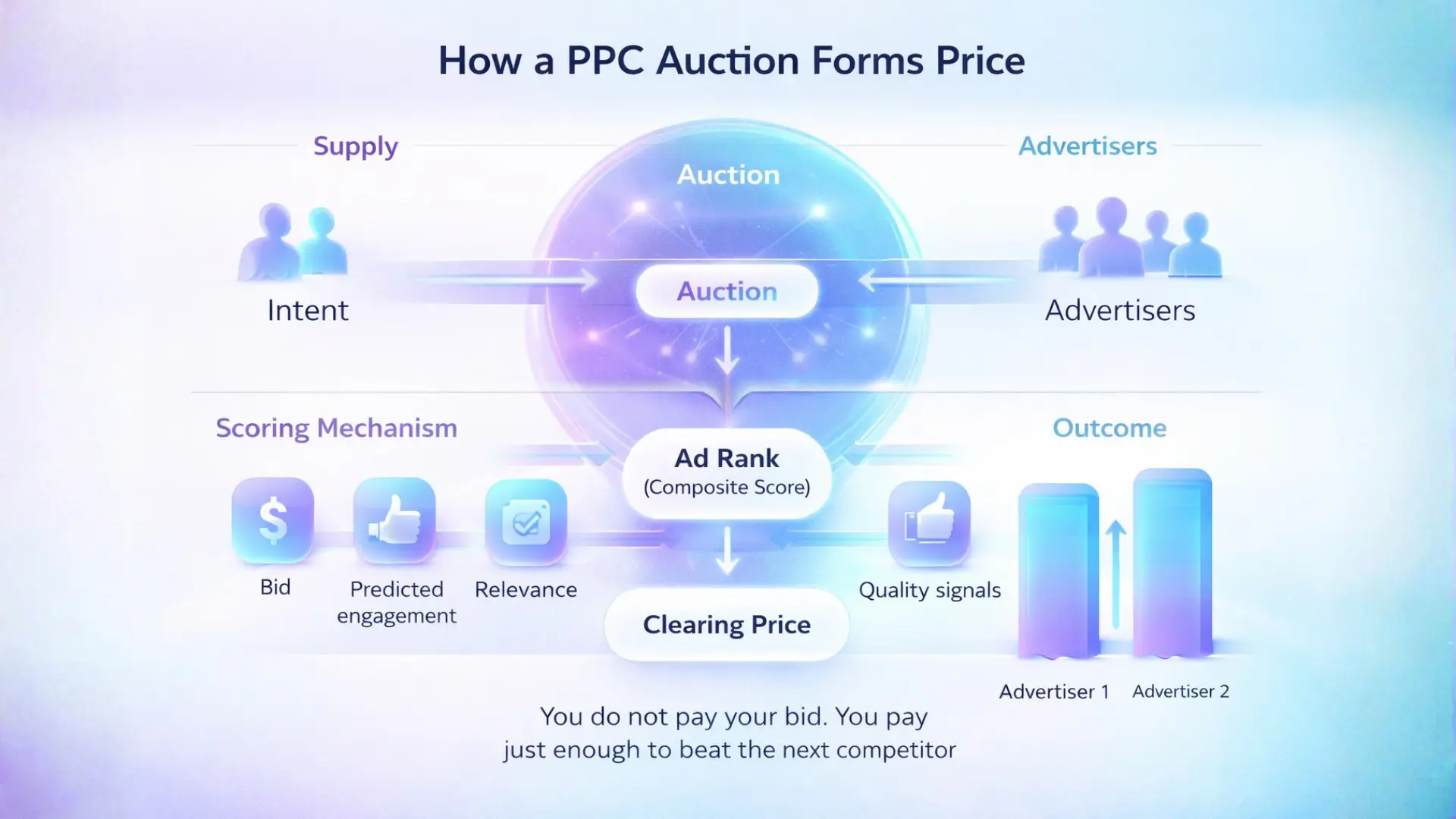
- Your bid is not the price. Most platforms use Ad Rank-style scoring and second-price logic, so you usually pay the clearing price – just enough to beat the next competitor.
- Scaling makes the math harder. As spend grows, you move from the best intent pockets to weaker ones, so conversion rate often drops before volume rises and costs rise faster than results.
- Many cost spikes are structural, not mistakes. Rising CPC often comes from three drivers: competition density, platform scoring changes, or shrinking click supply (fewer ad slots/clicks), even when your account “changed nothing”.
Paid traffic can get more expensive when competitors spend less.
That sounds backwards.
It’s a normal outcome in an auction.
That’s often the real reason ads feel “more expensive” month over month.
A PPC auction is a real-time market that allocates access to limited intent.
Each time someone searches or scrolls, the system runs a quick contest for attention.
The “cost” most teams feel first is cost per click (CPC) – the amount you pay when someone clicks.
That cost is determined by competition for intent, not by your bid alone.
That’s why cost per click can rise even when you “changed nothing”.
In other words: you don’t set a price; you enter a competition that keeps re-pricing access.
If you want the full system view, it lives in our PPC & Paid Media capability.
This spoke zooms in on one layer: how the price is formed.
Quick definitions for clarity:
- Cost per click: what you pay when someone clicks.
- Auction: the real-time system that allocates attention.
- Clearing price: the minimum you must pay to win your position.
- Price discovery: the market constantly recalculating the price of access.
This page is not about running campaigns.
It is about why paid prices move, even when your account does not.
It does not cover bidding strategies, platform setup, or “how to lower costs”.
It explains how auctions form price and why scaling changes the math.
Imagine one empty taxi in heavy rain.
Ten people step off the curb at once, and the price “moves” without anyone negotiating.
That’s what your ads enter.
And once you see it, cost shifts stop feeling personal.
Auctions decide access first; price comes after. Next, we show how the price is set.

Auction mechanics – how pricing is determined
You can raise your bid and still lose position.
And you can keep bids flat and pay more.
That’s the part people don’t expect.
An auction is an allocation system.
It assigns limited attention to competing advertisers.
Supply is intent in the moment.
Demand is everyone chasing it.
Every search opens a tiny contest.
A few ads enter the screen.
Most never appear.
Here’s where pricing actually forms.
The platform computes a combined score, often called Ad Rank.
Ad Rank is a composite score that blends bid with predicted response and relevance.
Plain version: it estimates how likely the user is to engage.
It also estimates how much you’re willing to pay.
That score decides order.
Order decides who gets seen.
Now the counter-intuitive part.
Most large ad platforms behave like a second-price model.
In practice, platforms use variants, but the idea is consistent: you rarely pay your full bid.
You don’t pay your bid; you pay just enough to beat the next advertiser.
Your bid is a ceiling.
The auction is the cashier.
We saw this with an industrial supplier last year.
They lifted bids 20% in one segment for four weeks.
Average click cost rose only 6%.
Competitors weren’t pushing the floor, so the clearing price barely moved.
Then we saw the inverse in a B2B services account.
No bid changes for 60 days.
Click cost climbed 18% anyway.
One new entrant improved predicted engagement and raised the effective price floor for that intent pocket.
This is price discovery.
It means the market keeps recalculating what access costs.
The clearing price is a market outcome. Next, we define what makes competition dense.

Competition density and marginal cost
Costs often rise because you improved.
When your ads get better, you qualify for more auctions.
That can push you into hotter competition.
Competition density is the number of advertisers chasing the same intent at the same time.
The denser the room, the more you pay to stay visible.
This is where scaling starts to feel “unfair”.
It isn’t unfair. It’s arithmetic.
At lower spend, you buy the easiest access first.
At higher spend, you must buy the next layer.
That’s marginal cost.
Marginal cost is the price of the next unit of volume.
In auctions, it usually rises as you expand.
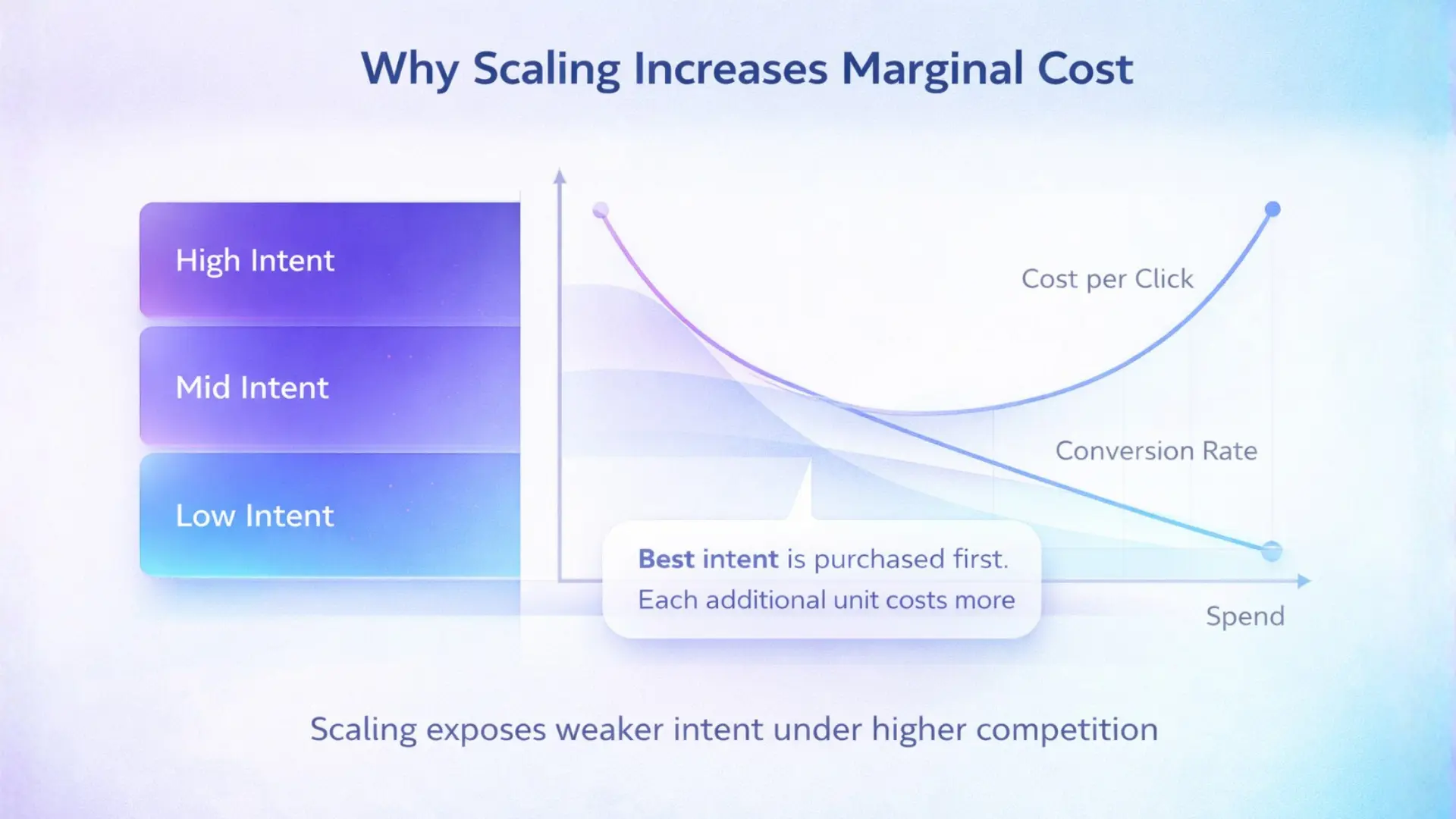
We saw this with a SaaS team scaling from €40k to €90k in 90 days.
Lead volume rose 52%, but cost per lead rose 31% in the same window.
The team assumed targeting “broke”.
What changed was the room: more overlap, more bidders, more expensive intent.
Here’s a simple picture.
Imagine a quiet restaurant with two tables left.
At 6pm, you can walk in.
At 7pm, you need a reservation.
At 8pm, you pay a premium tasting menu or you don’t get in.
Same restaurant.
Different density.
Have you ever increased budget and felt results flatten anyway?
That’s often marginal cost rising faster than volume.
Crowding increases the cost of the next unit of volume. Next, we cover outside forces that shift prices without your input.

External forces – platform incentives & market conditions
Costs can rise when competitors disappear.
That feels impossible.
It happens when the auction gets more selective.
Platforms don’t just “show ads”.
They run prediction systems that decide which ads deserve access.
When those prediction systems improve, weak ads drop out faster.
What’s left is a smaller set of stronger competitors.
A smaller field with stronger players can cost more.
Even if “competition” looks lower on paper.
We saw this in a healthcare account last year.
No structural changes were made for six weeks.
Same budget.
Same targeting.
Same creative.
Click cost increased 14% in that window.
Auction overlap showed fewer active advertisers, not more.
The difference was quality.
The remaining ads had higher predicted engagement, so the clearing price moved up.
Now add the economy.
When capital is cheap, more bidders flood in.
When markets tighten, weaker bidders pause.
But the strongest often push harder.
That’s when costs rise during “slow” periods.
In one B2B case, a client reduced spend 18% in a cautious quarter.
Two competitors increased budgets by over 20% in the same period.
Costs rose anyway.
The auction didn’t calm down. It hardened.
Then supply shifts.
If the page shows fewer ad slots, inventory shrinks.
If AI summaries absorb clicks, fewer clicks remain to compete over.
Less supply with steady demand raises the clearing price.
It’s the same physics as traffic narrowing into one lane.
So when costs move, don’t start with blame.
Start with a diagnostic question.
“Did the competitive set change without us noticing?”
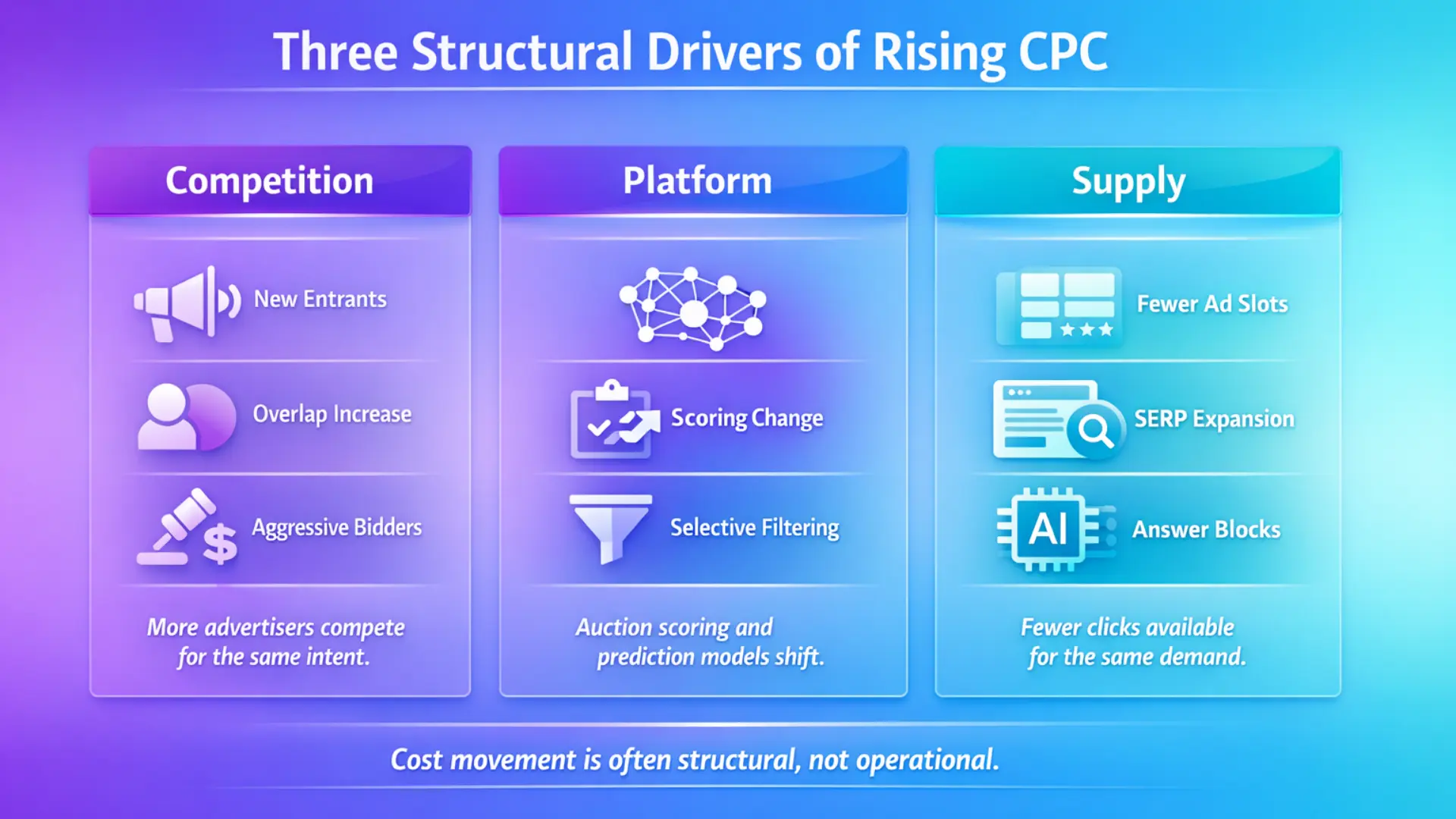
Three buckets explain most cost spikes:
- Competition: new entrants, stronger advertisers, or tighter overlap.
- Platform: prediction models and auction rules shifting how winners are chosen.
- Supply: fewer available placements or clicks for the same intent.
| What changed | What you observe | What it usually means |
| Competition | Costs rise first in your best intent pockets | More bidders or tighter overlap around profitable intent |
| Platform | Costs move without any internal change | The auction became more selective or scoring shifted |
| Supply | Costs rise while click volume is harder to grow | Fewer placements/clicks available for the same intent |
Prices move even when you stand still. Next, we fix the most common misinterpretation executives make.

Why CPC rises without changes
Here’s the uncomfortable truth. Your cost per click can rise even if you change nothing.
That is price discovery: the market continuously recalculating what access is worth.
In PPC, it happens in milliseconds.
Every auction recalculates relative strength.
If a competitor improves quality signals, your effective position shifts.
If someone raises bids slightly across a high-intent segment, the clearing price moves for everyone.
You feel it as “cost inflation”.
The system sees it as equilibrium.
One manufacturing client experienced a 21% increase in cost per click over two quarters.
No new campaigns.
No bid increases.
When we dissected auction overlap, we found three new entrants targeting the same high-margin queries.
Each entered with strong historical accounts and high predicted engagement.
The system did what it is designed to do.
It rebalanced around the new competitive mix.
This is where myths creep in.
Myth: “If CPC rises, the account is mismanaged”.
Reality: rising CPC often signals intensified competition within a profitable intent pocket.
Another common misread is blaming the platform instantly.
Yes, algorithms evolve.
But many increases reflect demand pressure, not hidden penalties.
Ask yourself a sharper question.
Did the economics of this intent change?
Or did we assume they would stay static?
Markets rarely stay static.
Small shifts in competitor bids, quality, or coverage compound over thousands of auctions.
The effect becomes visible weeks later as a steady upward drift in average CPC.
This is not chaos.
It is adjustment.
When you interpret rising CPC as a market response, you stop chasing random optimizations.
You start diagnosing structural pressure.
CPC increases are often a symptom of competitive strength around valuable intent.
Understanding that reframes cost from failure to signal.
Two signals that costs are rising for structural reasons:
- Costs rise first in your best-performing intent pockets.
- Costs rise while your internal settings stay stable.
Two common misreads:
- “Our team broke something”.
- “The platform is punishing us”.
Next, we look at what happens when you try to push past that signal.

Efficiency drops before volume – diminishing returns
The fastest way to lower your conversion rate is to increase budget?
It sounds like a mistake, yet it’s a predictable effect of buying the next layer of intent.
You spend more and you reach more people.
The “extra” people are rarely the same quality.
That’s where efficiency slips first.
Diminishing returns means each additional unit of spend produces less incremental outcome.
In auctions, it shows up early because the best intent gets consumed first.
At lower spend, you buy the clearest buying moments.
At higher spend, you start buying “maybe later” moments.
We saw this with a B2B tech company.
Spend rose from €25k to €60k per month in 90 days.
Lead volume increased 38%.
Cost per lead increased 27% in the same window.
Conversion rate dropped from 6.4% to 4.9%.
Messaging and landing pages stayed the same.
Nothing “broke”.
They simply moved past prime intent.
You get the clearest buying moments first; the next layer is colder and costs more to convert.
Have you ever seen volume rise while profit tightens?
That’s usually diminishing returns showing up before the dashboard looks “bad”.
This signal doesn’t mean stop spending.
It means the easy layer is gone, so every extra unit costs more to convert.
Efficiency slips before growth stalls. Next, we separate auction limits from demand limits.

From auction limits to intent limits
Winning auctions can make growth harder.
Because it pushes you into the last pockets of demand.
Once you stabilize pricing, the next constraint shows up fast.
It’s not your ads. It’s the size of the room.
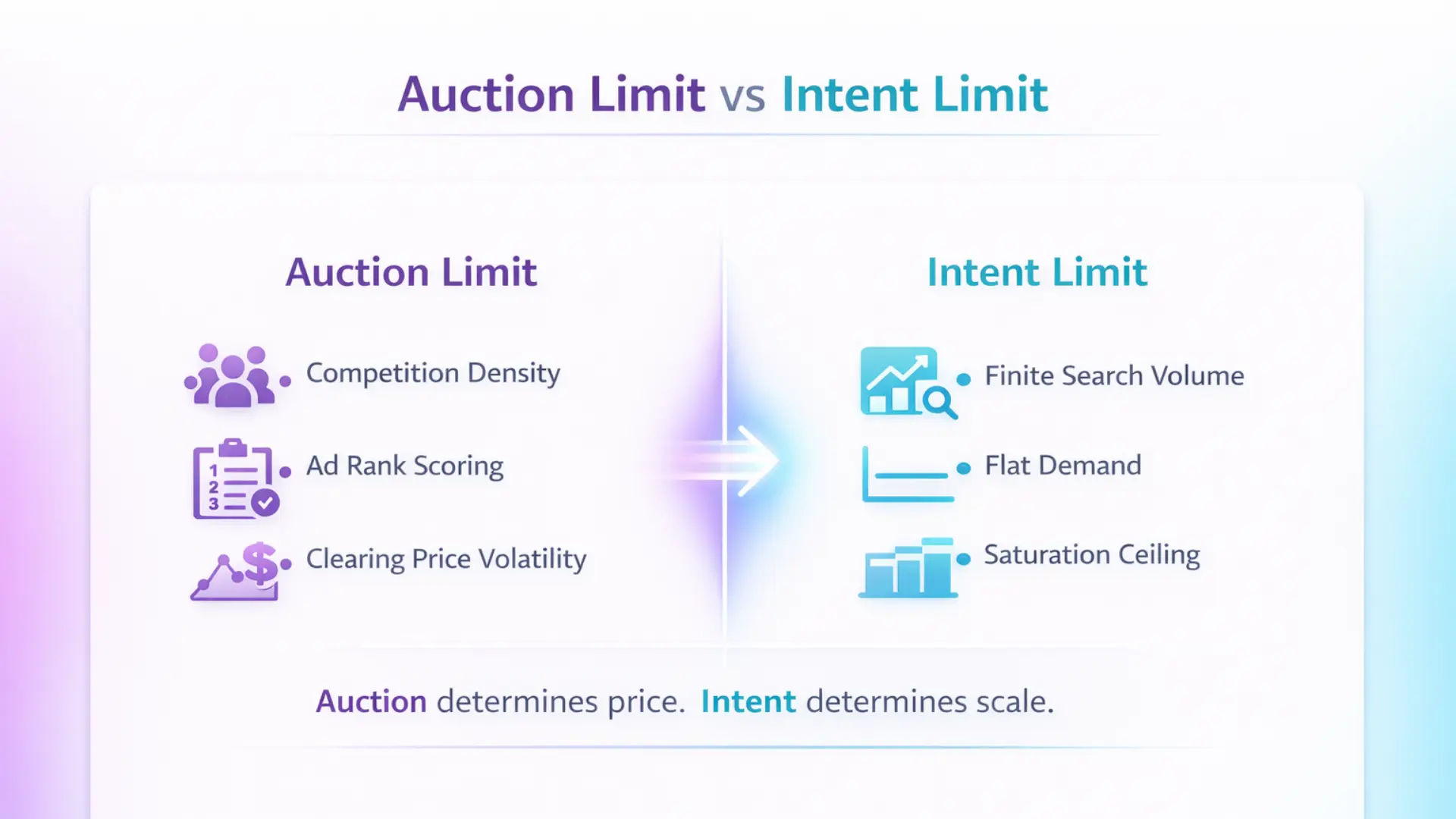
Auctions allocate access to intent.
They do not create intent.
So you can improve quality, stabilize click cost, and still stall.
The ceiling is set by how many buying moments exist in your category.
We saw this in an enterprise account last year.
After a volatile quarter, auction overlap normalized and costs stopped swinging.
Conversion rate improved.
Sales feedback improved.
Growth still stalled.
Search volume for core commercial terms had been flat for twelve months.
Competitors rotated, but total demand did not expand.
That’s the trap.
Executives feel they “should” be able to buy more.
But you can’t buy intent that doesn’t exist.
Have you ever felt capped after doing everything right?
That cap is often demand, not execution.
When auctions are understood, the next limit is intent availability. That’s where we examine intent saturation.
Auctions decide who wins the moment.
Intent decides how many moments exist.
Auctions can be stable while demand is capped. Next, we close with decision-level implications.

Conclusion
Cost per click does not rise because you pressed the wrong button.
It rises because competition shifts, supply tightens, or demand intensifies.
Auctions allocate access.
They recalculate price in real time.
They respond to relative strength, not your intentions.
Market conditions amplify that pressure.
Automation changes competitive dynamics.
Inventory constraints compress supply.
Put together, cost movement becomes logical.
One executive once told us, “It feels like the platform is punishing us”.
After mapping auction density, new entrants, and intent volume, the pattern was clear.
They were competing in the most profitable pocket in their category.
Of course the room was expensive.
When you view rising CPC as a market signal, you regain agency.
You decide whether to defend, reposition, diversify, or expand beyond that pocket.
You stop chasing minor tweaks.
You start evaluating structural constraints.
Rising costs are usually a signal of competition and constraint, not a broken account. If scale still stalls, the next diagnostic layer is intent availability.
Understand the auction.
Then evaluate the size of demand.
Because price volatility is rarely random.
It is usually the market telling you something.

Scientific context and sources
The sources below provide foundational economic and auction theory context for the mechanisms described above. They explain how competitive allocation systems determine price, how markets discover clearing prices, and why diminishing returns emerge as demand concentrates.
- Auction theory and second-price models
Counterspeculation, Auctions, and Competitive Sealed Tenders – William Vickrey (1961) – Journal of Finance
Introduces the second-price auction model (Vickrey auction), explaining why winners pay the minimum required to beat the next bidder rather than their own maximum offer.
https://www.jstor.org/stable/2977633 - Market design and real-time allocation systems
Auction Theory – Vijay Krishna – Academic Press
Comprehensive treatment of auction formats, clearing prices, and strategic bidding behavior in competitive allocation environments.
https://www.sciencedirect.com/book/9780123745071/auction-theory - Price discovery in competitive markets
Price Discovery – Fama, Eugene (1970) – Efficient Capital Markets: A Review of Theory and Empirical Work
Explains how markets continuously incorporate new information and adjust prices through competitive interaction.
https://www.jstor.org/stable/2325486 - Law of diminishing returns (microeconomics foundation)
The Law of Diminishing Returns – Encyclopaedia Britannica
Describes how incremental input produces progressively smaller output gains once optimal capacity is exceeded, a principle applicable to budget scaling in competitive systems.
https://www.britannica.com/money/diminishing-returns
Questions You Might Ponder
How is my actual CPC really calculated in PPC auctions?
Most major PPC platforms use an Ad Rank system within a second-price style auction. Your actual CPC is typically determined by the Ad Rank of the competitor below you, divided by your quality score, plus a small increment. You usually pay just enough to maintain your position – not your full bid.
Why are my CPCs going up even though I haven’t changed bids or settings?
CPC can rise without internal changes because auctions constantly reprice access. New competitors may enter, existing advertisers may raise bids, quality signals may shift, or platform scoring models may update. Even with stable settings, stronger competition or reduced click supply can increase the clearing price.
Why does scaling PPC spend often reduce efficiency or conversion rate?
When you increase spend, you typically capture the highest-intent clicks first. Additional budget forces you into broader, less qualified traffic. This creates diminishing returns: higher marginal CPC, lower conversion rates, and reduced ROAS. Efficiency often drops before volume visibly plateaus because the remaining intent is weaker.
Can CPC go up even when some competitors pause or spend less?
Yes. If weaker advertisers exit and auctions increasingly consist of high-quality or aggressive bidders, the effective price floor can rise. Fewer but stronger competitors, tighter ad placement supply, or reduced click volume can all push CPC upward despite fewer visible advertisers.
How do I know whether rising CPC is mismanagement or just market reality?
If CPC increases follow targeting errors, tracking issues, or structural campaign changes, the cause is internal. However, steady increases in profitable intent segments with stable settings usually signal auction pressure or demand constraints. Consistent overlap growth and competitor entry often point to market dynamics, not account failure.