
What You’ll Learn
Trust thresholds in regulated conversion are the minimum levels of perceived safety, credibility, and risk clarity a user needs before taking action in high-stakes industries such as healthcare, finance, insurance, legal services, or addiction treatment.
In these markets, users do not convert only because an offer is persuasive or convenient.
They first need enough evidence that the decision will not expose them to financial harm, privacy risk, medical risk, compliance problems, or hidden obligations.
Effective regulated conversion reduces suspicion through restraint, plain language, visible safeguards, clear limitations, and relevant proof.
Conversion happens only after trust makes action feel safe.
Key Takeaways
- In regulated environments, crossing the trust threshold is essential for conversion – persuasion without trust increases abandonment.
- Heavy-handed tactics like urgency or scarcity trigger suspicion in high-risk industries, often elevating resistance rather than boosting action.
- Risk-calibrated users prioritize perceived harm and safety signals over incentives; trust cues function as the real conversion enabler.
- Funnel optimizations succeed only after diagnosing and removing trust barriers, not by amplifying traditional marketing persuasion.
Most companies ramp up persuasion – words, urgency, friction-reduction – hoping to drive more conversions.
In regulated spaces, this fails spectacularly.
The real shift?
Every high-risk decision triggers an invisible “trust threshold”, and no amount of clever messaging can force conversion before that line is crossed.

Why trust thresholds govern conversion under risk
When persuasion increases resistance, not results
Push harder, get the opposite.
The assumption that more persuasive tactics always boost results breaks down fast in regulated sectors – think finance, healthcare, or insurance.
A shadow cost hangs over the user’s mind: perceived harm.
The myth?
That higher risk just means you need more persuasion.
Take, for instance, a recent financial services campaign: after urgency banners were introduced, abandonment rates rose sharply – classic evidence of risk-weighted conversion barriers in action.
Users spot the pressure, hesitate, then abandon.
It’s like trying to speed a nervous driver by tailgating – they press the brake instead.
Our agency’s audits reveal something odd: Trust-driven conversion isn’t about reducing friction but about not increasing suspicion.
Why does resistance spike?
Because persuasive signals in high-risk contexts get recoded as manipulation attempts, raising risk-weighted conversion barriers instead of lowering them.
Would you trust a financial advisor who’s always in a hurry?
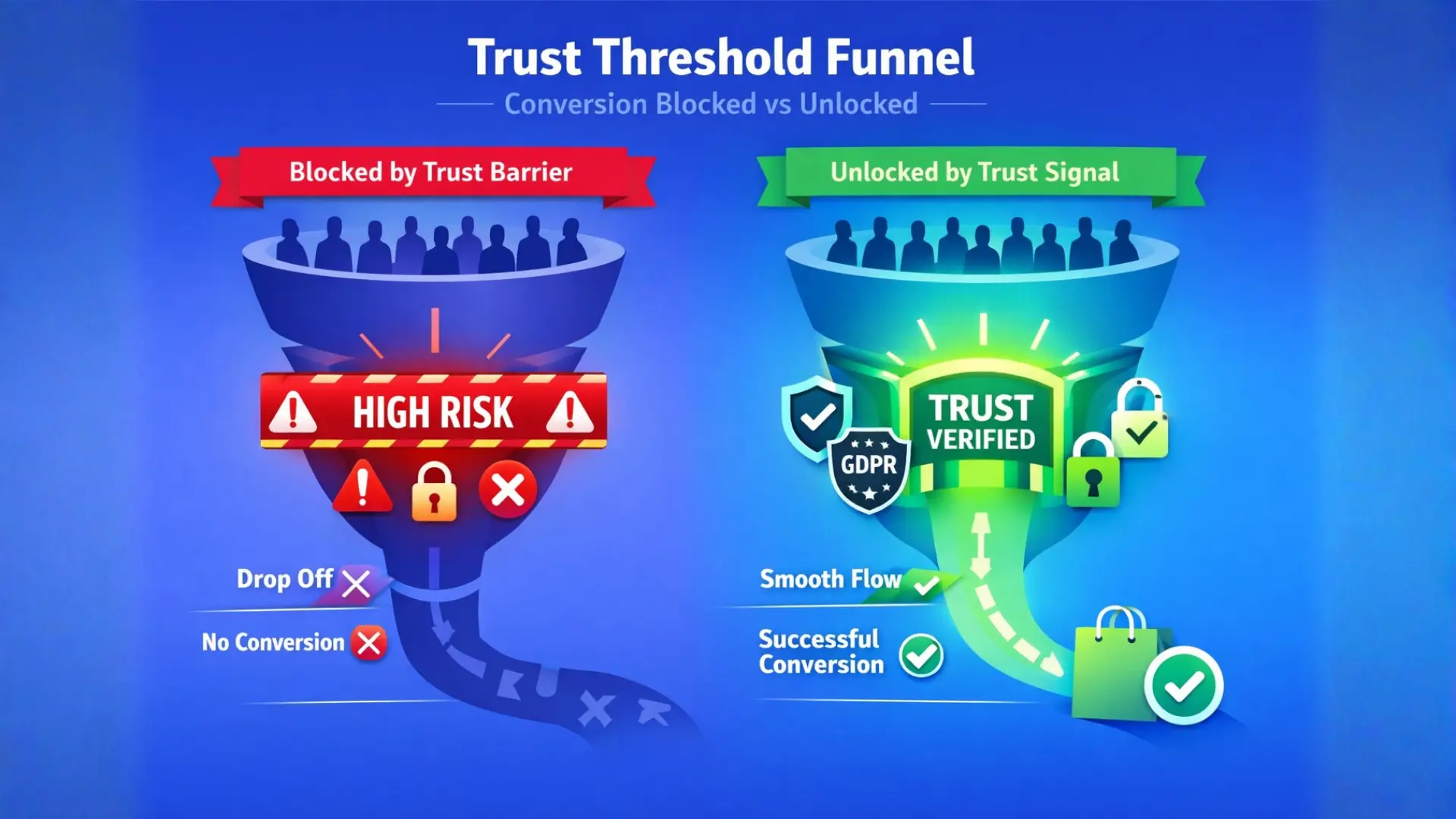
How trust acts as ‘safety to act’ before conversion happens
No trust, no action – no matter how “optimized” your funnel appears.
In regulated environments, trust isn’t a bonus; it’s the safety net users need before they’ll take a step.
This is the real prerequisite, not just another lever.
We see trust function less like a persuasive tool and more like an access pass: without it, the conversation never really starts.
One insight from our regulated-industry projects: Conversion friction from perceived harm outweighs any incentive or discount tactic you layer on top.
Instead, the moment a user believes you’ve passed their mental safety check, the barrier drops – and decision dynamics flip.
Conversion becomes possible not because your persuasion was strong but because their sense of risk tipped from “unacceptable” to “manageable”.
The upshot: In high-risk industries, trust isn’t just a prerequisite – it’s the filter through which every conversion opportunity passes.
The winners outpace competitors not by pushing harder, but by clearing the trust threshold before asking for action.

What changes in regulated environments shift conversion dynamics
Most marketing teams treat regulated environments like any other funnel – adapt your persuasion, dial up urgency, clear friction, and assume action will follow.
But the instant a financial, health, or legal risk is even faintly perceived, the rules flip: persuasion no longer accelerates conversion; it triggers more suspicion.
Here’s the catch – every step in the customer’s mind is weighted by a silent cost calculator: “If I make the wrong move, how bad does this get?”
How risk cost reshapes decision mechanics
In high-stakes industries, your prospect isn’t just weighing benefit – they’re mapping out the downside.
The cost of a misstep could mean a regulatory investigation, a medical error, or a major financial penalty.
Suddenly, small bits of friction aren’t the problem: perceived risk is.
We’ve seen users in compliance-heavy sectors delay a signup for weeks just to parse what’s between the lines, forwarding terms to legal or requesting references few B2C marketers ever encounter.
Conversion barriers aren’t about lazy forms – they’re about risk-weighted decision delay.
Think of the decision process like a bridge suspended over a canyon.
In low-risk markets, people look for speed: the shortest distance, the smoothest boards.
Ramp up the stakes, and every user is checking the integrity of each plank.
If one feels loose – uncertainty about fees, ambiguous terms, unclear leadership – most will step back regardless of your persuasion stack.
That’s why even premium offers stall if perceived safety isn’t established.
One logic keeps surfacing: the higher the risk, the slower the decision – because people are defending against downstream harm, not chasing upside.
Anyone optimizing regulated funnels must respect these heavy brakes.
Why conventional CRO tactics seem manipulative when stakes are high
Urgency timers, one-time discounts, and high-pressure forms don’t just fall flat here – they can actively harm trust.
In regulated settings, users equate pressure with evasiveness: “If they’re rushing me, what are they hiding?”
What convinces in e-commerce turns radioactive in healthcare or finance.
A few regulated clients learned this the hard way.
Scarcity banners and pushy copy doubled their abandonment rate among compliance-savvy buyers.
The myth is that scarcity and pressure tactics exploit cognitive shortcuts everywhere.
In reality, they get flagged as red alerts when users fear long-term impact.
In regulated high-risk contexts, restraint signals credibility, while persuasion invites scrutiny.
If your funnel feels like a carnival barker, the perceived risk can’t be neutralized – your sharpest urgency tactic becomes a liability, not a lever.
When trust drives conversion, heavy-handed CRO turns into a warning siren.
The lesson: risk cost and ethical sensitivity must directly shape how – and whether – you use traditional marketing playbooks.
True progress begins by reversing the script: first eliminate manipulation cues, then signal you recognize – rather than dismiss – the real risks at play.
Only then do decision makers begin to move.

How restraint can outperform persuasion in building safety perception
Most executives still assume that the path to higher conversion is paved with clever persuasion.
In regulated spaces, the opposite often holds: restraint – not pressure – signals safety, and safety is what unlocks high-stakes decisions.
If persuasion is a volume knob, restraint is the noise-canceling technology that lets users finally hear what matters.
But why does holding back work better when risk is on the line?
What to compare: clarity versus persuasive pressure
Comparison of Clarity vs Persuasive Pressure in Regulated Conversion
| Trust Block Indicator | Description | User Signal |
|---|---|---|
| Missing Credentials | Absence of verification/security proofs | User hesitation or abandonment |
| Complex Legal Language | Terms and policies are hard to understand | Delays and requests for legal review |
| Lack of Visible Safeguards | No clear safety or compliance signals | Cold silence or drop-off at input forms |
| Perceived Pressure Tactics | Urgency or scarcity campaigns | Increased suspicion and bounce rates |
| Stacked Risk Signals | Multiple ambiguous or negative cues | Gradual decision delays or funnel stalls |
Watch how seasoned decision-makers react during compliance-heavy pitches: the harder someone pushes, the more mental safety barriers go up.
We’ve seen financial services funnels where a single “limited time” nudge triggered buyer withdrawal – even when legal didn’t object.
The lesson?
In risk-weighted, trust-driven conversion, pressure reads as desperation or concealment.
What actually moves the needle is clarity – plain, unforced information that answers, “What won’t happen to me if I proceed?”
The myth is that stronger incentives or urgency always produce more action.
In regulated conversion, piling on pressure erodes trust signals already under strain.
By contrast, we’ve found that explicitly stepping back – highlighting checks, admitting limitations, stating what’s not promised – freezes drop-off rates and sometimes even raises conversion by double digits over persuasive copy.
Restraint provides breathing room.
The greater the perceived harm, the more credible you seem by defending the user’s interest, not your pitch.
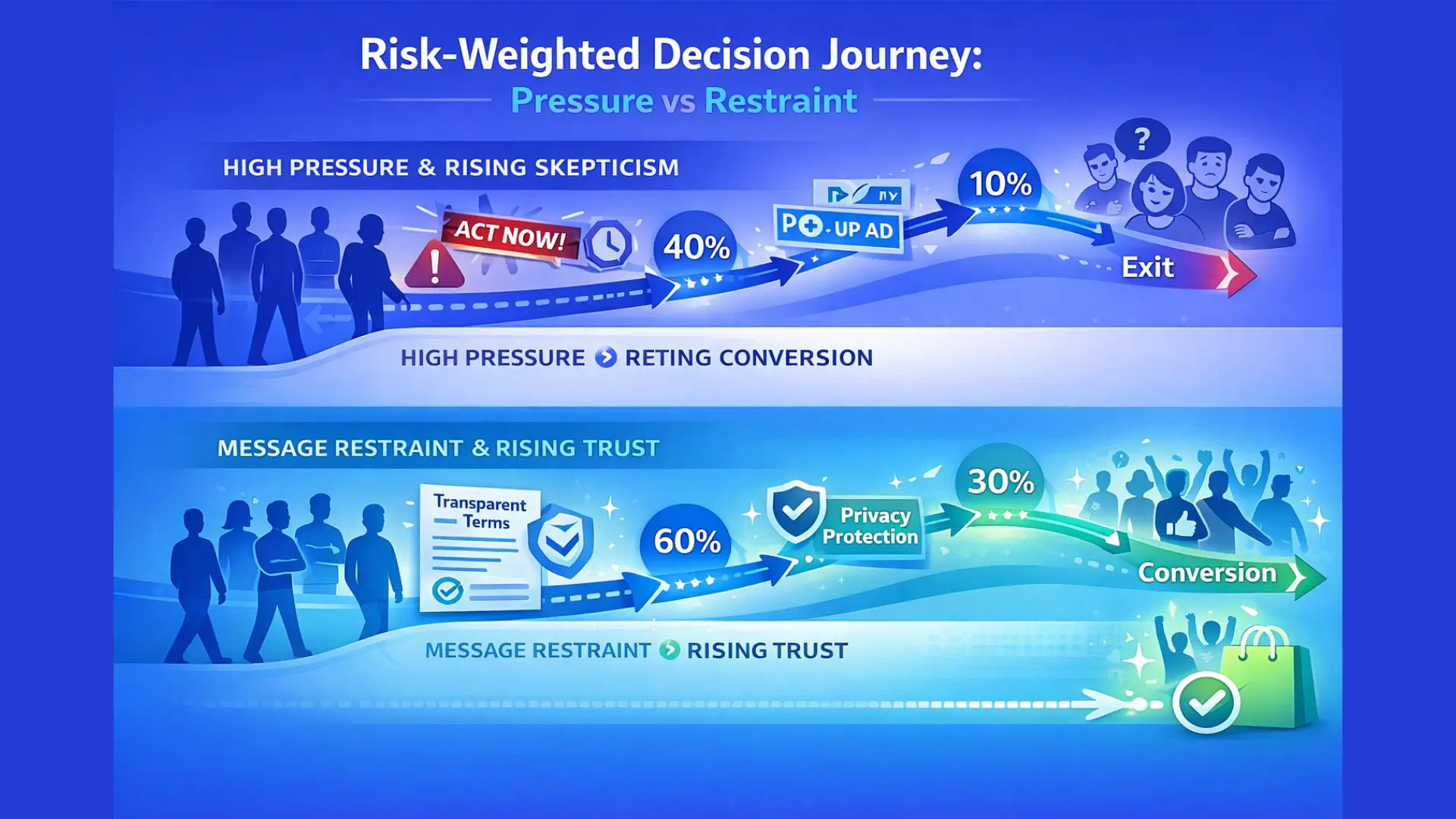
When reducing harm framing improves decision activation
Just like a safety inspector refusing to rush an approval, marketers who acknowledge risk – without downplaying or sugarcoating – activate trust that raw persuasion can’t reach.
We’ve guided health and finance teams to lead with what users won’t get: “We won’t sell your data. We can’t guarantee returns. You’ll never see surprise fees”.
The result?
Recipients lean in; skepticism drops.
This “reduced harm” clarity is not just ethical CRO – it’s high-performance strategy for regulated environments.
A simple analogy: persuasive pressure is a heavy hand on the scale.
Restraint is the open palm, inviting scrutiny and confidence.
Which would you trust to weigh your decisions when the outcome means real loss?
In risk-sensitive conversion, resisting the urge to persuade too hard becomes your signal of safety.
The less you oversell, the more credible your offer feels – and the more reliably users act.
This approach exemplifies ethical CRO in regulated environments: prioritizing clarity and genuine reassurance over pressure.

What next: Validate your trust threshold before optimization
Executives usually look for leaks in their conversion funnel – abandonments, hesitation, unexplained drop-offs – then reach for optimization tactics.
But in regulated industries, the real choke point is almost never buried in a landing page detail or call-to-action.
It’s invisible: a trust block, not a simple friction point.
So, what exactly does that look like in your funnel?
And how do you spot trust breakdowns before they sabotage every downstream fix?
How to assess where trust is blocked in your funnel
Trust Block Diagnostic Checklist for Regulated Conversion Funnels
| Aspect | Clarity (Restraint) | Persuasive Pressure |
|---|---|---|
| User Perception | Signals safety and credibility | Reads as desperation or concealment |
| Impact on Trust | Builds and protects trust | Erodes trust, triggers suspicion |
| Conversion Outcome | Freezes drop-off rates or raises conversion | Increases abandonment and hesitation |
| Typical Tactics | Plain info, highlighting what won’t happen | Urgency banners, scarcity, one-time offers |
| Effect on Decision Activation | Enables confident decision-making | Raises mental safety barriers |
Here’s what catches most teams off guard: you can pour weeks into conversion rate optimization, only to find the needle stuck, because the central question – “Can I trust this?” – remains unaddressed.
We’ve seen clients spend six months tweaking copy and visuals, never realizing users were abandoning because a single credential was missing at the verification step.
In regulated settings, these trust requirements act less like potholes and more like concrete barricades – until removed, nothing gets through.
The best diagnostic move is to think like your most skeptical user.
Where will they see potential harm – loss, exposure, compliance risk – rather than opportunity?
Are risk signals stacking up right before a key input?
Does your privacy policy feel buried?
Are safeguards clear?
Sometimes the only sign is a cold silence: high engagement on information pages but steep falloff at transaction points that carry perceived risk.
The friction doesn’t appear as confusion – it shows up as absence of action.
Isolating where users slow or vanish can reveal where your funnel is failing the trust prerequisite, not the value proposition.
Imagine trust as a locked door inside your funnel: all the persuasive messaging in the world rattles the handle, but nobody walks through until the key – visible safety signal or proof – clicks into place.
Ask: If you stripped away every conversion trick, would a skeptical user still see enough risk coverage to say yes?
When the next move is routing to industry-specific trust frameworks
Sometimes, diagnosing trust barriers is just the start – and the next action isn’t to apply generic fixes, but to bring in frameworks built for your specific risks and regulations.
What signals safety in healthcare won’t match what’s required in financial services or legal tech.
We’ve worked with compliance-heavy organizations where a generalist CRO audit only scratches the surface, missing entire classes of trust friction: consent protocols, regulatory trust marks, disclosures only locals recognize.
The trigger for escalation is clear: when your funnel consistently stalls at moments tied to legal disclosure, consent capture, third-party validation, or any high-risk user input, it’s time for a referral.
Your optimization isn’t a copywriting challenge – it’s an industry-reputation threshold that demands specialized expertise and frameworks.
The best move?
Route these bottlenecks to teams that live in your regulatory space and know which cues, and omissions, flip risk perception.
Spotting and mapping trust blocks isn’t about patching leaks, but unlocking the real barrier to conversion in regulated environments.
Address that first, and every optimization lever you pull afterward actually moves the dial.
To dive deeper into resolving trust barriers unique to your industry, continue to the linked industry-specific CRO hubs for sector-driven trust frameworks and diagnostics.

Scientific context and sources
The sources below provide foundational context for how decision-making, attention, and performance dynamics evolve under scaling and constraint conditions.
- Risk and trust calibration
“Online Consumer Trust: Trends in Research” – Antonina Bauman, Reinhard Bachmann – Journal of Technology Management & Innovation
Synthesizes empirical research showing that trust is a primary determinant of purchase intention, and that perceived risk directly suppresses conversion unless mitigated by clear signals such as security, transparency, and reputation.
https://www.researchgate.net/publication/318959454_Online_Consumer_Trust_Trends_in_Research - Behavior under uncertainty
“Risk as Feelings” – George F. Loewenstein et al. – Psychological Bulletin
Demonstrates that decision-making under risk is driven by emotional responses rather than rational evaluation, meaning users may abandon conversions despite favorable conditions if perceived risk is not resolved.
https://psycnet.apa.org/record/2001-16969-005 - Trust and ethical cues in regulated environments
“Sharing with perfect strangers: The effects of self-disclosure on consumers’ trust, risk perception, and behavioral intention in the sharing economy” – T.T.H. Tran et al. – Journal of Business Research
Shows that trust-building signals (e.g., transparency, identity cues) increase behavioral intention, but excessive or mismatched information can reduce effectiveness, highlighting the importance of calibrated trust signals in conversion environments.
https://www.sciencedirect.com/science/article/pii/S0148296322000935 - Cognitive load and resistance in high-stakes decisions
“Dark Patterns in Online Shopping: Of Sneaky Tricks, Perceived Annoyance and Respective Brand Trust” – Voigt et al. – arXiv / HCI research
Empirical study showing that manipulative or complex interfaces increase cognitive load and reduce trust, leading to higher abandonment rates and lower conversion, especially in high-stakes decisions.
https://arxiv.org/abs/2107.07893 - Peer-reviewed framework: trust formation and manipulation signals
“A Study on the Factors That Influence the Consumers Trust on Ecommerce Adoption” – Thaw et al. – arXiv / Information Systems research
Finds that perceived risk negatively impacts trust and conversion, while trustworthiness signals (security, reliability) directly increase purchase intention, confirming that trust acts as a gating mechanism for conversion.
https://arxiv.org/abs/0909.1145
Questions You Might Ponder
Why do conversion rates drop when trust thresholds are not met in regulated industries?
If trust thresholds aren’t crossed, users perceive higher risk and manipulation, leading to hesitation and abandonment. In regulated sectors, conversion is blocked until safety and credibility are evident, making traditional persuasion tactics counterproductive.
How can marketers identify trust breakdowns in high-risk conversion funnels?
Marketers can identify trust breakdowns by monitoring where user drop-off coincides with risk cues, like compliance inputs or unclear guarantees. Diagnostic tools include tracking engagement drop-offs, direct feedback, and simulating the journey of the most skeptical users.
What’s the impact of persuasion tactics in risk-sensitive decision environments?
Heavy-handed persuasion such as urgency or scarcity cues can trigger suspicion and resistance rather than conversions in high-risk industries. Users interpret pressure as evidence of hidden dangers, increasing the perceived risk and undermining trust.
How should companies adapt CRO strategies in regulated spaces to cross trust thresholds?
Companies must shift from optimizing persuasion to minimizing risk-signaling friction. This involves enhancing transparency, openly addressing limitations, and foregrounding compliance credentials – instead of relying on urgency or promotional pressure.
What are common signs that trust, not friction, is blocking conversions?
Typical signs include high engagement on upper-funnel pages but sharp drop-offs before any commitment, minimal form completion in high-risk steps, and recurring questions about safety or compliance – indicating unaddressed trust rather than technical friction.