
What You’ll Learn
Trust completion is the final-stage conversion condition where a user has enough confidence to move from intent to commitment.
It matters most at checkout, form submission, booking, subscription, or any point where action feels risky or hard to reverse.
Trust completion fails when unresolved financial, functional, privacy, cancellation, refund, or support concerns appear at the last step and make the user pause or abandon.
In CRO, trust completion is not about adding generic badges.
It means matching reassurance to the size of the decision, using clear terms, visible support, refund clarity, cancellation transparency, and consistent messaging from first click to final action.
Key Takeaways
- Last-mile abandonment is primarily driven by a spike in perceived risk and trust fragility at the commitment point, not by rational or feature-based objections.
- Surface-level trust cues are often inadequate; only context-aware, commitment-level assurances reduce hesitation and complete conversions.
- Recognizing trust breakdown requires behavioral analysis (pauses, FAQ clicks, support queries) distinct from friction or upstream confusion.
- True trust completion relies on upstream message consistency – trust cannot be repaired at checkout if earlier steps seeded doubt or misalignment.
Executives assume that a visitor making it to the final step – with cart full, details entered, and intent obvious – means the deal is all but closed.
Here’s the shock: most last-mile abandonment isn’t caused by price, features, or logic.
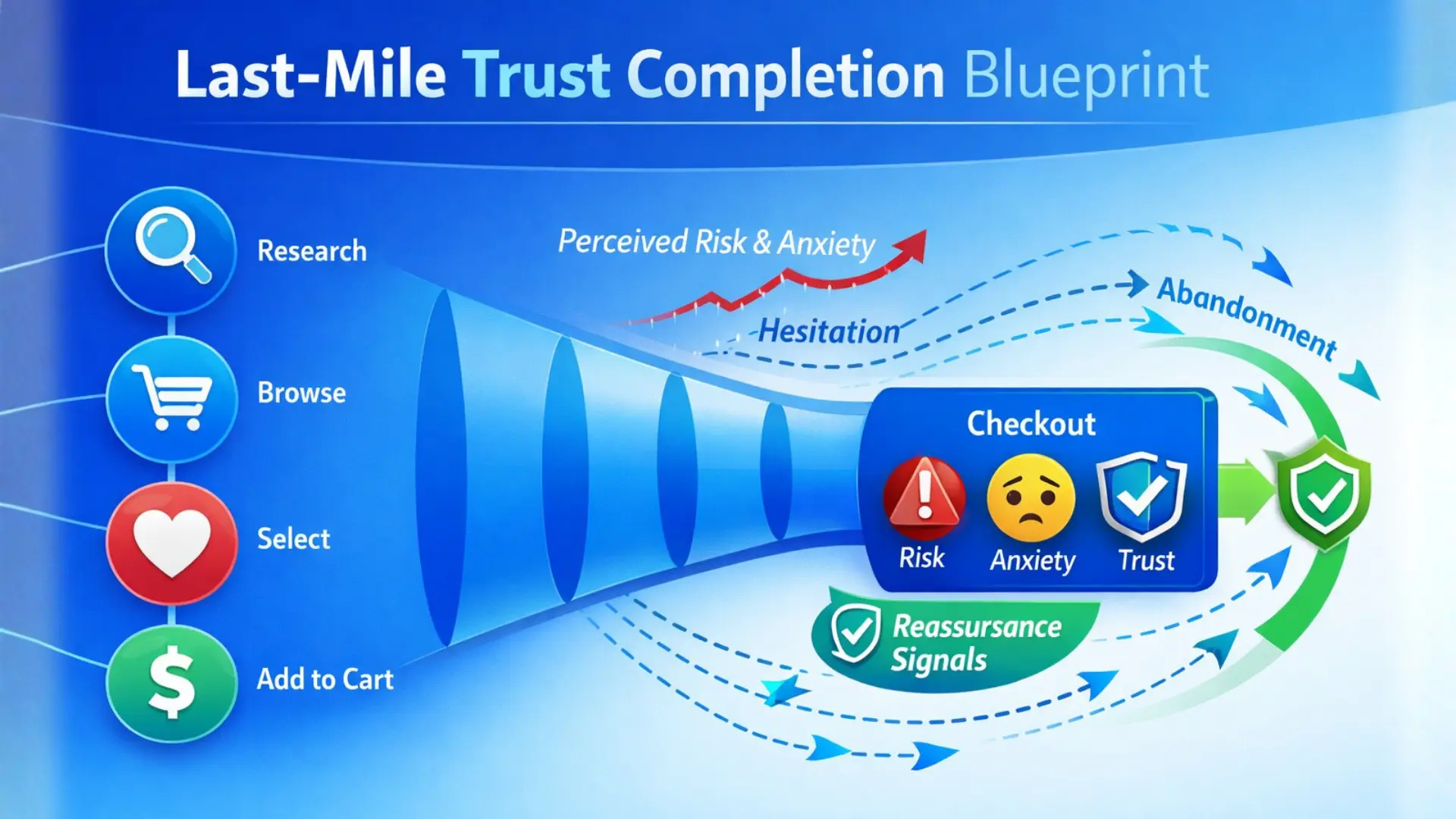
The real culprit is the invisible spike in perceived risk just as commitment is needed.
In our experience, conversion optimism hides a psychological cliff – the final click doesn’t just complete a transaction, it signals an irreversible leap.
When the mind senses one-way doors, intent stalls, hesitation blooms, and even eager buyers freeze.

Why the last mile triggers hesitation despite intent
Despite a well-designed checkout and high reported purchase intent, companies often see last-minute abandonment rates spike without an obvious technical flaw.
This hesitation almost always traces back to the emergence of specific risks – often financial, social, or functional – that intensify just before commitment.
How unresolved perceived risk stalls action
Financial anxiety rears up – will this payment expose me to fraud or recurring charges?
Social doubts creep in – does this purchase make me look reckless or naive?
Functional uncertainty triggers – what if this doesn’t work and I can’t fix it easily?
What’s counterintuitive is the timing: risks that seemed minor during research become deal-breakers at the moment of commitment.
We’ve seen checkouts lose 18% of high-intent users simply from a poorly framed return policy or hidden fees surfacing in the last step.
The myth is that “ready to buy” means immune to friction.
In reality, the volume of perceived risk multiplies precisely when the user senses they’re about to lose control.
If your metrics show unexplained drop-offs post-intent, it’s usually not logic failing – it’s emotional calculus shifting.
When ‘fine’ trust masks fragility
Good-enough trust signals (SSL badges, recognized logos, social proof) often survive casual scrutiny.
But the final step exposes where that trust is brittle.
Like a bridge that appears sturdy until its first heavy load, “fine” trust fractures when stakes feel high or time pressure mounts.
We’ve watched users breeze through cart flows only to pause for several seconds – sometimes opening a new tab to search “Is this site safe?” or pinging customer support with a ‘just checking’ question.
What looked like strong trust was only surface-deep.
If you’ve ever seen abandonment spike due to a popup, a sudden request for sensitive info, or tiny inconsistency in branding, you’ve witnessed fragile trust shatter in real time.
Strong trust isn’t about the absence of fear, it’s about outlasting the moment when fear is loudest.
Most brands overestimate the strength of their trust foundation because it goes untested – until the checkout becomes a crucible.
Last-mile hesitation isn’t a traffic problem or an interest problem.
It’s a trust completion problem: the moment intent meets irreversibility, only deep, well-matched assurances move the needle.

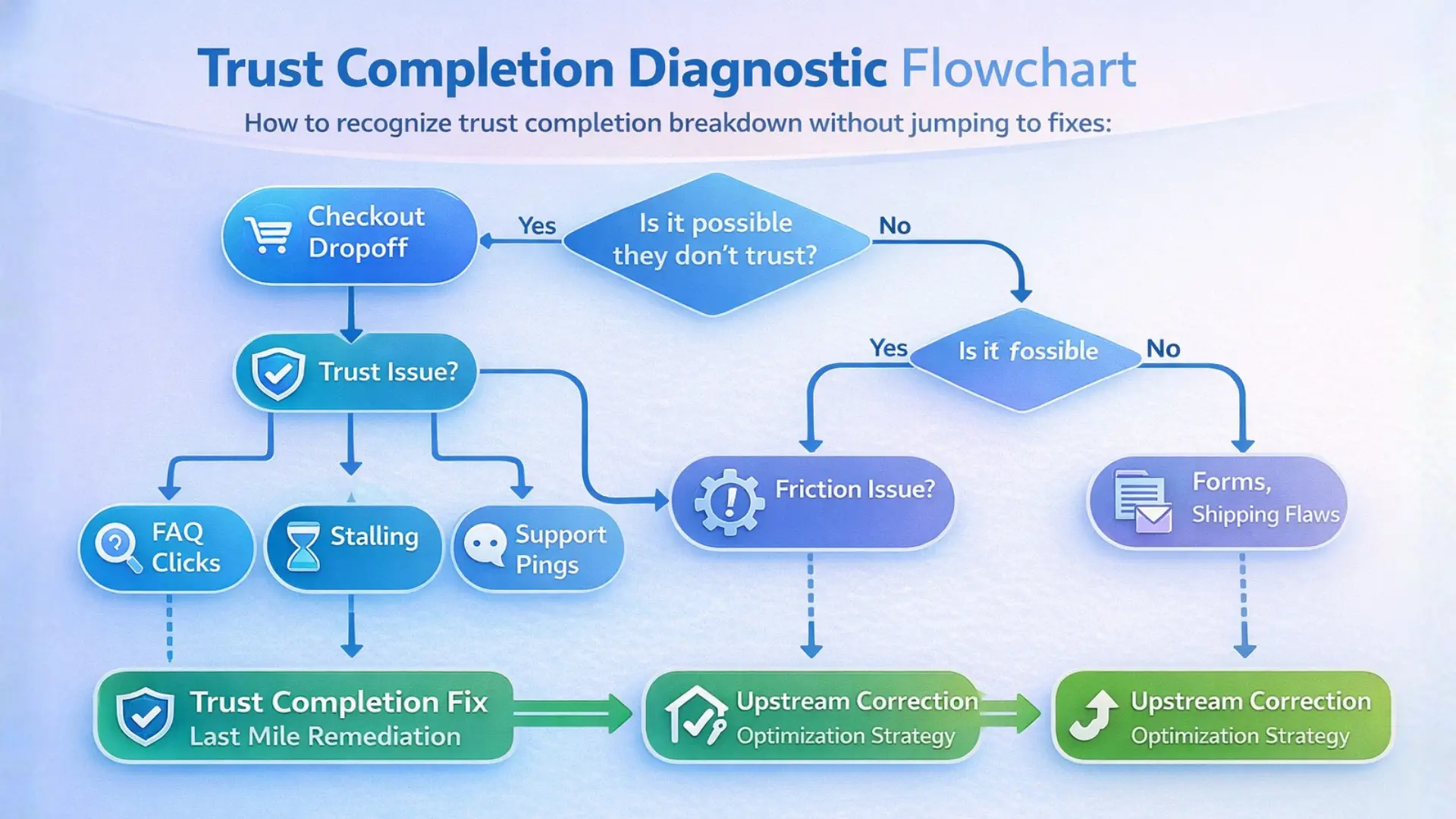
How to recognize trust completion breakdown without jumping to fixes
It’s easy to misread a sudden drop-off as just the price of doing business online.
But the real threat is silent: most last-mile conversion failures are trust breakdowns hidden behind data that looks like normal abandonment.
Are those customers really lost to indecision – or are they pausing for reassurance you haven’t provided?
The difference determines whether you pour money into the wrong solution.
Behavioral signals of hesitation at the end
Behavioral Signals and Red Flags of Last-Mile Hesitation
| Purchase Type | Typical User Risk | Recommended Assurance |
|---|---|---|
| Low-cost impulse buy | Low financial risk, low commitment | Simple secure payment badges, clear refund promise |
| Medium-value purchase | Moderate financial and functional risk | Prominent refund policy, cancellation terms |
| High-ticket or subscription | High financial and irreversibility risk | Detailed cancellation info, visible support guarantees |
| Recurring commitments | Ongoing financial exposure | Explicit cancellation instructions before confirmation |
| Complex or unfamiliar products | Higher functional and social risk | Clear usage support info and social proof |
Watch what happens in the seconds before a customer disappears.
Drop-offs right after “add to cart”, users stalling on the payment screen, form fields half-completed, or a sharp uptick in support queries about returns and refunds – these are not random churn.
We’ve seen clients with 15% higher abandonment rates at checkout, far above their industry baseline, only to discover a surge in clicks to “FAQ” and “Contact Us” at the same moment.
Common red flags include unexpected shipping fees, long or complex form fields, unclear return policies, or an unfamiliar checkout layout – all of which heighten last-mile hesitation.
Look beyond the numbers.
If a shopper opens more than one tab with your refund or shipping policy – or pings chat support for a basic confirmation – they’re hunting for trust, not features.
Ask: are they seeking clarity on something you assumed was obvious, or trying to expose a risk you buried?
Separating trust breakdown from upstream friction or mismatch
Here’s where many teams go off course.
They assume every late-stage bounce means the funnel or offer is broken.
But trust completion breakdown has a distinct fingerprint: upstream, friction feels like confusion or effort (fields too long, unclear instructions, slow site).
At the finish line, hesitation is sharper – rooted in unaddressed risk, not inconvenience.
An analogy: upstream friction is a slow leak in a pipe.
Trust breakdown at the end is a closed valve – everything flowed fine, then abruptly stops.
If your analytics show high engagement up to the final step, but exits or hesitations cluster around payment or confirmation, it’s rarely a classic UX flaw.
It’s a trust signal not matching the commitment you’re asking for.
So before rewriting forms or blitzing A/B tests, pinpoint whose confidence faltered and why.
Don’t confuse uncertainty about what to do with anxiety about whether to finish.
Make this distinction, and you’ll stop treating symptoms and start resolving root causes.
Spot where intent stalls, and you see where conversion lives or dies.
That’s where your next move matters most.

What shifts the balance: framing commitment-level assurances
Trust completion signals are context-aware cues that specifically address the magnitude of a user’s perceived risk at the final commitment point – such as prominent refund options, clear cancellation terms, or visible support guarantees – rather than generic symbols or badges.
Everyone’s seen the trust badge graveyard at checkout – logos lined up like armor, yet abandonment rates barely budge.
The inconvenient truth: most users don’t care about another widget or certificate.
They need proof that your brand actually protects them at the precise moment risk peaks.
Commitment signals that match user stakes
Trust Completion Signals Tailored to Purchase Stakes
| Behavioral Signal | Description | Impact on Conversion |
|---|---|---|
| Drop-offs after add to cart | Users abandon directly after adding items to cart | Indicates immediate hesitation post-intent |
| Stalling on payment screen | Users pause or delay completing payment info | Shows increased perceived risk at final step |
| Half-completed form fields | Users fill some but not all required fields | Sign of uncertainty or friction |
| Surge in support queries | Increase in questions about returns/refunds | Reflects trust signals are insufficient |
| Opening multiple tabs | Users look up refund, shipping policies externally | Search for reassurance beyond site’s content |
Trust completion in conversion optimization begins not with graphic symbols, but with demonstrating that you respect the size of their decision.
A $10 impulse buy needs different assurances than a SaaS annual contract.
We’ve watched high-ticket checkouts tank despite rock-solid infrastructure, all because the only visible cues were generic badges and one-size-fits-all “secure payment” copy.
What drives commitment isn’t decoration – it’s tailored reassurance that directly mirrors what’s at stake for the user.
Take reversibility: putting a bold, unambiguous “30-day free returns, no questions asked” right beside the final action button calms irreversibility signals in a way a badge never will.
For recurring commitments, explicit notice of how and when users can cancel – placed before purchase confirmation – shrinks last-mile hesitation dramatically.
It’s the digital equivalent of showing the key to the exit before asking someone to step in.
Clients often fear this level of candor, worried it will increase cancellations or seem weak.
In practice, it almost always has the opposite effect.
When users see escape routes, their willingness to commit jumps.
What feels risky to the brand looks like safety to the buyer.
Are your assurances proportionate to the action you’re asking for, or are they just background noise that could be swapped out for any competitor’s template?
The answer decides whether you see a completed conversion – or another abandoned cart.
For example, sites that moved prominent refund or cancellation terms next to the purchase button have seen checkout abandonment drop by 8 – 15% versus prior generic badges – demonstrating the measurable impact of tailored, commitment-level signals.
Tradeoffs between reassurance and friction at the final step
Push too hard to explain policies, and you risk overwhelming users or introducing doubts they never had.
One executive demanded every FAQ appear on the checkout page “just in case”.
The result: scroll fatigue, clutter, and counterproductive distraction.
When confidence should peak, friction quietly climbs.
The sweet spot is clear: context-aware, decision-aligned assurances – visible enough to interrupt hesitation, concise enough not to derail momentum.
A single sentence that clarifies refund terms outperforms an entire legal section buried in fine print.
Direct links to support or live chat at the exact action point strike a better balance than walls of boilerplate.
Think of assurance like seasoning: enough to enhance, but too much ruins the dish.
The art is in clarity, not quantity.
Does every element at checkout shrink fear, or is anything making the leap feel heavier?
Ultimately, trust completion isn’t about adding elements – it’s about removing the doubt that makes commitment feel like a trap.
Sharpen your assurance to mirror their risk, and you shift the balance from hesitation to action.

When trust completion needs upstream correction first
Sometimes, the real drag on final conversion isn’t trust at checkout – it’s a hidden disconnect seeded much earlier.
The brutal truth: conversion can collapse even when the last step looks frictionless, because belief broke long before the cart loaded.
Trust cues at the finish line can’t patch over confusion, misalignment, or disappointment that’s been accumulating since first click.
Why do so many brands frantically optimize button copy or add more assurance badges, while abandonment keeps spiking?
Because they’re treating symptoms, not the source.
Discrepancies between messaging, expectations, and checkout signals
A promise made upstream but left unkept by the time of purchase corrodes trust faster than any missing badge.
We’ve watched clients pour budget into sleek checkout flows, only for users to stall the instant price, policy, or product context deviates from original ads or landing pages.
Imagine preparing for a direct flight, then learning at the gate you’ll need to change planes twice – would you still board enthusiastically?
This is how irreversibility signals and last-mile hesitation creep in: not from a broken form, but from a mismatch between the journey promised and the reality delivered at commitment.
Commitment fear skyrockets when the cart or checkout subtly signals, “You didn’t get what you expected”.
One repeated myth: that improving perceived risk at checkout is always the highest ROI fix.
In practice, perceived risk is often just the last symptom of erosion that began at the ad or homepage.
We’ve diagnosed so-called “checkout trust failure” for clients whose traffic was primed for one offer, only to discover a different value proposition partway through the funnel – and every layer of contradiction builds up to checkout abandonment.
The user’s memory of earlier expectations always follows them to the point of decision.
Referral to deeper diagnostics: friction, uncertainty, mismatch
So how do you know if last-mile trust issues are the root cause – or only the most visible?
Look for evidence that user questions or hesitations cluster around inconsistencies, missing context, or vague terms rather than direct security or legitimacy concerns.
If support tickets, FAQ searches, or qualitative feedback point back to confusion about what’s actually included, return policies, or “is this really what I was promised?”, your main battle isn’t checkout optimization: it’s upstream correction.
Conversion friction can start at the ad, escalate at landing, and culminate in checkout abandonment.
Is the value proposition plain from start to finish?
Does each messaging handoff deliver on the narrative that began at click?
Most enduring conversion blockers trace back to this chain: expectation set, expectation maintained, expectation met.
If in doubt, pause.
Test the full experience as if you’re the most skeptical, risk-averse customer.
That’s where the next-level growth opportunities – and the silent threats – will be found.
Trust completion only pays off when every prior step earns it.
To truly fix last-mile dropout, get upstream.
Otherwise, you’re redesigning the bandage, not healing the wound.

Scientific context and sources
The sources below provide foundational context for how decision-making, attention, and performance dynamics evolve under scaling and constraint conditions.
- Perceived Risk in E-Commerce
“Consumer Acceptance of Electronic Commerce: Integrating Trust and Risk with the Technology Acceptance Model” – Panayiotis A. Pavlou – SSRN / MIS Research
Analyzes how perceived risk reduces transaction intent in online environments and how trust mechanisms counteract that risk, directly explaining hesitation at the point of commitment.
https://papers.ssrn.com/sol3/papers.cfm?abstract_id=2742286 - Decision-Making Under Uncertainty
“Risk as Feelings” – George F. Loewenstein et al. – Psychological Bulletin
Explores how emotional reactions to risk often override analytical reasoning, especially in high-stakes or uncertain decisions, explaining last-mile hesitation before commitment.
https://collaborate.princeton.edu/en/publications/risk-as-feelings/ - Trust and Commitment in Online Environments
“Trust and TAM in Online Shopping: An Integrated Model” – David Gefen, Elena Karahanna, Detmar W. Straub – MIS Quarterly
Shows how trust signals reduce perceived risk and directly increase purchase intention, highlighting the role of trust-building elements in driving final commitment decisions.
https://www.jstor.org/stable/30036519 - Expectation Disconfirmation and Abandonment
“A Cognitive Model of the Antecedents and Consequences of Satisfaction Decisions” – Richard L. Oliver – Journal of Marketing Research
Introduces expectation-disconfirmation theory, explaining how mismatches between expectations and actual experience lead to dissatisfaction and abandonment behaviors.
https://www.jstor.org/stable/3150499
Questions You Might Ponder
What is trust completion in online checkout?
Trust completion refers to context-specific signals and assurances that address heightened buyer risk perception at the final point of commitment, such as clear refund or cancellation policies, which reduce last-mile abandonment not by adding generic trust badges but by directly matching user concerns when stakes are highest.
Why do shoppers abandon carts at the last step even if intent is high?
Most last-mile abandonment occurs not due to pricing, features, or logical flaws, but from a surge in perceived risk or psychological fear that final commitment is irreversible. Shoppers hesitate when safety, reversibility, or clarity signals are missing at the exact point of transaction.
How can businesses recognize actual trust breakdown during checkout?
Trust breakdown shows through behaviors such as stalled form completion, sudden FAQ/policy searches, and escalating support queries right at payment. Analyzing these patterns identifies trust completion issues rather than upstream confusion or friction, allowing targeted remediation.
What trust signals actually reduce checkout abandonment?
Commitment-level assurances – like visible, plain-language refund options and simple cancellation details near the purchase button – outperform generic badges. Assurance must be tuned to match the size and type of user risk (impulse vs. recurring purchase), enabling action by reducing fear at the decision point.
How do mismatched expectations upstream sabotage trust completion?
If ads or landing pages promise different terms than are delivered at checkout, trust completion fails even with perfect checkout flow. Consistency from first click to final confirmation is essential: each step must reinforce the original value proposition to prevent hesitation and abandonment.