
What You’ll Learn
Handoff failure vs CRO is the distinction between a page-level conversion problem and a downstream operational problem after a user submits a form, books a call, or requests contact.
CRO can improve the page experience before submission by reducing friction, clarifying value, and increasing form completions.
Handoff failure happens after that point, when leads are delayed, misrouted, lost between form and CRM, contacted with the wrong message, or handled too slowly to preserve intent. In conversion strategy, better pages cannot fix broken follow-up systems.
If form fills are healthy but sales, admissions, or pipeline outcomes lag, the issue is likely operational handoff – not CRO.
Key Takeaways
- CRO alone cannot fix pipeline breakdowns; most conversion loss happens after form submission due to poor handoff and operational gaps.
- Timely and relevant post-submit responses are essential – delays or generic follow-up rapidly erode trust, harming lead quality.
- Technical failures between forms and CRM systems silently destroy potential deals, often hiding as “healthy” analytics upstream.
- Escalating persistent post-form issues beyond marketing to CRM and operational teams is crucial for tackling hidden conversion blockers.
Most teams pump resources into page tweaks, expecting a magical lift in leads.
Here’s the trap: even the cleanest funnel crashes if downstream handling is broken.
It’s like paving the road – then watching cars fall off a cliff just after the finish line.
Let’s get brutally clear: if your post-submit flow leaks, more conversions just mean more wasted opportunities, not more customers.

When the problem isn’t CRO but handoff failure
Why form completion doesn’t guarantee conversion quality
It feels good to see form completions spike.
Executives celebrate; marketers breathe easier.
But here’s the myth: a bigger top-line number means better results.
What actually happens?
Volume surges, but outcomes barely budge – or even slip.
We’ve seen B2B clients double lead volume with a polished form, only to stall at the next stage because call-back processes lag or skip leads entirely.
The decay after form submission is real.
If callbacks are slow, scripted, or clumsy, prospects cool fast – and the original conversion loses all value.
One enterprise saw hundreds of “hot” leads rot in the CRM, never getting a follow-up within 24 hours.
Not all conversions are progress.
Many are just new entry points for failure if what happens after isn’t built for speed and relevance.
Form fills are a vanity metric when the post-form system can’t deliver the promise.
But what’s really driving the decay?
Let’s look at how timing quietly destroys trust.
How response timing creates decision friction after submission
Picture this: a prospect completes a form after hours of research.
Five minutes later, they’re primed for a response.
After sixty minutes?
The urgency evaporates.
Post-submit decay isn’t just a theory – it’s where most friction hides.
Rapid response is oxygen for interest; wait too long and the spark dies.
Less than 15 minutes – sometimes even less – is the window you get before competitors swoop in or the lead forgets why they cared.
We’ve watched high-performing campaigns unravel when operational slowdowns turn intent into apathy.
Is your team actually routing leads instantly, or are they stuck in a “new leads” bucket, waiting for someone to notice?
Here’s the analogy: your page is a high-performance faucet, but the pipes behind the wall are clogged.
Water looks great coming out – until the flow stops cold.
Why chase conversion rate optimization if the real leak starts the second someone clicks “submit”?
Every frictionless page will underperform if handoff execution lags behind.
The lesson: conversion quality depends less on the button and more on the speed and precision of what happens next.

Identifying response and routing breakdowns post-submission
Types of Post-Submission Breakdowns
| Signal | Indicates | Possible Causes | Recommended Focus |
|---|---|---|---|
| Leads pile up untouched | Throughput issue | Slow follow-up, poor routing, response delays | Improve speed and routing of lead follow-up |
| Every lead contacted promptly but conversions stall | Quality issue | Source mismatch, unclear expectations, misaligned messaging | Audit lead sources and messaging alignment |
| Sudden post-submit conversion drop | Potential combination of issues | Data loss, routing errors, or quality mismatch | Collaborate between CRO and operations teams for diagnosis |
The real conversion killer often isn’t on the page – it’s the invisible failure downstream.
Submissions might surge, but if leads disengage or disappear after contact, the real leakage is buried in operations, not user experience.
Pinpointing the exact handoff breakdown is where growth becomes possible.
Mismatch between promise and follow-up handling
Ever had a sales rep open with, “How can I help you?” when you’ve just requested a specific quote?
That disconnect destroys trust in seconds.
Many companies promise speed, expertise, or custom follow-up on the site – then deliver a generic, delayed, or clueless callback.
We’ve seen real cases where the ad promised a product specialist callback, but the follow-up came days later from a general agent reading a script.
Lead expectation and response never matched, so brand credibility took the hit.
This isn’t just awkward – it’s expensive.
Prospects who feel misled rarely pick up the phone again.
It’s like ordering a premium service and getting handed a form letter.
Conversion quality failure isn’t about CRO at this point; it’s a mismatch between what’s sold at the first touch and what’s delivered after.
Ask yourself: if you audit your last 20 leads, would their post-form experience match what your funnel promised?
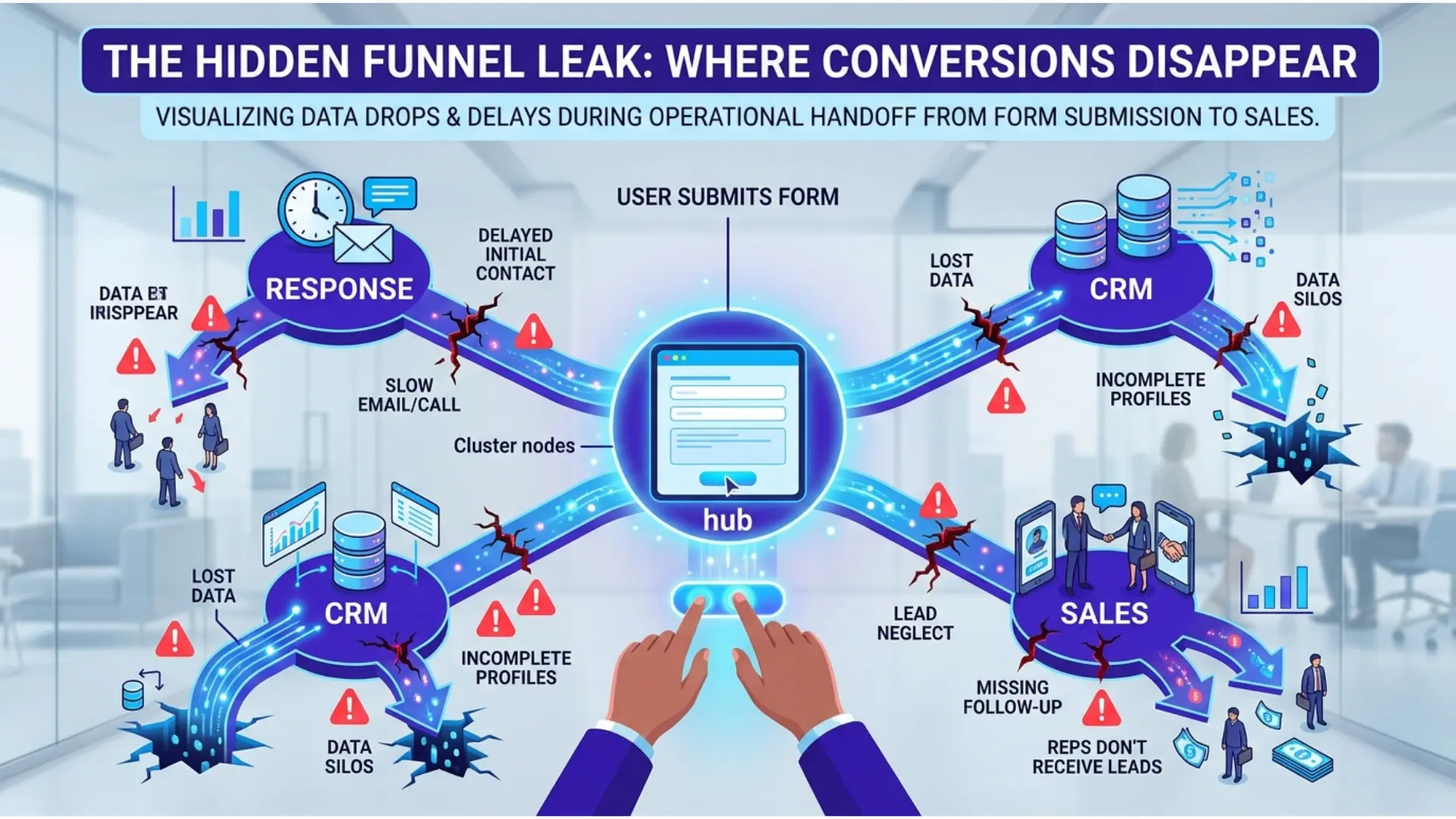
Technical drop-off: silent loss between submission and CRM
But there’s a more invisible threat – technical drop-off between form submit and CRM.
Imagine operations running perfectly on the surface, but under the hood, webhook errors or slow API syncs quietly cause leads to disappear before anyone follows up.
In one client scenario, 12% of form submissions never reached admissions due to a queue timeout nobody spotted until the numbers stopped adding up month over month.
The front-end showed healthy volume, but back-end routing mismatch ate potential deals before they got a chance.
We often see pipelines riddled with silent decay: tracking tags that fail, automated lead assignments stuck in limbo, or records shrugged off as spam due to misfired filters.
It’s the operational equivalent of locking new customers out while claiming strong conversions upstream.
You can’t fix this with more testing or prettier pages.
Only surgical diagnostics from ops and CRM teams expose these gaps.
If outcomes lag but web analytics look clean, look harder at post-form routing.
The handoff may be starving the rest of your funnel long before optimization can help.
Real growth starts where accountability is clear – and invisible decay is treated as urgent, not background noise.

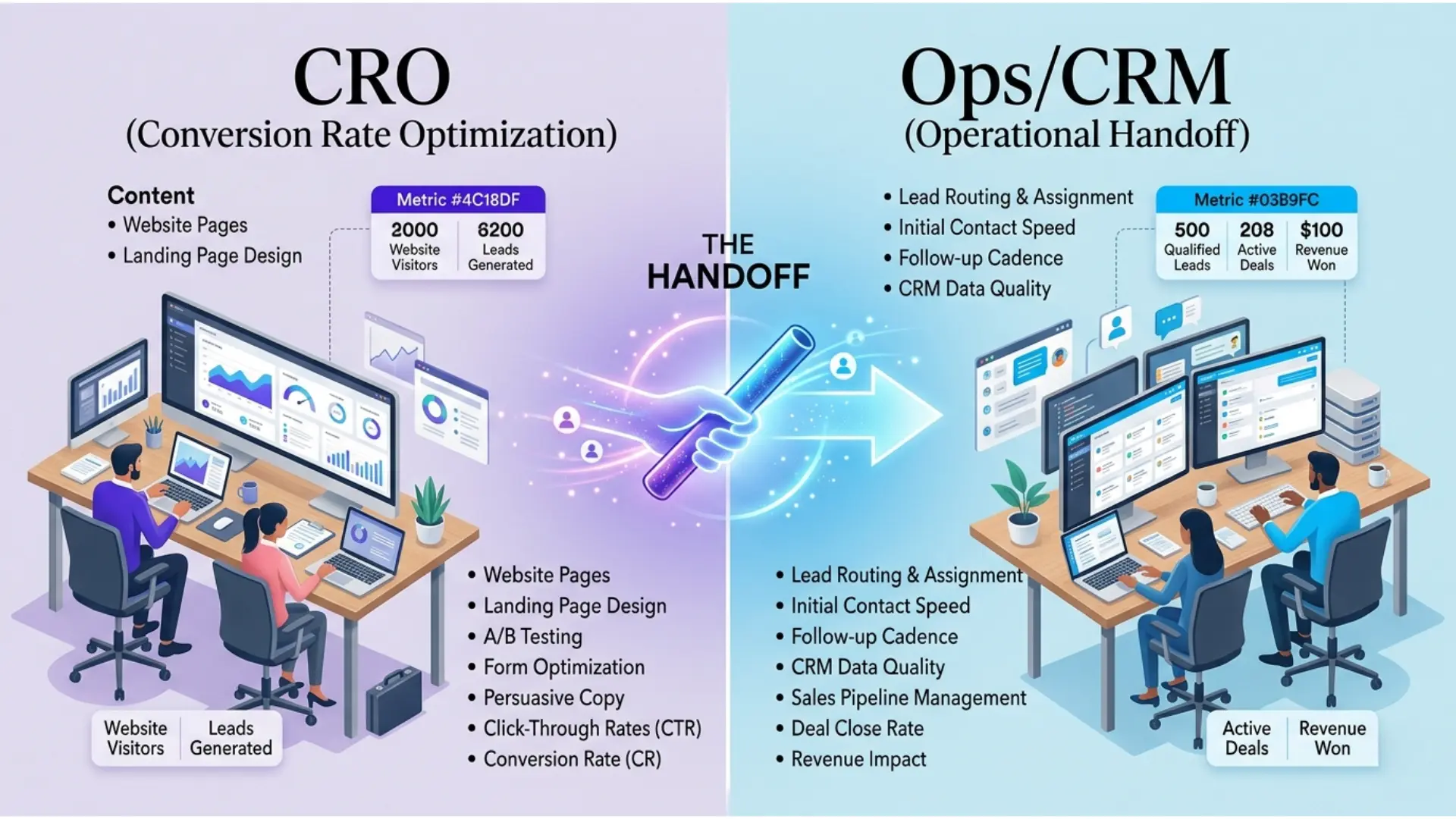
Where CRO responsibility ends and operational handoff begins
Most teams assume that once a lead hits “submit”, the conversion is in the bag.
It’s not – the truth is, the single biggest point of control for CRO ends the moment data leaves the page.
From there, a new set of risks starts, and digital marketers don’t own that terrain.
The difference between a strong CRO program and an operationally sound pipeline is as real as an airport’s runway versus air traffic control: you can build world-class landing strips, but if the tower fails, planes go nowhere.
What CRO can influence – and what it cannot after form submit
CRO lives upstream – its mission is friction reduction.
That means guiding users past uncertainty, eliminating unnecessary fields, and making the value clear before the form is filled.
Once the submit button is hit, though, the baton passes.
Marketers can optimize persuasion, not what happens in the black box after.
Here’s where we see most confusion: when campaigns tank, the blame boomerangs to page design, even when every technical handoff issue, like webhook misfires or CRM sync errors, sits outside CRO’s practical scope.
One healthtech brand we supported spent three months cycling new form variants, chasing single-digit conversion bumps, only to discover that their CRM was throttling 30% of leads as spam.
That’s an operational failure misattributed as a marketing one – no amount of A/B testing can patch a post-form black hole.
If you’re pushing for lower drop-off on the website but leads vanish post-submit, you’re no longer in a world CRO controls.
This is where the notorious handoff failure vs CRO blame game starts – and where real diagnostics begin.
When to escalate to CRM or admissions teams
How do you know when a lead quality disconnect points beyond CRO?
Look for signals: sudden post-submit decay, inconsistent response time, or discrepancies between what was promised and what happens next.
If your analytics show healthy form fills but sales or admissions teams complain about low contact rates or mismatched intent, it’s a flashing indicator that routing mismatch – not on-page experience – is at fault.
We advise clients to draw a hard line.
If the funnel delivers valid leads to the next system and outcomes drop, escalate to the specialized team: CRM, admissions, or operations.
This should happen if you see:
- Multiple leads processed but no rapid follow-up, response time friction.
- Data loss between submission and back-end systems, post-form handling failure.
- Repeated disconnects between fielded leads and what teams expect, conversion quality failure.
A well-run CRO program brings transparency, but it doesn’t handle everything after form submit.
Executives need to spot handoff blind spots before authorizing another round of design tweaks.
Knowing where your job stops – and when to call in experts – prevents wasted cycles and accelerates the real fix.
For deeper diagnosis of these operational gaps, executives should consult CRM or admissions capability hubs, as well as specialized sales operations resources, to map breakdowns outside CRO’s direct scope.

Next steps when CRO improvements don’t move quality outcomes
Most executives push for sharper CRO only to discover the real blockage shows up nowhere in their A/B test data.
So what do you do when every page variation looks polished, metrics plateau, and yet closed deals flatline?
The common reflex – run another design experiment – is like checking a thermometer when the furnace isn’t even on.
The real work?
Stop optimizing forms and start tracing what happens after a lead hits your system.
Where to run operational diagnostics, not design tests
When metrics plateau but revenue lags, look past the page – many of the biggest breakthroughs come from tracing the lead’s journey through your internal systems, not from another round of design changes.
Practitioner reality: You don’t need a new headline, you need a triage of your CRM, admissions, and sales handoffs.
Dissect responses – were they prompt, relevant, and outcome-driven, or did leads rot waiting for human contact?
Is response time friction killing momentum?
To isolate failure, engage with sales ops and CRM admins, not designers.
The best move is a heatmap – not of click activity, but of response logs, call attempts, and CRM stage movement.
One client, staring down a stalled sales pipeline, mapped submission timestamps against first-response delays and discovered half their “qualified” leads went 36 hours before being touched.
In that time, interest died.
Think of it like a relay race: a pristine baton pass looks good on paper, but if the runner never gets out of the starting block, the handoff means nothing.
Where in your pipeline does speed or routing mismatch break the flow?
How to signal need for throughput vs. quality correction
Diagnosing Throughput vs. Quality Issues Post-Submission
| Type of Breakdown | Description | Impact | Example |
|---|---|---|---|
| Mismatch between promise and follow-up handling | Follow-up does not align with lead expectations set by marketing messaging | Loss of trust and reduced likelihood of engagement | Sales rep calls with generic script instead of promised specialist callback |
| Technical drop-off | Leads lost between form submission and CRM due to errors or delays | Leads disappear silently, reducing pipeline volume | 12% of form submissions not reaching admissions due to queue timeout |
| Response timing friction | Slow or delayed responses causing loss of prospect interest | Leads cool off, lowering conversion at later stages | Leads not contacted within 15 minutes after form submit |
It’s common to see high lead volume and flat closed deals – yet the real split is between a breakdown in throughput versus an issue with lead quality.
Instead of defaulting to surface fixes, diagnose whether uncontacted leads signal operational failure, or whether prompt outreach with no conversions signals an upstream traffic or messaging disconnect.
Look for where failures cluster:
- Leads pile up untouched. That signals a throughput issue: slow follow-up, poor routing, or response delays.
- Every lead is contacted promptly, but conversion stalls. Diagnose quality: source mismatch, unclear expectations, or misaligned messaging.
Codifying these patterns accelerates triage and prevents time wasted chasing page tweaks for non-CRO breakdowns.
Ask yourself: What’s the signal in your noise?
Monitor response lag, distribution bottlenecks, and lead feedback cycles, then flag to the right team.
Sometimes, the message your pipeline sends isn’t “fix the page” – it’s “fix what happens after the click”.
The core: Better pages can’t salvage broken pipelines.
The real path forward is operational clarity, not pixel perfection.

Scientific context and sources
The sources below provide foundational context for how decision-making, attention, and performance dynamics evolve under scaling and constraint conditions.
- Funnel Friction and Decision-Making
“The Hidden Conversion Funnel of Mobile vs. Desktop” – A. Goldstein et al. – Electronic Commerce Research and Applications
Analyzes user progression through conversion funnels using behavioral data, showing that users move through multiple cognitive stages and that drop-offs occur between stages due to friction, not just page-level persuasion issues.
https://www.sciencedirect.com/science/article/abs/pii/S1567422322000199 - Information Processing Delays and Customer Reaction
“A Study on Tolerable Waiting Time: How Long Are Web Users Willing to Wait?” – F. Nah – Behaviour & Information Technology
Empirical study showing that user tolerance for system delays follows strict cognitive thresholds (≈0.1s, 1s, 10s), where increasing latency disrupts attention, breaks task flow, and leads to abandonment – demonstrating that conversion loss can stem from system performance issues rather than CRO factors.
https://ink.library.smu.edu.sg/sis_research/10073/ - Organizational Handoff Failures
“Predictive Analytics for Marketing Funnel Drop-off Reduction” – International Journal of Advanced Research in Commerce, Management & Social Science
Shows that conversion losses cluster at specific funnel stages, where users fail to progress due to system-level issues such as misalignment, friction, or execution gaps – not merely messaging or UI optimization problems.
https://doi.org/10.62823/ijarcmss/8.3(ii).7980 - Revenue Attribution and Conversion Pipeline Leakage
“E-Commerce Conversion Analytics” – ResearchGate / academic study
Demonstrates that conversion must be analyzed across the full system using multi-step analytics, as visible conversion rates often mask underlying bottlenecks and leakage across stages.
https://www.researchgate.net/publication/358989030_E-Commerce_Conversion_Analytics - Organizational Boundaries and Accountability
“Funnel Analysis (Concept and Application)” – Academic synthesis (behavioral analytics literature)
Explains that conversion funnels measure user progression across steps, where each stage introduces attrition (often 30-80%), and performance differences emerge from system structure rather than isolated page changes.
https://en.wikipedia.org/wiki/Conversion_funnel
Questions You Might Ponder
What is the difference between handoff failure vs CRO in lead generation?
Handoff failure refers to breakdowns after a form is submitted, such as delays in follow-up or technical errors in CRM routing – issues outside traditional CRO (Conversion Rate Optimization), which focuses on page and form improvements. Recognizing the distinction ensures the right team addresses each conversion leak.
Why do higher form completion rates not always lead to more sales?
Increased form submissions only boost sales if downstream processes – like response timing, follow-up quality, and CRM handling – work seamlessly. If operational handoffs are flawed, more form fills can simply result in more lost opportunities and lower conversion quality, not higher revenue.
How do you identify if a conversion problem is due to CRO or handoff failure?
If form completions are healthy but follow-up rates, response quality, or closed deals stall, it’s likely a handoff failure. Persistent technical errors or delayed responses post-submission are telltale signs the conversion barrier lies in operational or CRM systems, not on-page optimization.
What steps can a business take when A/B testing improvements stop yielding results?
When A/B tests plateau while sales lag, businesses should audit operations – mapping lead journey from submission through CRM response and team follow-up, tracking delays and failures. Collaborate with ops and sales teams to diagnose pipeline breakdowns beyond what CRO alone can resolve.
Why is rapid response after form submission critical in the sales funnel?
Prospects’ interest decays rapidly post-submission; research shows delays over 15 minutes drastically decrease successful connections. Speedy, relevant follow-up keeps prospects engaged while intent is strong, directly influencing conversion probability and final deal closure rates.