
What You’ll Learn
Decision uncertainty is the hesitation users feel when they want to act but lack enough clarity, confidence, or risk coverage to complete a conversion.
In CRO, it appears when visitors are unsure about the outcome, cost, time required, social risk, privacy, support, refund terms, or what happens after they click.
Decision uncertainty is not simple disinterest.
It is rational caution caused by unanswered questions and invisible trust gaps.
Strong conversion experiences reduce uncertainty by matching the user’s intent, clarifying next steps, proving credibility, and removing doubts at each micro-decision point, so users can move from interest to confident action.
Key Takeaways
- Conversion often fails due to decision uncertainty and invisible friction, not design flaws.
- Micro-level hesitations arising from trust gaps, message mismatches, and process obstacles accumulate to stall user momentum.
- CRO can only address blockers within the decision environment; root-cause issues often originate upstream in traffic and messaging.
- Effective optimization targets trust-driven decision points, clarifies uncertainty, and routes non-CRO problems to relevant teams.
A beautiful landing page can still repel buyers.
Most teams assume surface-level “fixes” – slick layouts, new fonts, fresh colors – move the needle, when in reality, invisible blockers are driving exits long before visuals come into play.
The difference between pages that convert and pages that stall is not aesthetics; it’s friction layered into the user’s decision-making path.

Why conversion fails: seeing CRO as a decision system, not design
Here’s a myth that drains budgets: good design equals high conversion.
We’ve worked with brands where traffic skyrocketed and bounce rates dropped, but actual lift in revenue or sign-ups was negligible.
What happened?
Decision friction.
Moments of uncertainty, mismatched expectations, and trust gaps compound – causing rational, silent hesitation.
The conversion equation is not “Does this look nice?” but “Do I feel safe, clear, and willing to act now?”
Why decision friction matters for outcomes, not appearance
One analogy: think of your conversion flow as a series of locked doors.
Each “no” or hesitation is a missing key – uncertainty, confusion, or even a nagging sense that something is off.
You can polish the doorknobs all you want, but without keys, no one moves forward.
Ask yourself: are your visitors pausing because they dislike your page, or because they’re not sure what happens next?
Most silent conversion killers never appear in analytics – they’re the micro-moments where outcome risk or lack of clarity outweighs desire.
When ‘trust incompletion’ meets ‘mismatch between intent and page,’ even passionate buyers freeze.
The real stakes are emotional, not cosmetic – and your revenue is on the line.
What CRO can influence – and what remains upstream or downstream
Not every conversion challenge is a CRO problem.
Most companies throw optimization at the wrong fire – tweaking buttons or headlines – without recognizing that some decision barriers begin long before a visitor lands, or far after they leave.
CRO can only solve for friction inside the decision environment you control.
Here’s what’s inside scope: removing blockers that create uncertainty in user decisions, clarifying offers, building trust mechanisms, detecting silent exit points.
What’s beyond?
Traffic quality, brand impression, upstream messaging, and downstream issues like onboarding and fulfillment – these fuel or poison your conversion potential, but live in other teams’ domains.
We’ve seen high-intent users bounced by upstream mismatches – the wrong audience, misaligned promises, or a brand narrative that doesn’t match user psychology.
A simple question to stay oriented: is the user’s hesitation about your actual experience, or their prior beliefs, traffic source, or post-click journey?
If it’s the former, intervention belongs to CRO.
If not, you’re chasing downstream noise or upstream signals, not friction itself.
Conversion is a chain of decisions; optimizing the links you own is mandatory, but don’t mistake the whole chain for a single page or test.
The strongest results come when CRO addresses friction where it occurs, and executives redirect root-cause issues to acquisition, brand, or product when that’s where the blockage lives.
Conversion doesn’t fail because of pixel-perfect design.
It fails when decision friction is ignored, cosmetic tweaks are overvalued, and real blockers remain untouched.
The path forward starts by seeing every conversion as a trust-driven decision, not an aesthetic event.

How uncertainty blocks conversion as rational hesitation
Here’s what catches most teams off guard: conversion hesitation is rational, not random.
When a user pauses, they aren’t indecisive – they’re weighing risks you haven’t addressed.
Most silent conversion killers look like indifference in the numbers, but beneath the surface they are precise defense mechanisms triggered by uncertainty.
What’s stalling action isn’t lack of appeal – it’s unaddressed doubt, quietly multiplying friction with every unanswered question.
Outcome, cost, social, and time uncertainty – and how they stall action
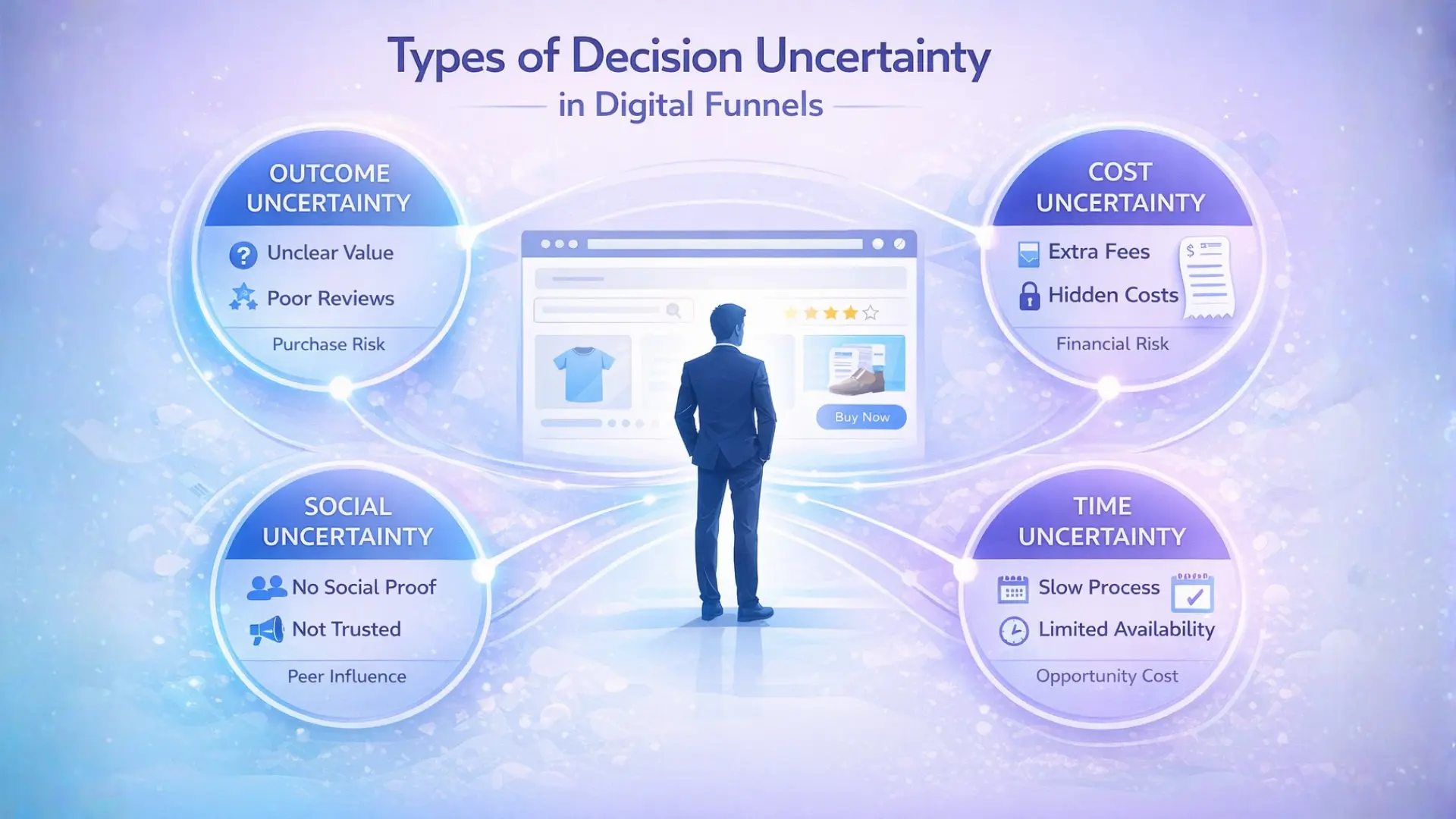
Types of User Decision Uncertainty That Stall Conversion
| Uncertainty Type | Description | User Concern |
|---|---|---|
| Outcome Uncertainty | Doubt about whether the product/service will deliver expected results | Will this actually deliver what I expect, or am I risking disappointment? |
| Cost Uncertainty | Unclear if the price or value is fair or if there is a hidden catch | Am I getting fair value, or is there a catch? |
| Social Uncertainty | Fear about how the decision affects the user’s social standing or reputation | Will this decision make me look uninformed or foolish? |
| Time Uncertainty | Unclear amount of effort, time, or follow-up required after the initial action | How much effort, time, or follow-up is required on my part beyond this click? |
Many executives overlook the biggest conversion hesitation causes: uncertainty in user decisions.
These come in four persistent forms.
- Outcome uncertainty: “Will this actually deliver what I expect, or am I risking disappointment?”
- Cost uncertainty: “Am I getting fair value, or is there a catch?”
- Social uncertainty: “Will this decision make me look uninformed or foolish?”
- Time uncertainty: “How much effort, time, or follow-up is required on my part beyond this click?”
Each category is a common reason why users don’t convert – stalling action not through lack of desire, but through unaddressed doubts or fears.
Every category acts as a mental speed bump.
In our client work, brands with strong traffic and polished pages still lose half their best prospects because users can’t get a clear answer to at least one of these.
It’s like running a relay where every hand-off has an invisible obstacle.
As more uncertainties pile up, users simply opt out, not because your offer is weak, but because their brains are hardwired to avoid ambiguous outcomes.
When one executive asked why a seemingly perfect page underperformed, our answer was blunt: the friction wasn’t surface-level – it was cognitive.
So, what’s the hidden multiplier? Unaddressed uncertainty stacks with remarkable speed.
Each category not only introduces doubt but subtly poisons trust in the decision environment.
If you’re asking, “Why aren’t we converting?” – start with these diagnostic gates.
When hesitation signals mismatch – not indifference
The most damaging myth in CRO is that hesitation means people don’t care.
In reality, hesitation usually signals a disconnect between what users expect and what’s actually offered.
Think of it like ordering a coffee and being handed tea – the mismatch isn’t fatal, but it instantly halts your next move.
We’ve seen high-fit prospects drop because a page assumed they already understood next steps.
Hesitation wasn’t driven by lack of enthusiasm, but by a missing link between their intent and what the page communicated.
The unspoken question: “Is this really for me, or am I about to make an expensive mistake?”
Conversion hesitation is rarely the end of the journey; it’s the moment silent rejection occurs.
That moment is less about lack of desire and far more about unmet expectations – users don’t leave in protest, they just don’t proceed.
This is the fundamental diagnostic shift: treat every stall as a signal, not a verdict.
Uncertainty isn’t an absence of desire – it’s the brain’s response to risk.
Diagnose it correctly, and hesitation becomes a map, not a dead-end.

Where friction appears in the journey – micro‑decisions that kill momentum
If you think conversion drops come from a single obvious blocker, look closer.
Most dead ends happen in the moments nobody’s watching – tiny frictions stacked across the funnel, killing momentum one micro‑decision at a time.
A pixel-perfect form or frictionless scroll won’t save you if the journey asks visitors to fight unnecessary battles on every step.
Real conversion hesitation rarely looks dramatic in analytics.
We’ve seen high-value leads quit after the second field of a three-step form – not because the fields were difficult, but because each click chipped away at trust or added doubt.
One SaaS client lost 14% of users on a navigation break buried between pages, discovering only later that a forced detour made intent vanish. Friction multiplies – it rarely operates in isolation.
The question isn’t whether friction exists, but where it compounds into a silent roadblock.
Form steps, navigation breaks, hidden fees: friction in motion
Picture your funnel like airport security: every extra bin, ID check, or rope barrier slows the line.
Each form field, every obscure menu, and one vague ‘continue’ button may seem harmless – until the cumulative drag overwhelms action.
Even “small” demands (like setting a strong password before any value is shown) can ignite hesitation.
Some teams obsess over removing single steps, thinking if one friction point is smoothed, flow returns.
But friction is cumulative.
A slick-looking checkout hides nothing if users are forced through three unnecessary log-ins or encounter a surprise fee at the last click.
We’ve watched luxury retailers lose cart conversions purely to hidden shipping surcharges that spark immediate distrust – the site looked flawless until the bill changed unexpectedly.
Practitioner insight: The more stages your process requires, the more fragile your momentum becomes.
Each step is a bet: will users believe this investment is still worth it?
When a single step destroys momentum, it’s rarely about complexity alone – it’s often the straw breaking a fatigued sense of trust.
This is why most “friction killers” in CRO are really about reducing the emotional tax of interacting, not just the number of inputs.
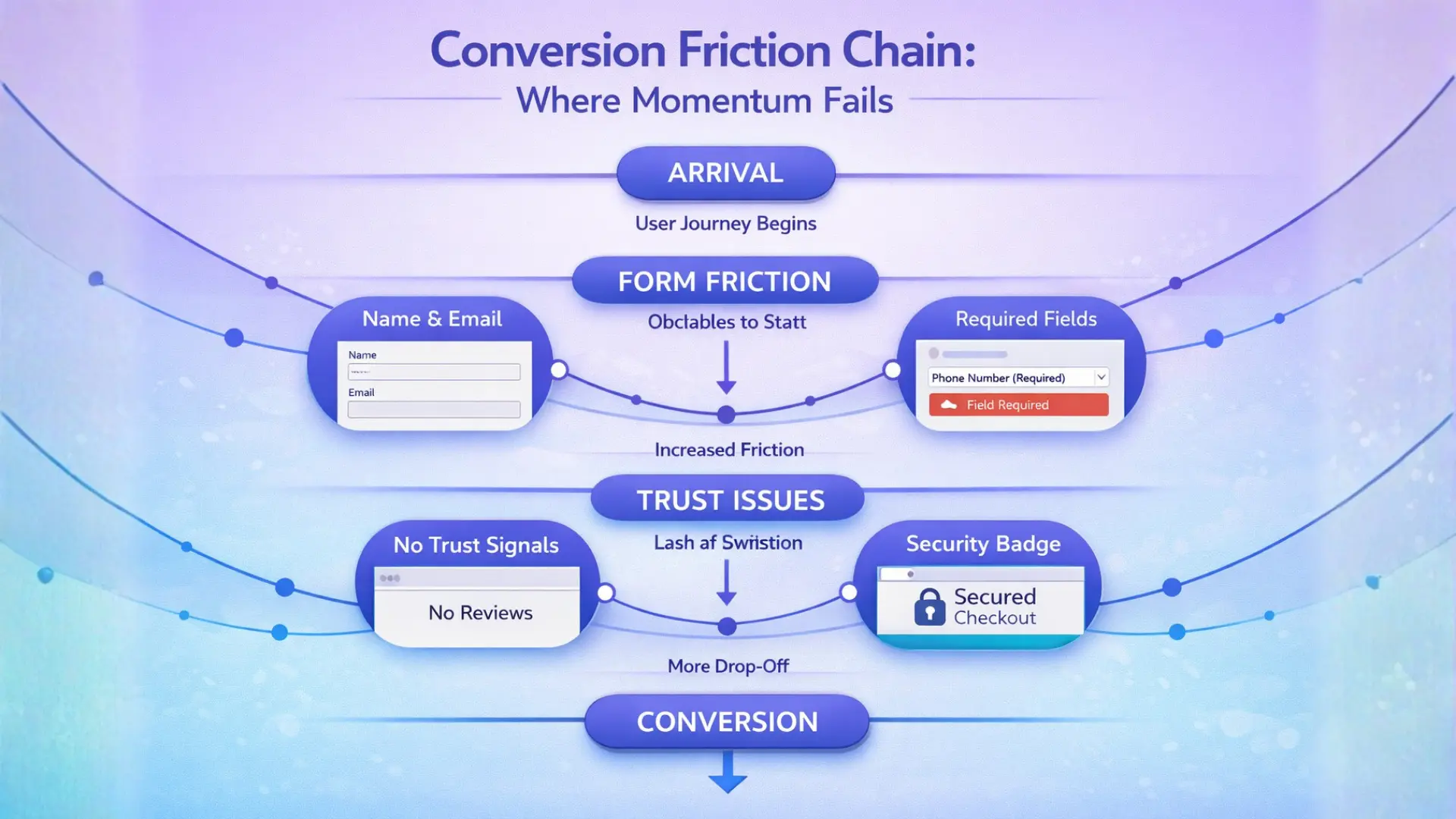
Message and intent mismatch: silent exits before form load
But friction doesn’t just sabotage momentum after interaction starts; it can silently terminate the journey before a single field loads.
Here’s the flaw most miss: if your messaging and users’ intent don’t match before the page even renders, there’s no chance friction removal can save you.
It’s the digital version of walking into a restaurant expecting sushi and finding only burgers – a trust signal lost before the menu even opens.
We’ve reviewed thousands of paid traffic sessions: the fastest exits occur on “clean” landing pages where the promise that got the click dies on arrival.
The silent conversion killer isn’t a technical error; it’s a trust fracture before supposed friction even begins. Users abandon before effort, not after.
This is why intent‑to‑message fit outweighs perfect UX. No amount of CRO surgery will recover users who feel deceived by a mismatched headline or offer.
Every campaign you run is an unspoken wager: will the story you told upstream match the experience found on-page?
Fail here, and your conversion pipeline becomes a leaky sieve – one silent exit at a time.
Map every micro‑decision and diagnose where momentum falters – not only after friction appears, but before the journey even begins.
The cost of neglecting these small blockers isn’t just incremental loss; it’s compound abandonment, multiplying across every stage.

Invisible trust gaps: when credibility stalls confident decisions
Most brands assume that slick testimonials or a modern badge near the button create trust.
Here’s what they miss: trust gaps are usually silent, invisible, and decay conversions before hesitation even registers as a bounce.
Your prospects aren’t thinking, “I don’t like this layout” – they’re wondering, “Can I risk my reputation, data, or money with these people?”
Trust incompletion as a silent conversion killer
The real conversion hesitation doesn’t announce itself.
A page that checks every design box can still leak revenue because it fails the “would I bet my job on this?” subconscious check.
In our client reviews, we’ve seen stunning landing pages stall because refund policies are ambiguous, team credentials are buried, or security details are missing.
Yet, visually, nothing seems wrong.
Think of trust as scaffolding beneath a bridge: invisible, but holding up every step the user takes.
When that scaffolding is incomplete, even ideal buyers quietly step back.
A financial software client once had impeccable branding – and suffered a 37% drop-off on their final signup step.
The culprit?
A missing mention of data privacy, surfaced only after session replays revealed users scrolling and abandoning with no interaction.
This isn’t about how the page looks – it’s about what the experience silently fails to answer.
Are there risk signals hiding in plain sight?
Would a skeptical prospect, under pressure, feel protected or exposed?
The silent conversion killers are usually trust incompletions, not design missteps.
When generic proof does more harm than none
Worse than missing proof is misapplied proof.
Stamping a logo carousel or bland testimonial above your CTA can actually amplify doubt, especially if the examples are irrelevant or clearly templated.
We’ve seen SaaS brands tout “Fortune 500 trusted” in unrelated niches – result: engagement drops, not rises.
The myth is that “any” social proof is better than nothing; in reality, poorly contextualized examples erode authenticity and make the offer look riskier.
Consider this: if your last three customer quotes all sound like corporate scripts, does anyone believe a real user wrote them?
If your security badge means nothing to your target audience, is it a signal or just noise?
In every credible diagnostic, generic proof creates friction because it introduces new uncertainty – “Who actually benefits from this?” – instead of closing the gap.
Concrete, relevant evidence outperforms quantity every time.
Trust is built through specificity: precise client stories, exact policy language, transparent credentials.
Anything less, and you’re just painting over a shaky foundation.
Trust incompletion isn’t a surface-level problem – it’s the silent force behind abandoned carts and indecisive sessions.
Find the real gaps, and conversions follow.

Where CRO stops – and when you must route elsewhere
Most conversion teams waste quarters hunting for hidden page friction, when the real issue started before the visitor even arrived.
If you’re tuning call-to-actions and button placements while acquisition is sending the wrong audience, CRO cannot save you – it can only polish a misfit.
When conversion issues reflect acquisition or messaging upstream
A painful truth: conversion rates often decline because traffic quality is misdiagnosed as an on-site problem.
We’ve seen brands invest six figures optimizing landing pages, only to find that their targeting strategy was attracting the wrong segment entirely.
The result?
Users land with expectations – then leave, fast – because the promise of the ad or channel never matched the reality offered.
Think of it as treating the symptom, not the cause.
If messaging upstream is unclear or misaligned, every CRO effort becomes an expensive distraction.
One client doubled down on design tweaks for months while the real leak was coming from poorly written search ads bringing in info-seekers instead of buyers.
Ask: Are users hesitating because of on-page friction, or because they never should have been there in the first place?
Misattribution kills momentum – and budget. CRO can only optimize what’s within reach.
If intent doesn’t match offer, the problem starts long before landing page elements matter.
When the decision delay is a design or execution problem – not CRO
Not all hesitation points to decision friction in conversion.
Sometimes users stall due to execution gaps that live in operational or technical domains: slow load times, broken forms, or clunky mobile experiences.
These aren’t psychological hurdles – they’re functional failures.
A fast analogy: it’s like blaming the cashier for low sales when the automatic doors are stuck shut.
CRO can diagnose friction blockers, but cannot resolve infrastructure or fix upstream deficiencies.
Our practice draws a hard line: if users struggle to access, read, or complete, the answer is rarely more persuasion.
You need the right specialist – product, dev, or IT – to fix technical blockers before conversion science becomes relevant again.
Marketing friction dilutes intent, but technical and audience mismatches shut down conversion before it starts.
The clearest growth comes when executives know exactly when to stop tuning conversion and start routing problems upstream or down.
Smart teams draw the boundary with conviction – and reclaim budget, speed, and confidence in the process.

Scientific context and sources
The sources below provide foundational context for how decision-making, attention, and performance dynamics evolve under scaling and constraint conditions.
- Decision Friction and User Behavior
“Neural correlates of dueling affective reactions to win–win choices” – Shenhav & Buckner – Proceedings of the National Academy of Sciences
Explains cognitive load and avoidance when uncertainty appears in decision environments, relevant for understanding how friction and doubt inhibit online conversion.
https://www.pnas.org/doi/abs/10.1073/pnas.1405725111 - Trust in Digital Environments
“A Meta-analysis of Online Trust Relationships in E-commerce” – Kim & Peterson – Journal of Interactive Marketing
Outlines how trust signals must match user intent and perceptions to enable action; explores how invisibly incomplete cues create conversion gaps.
https://www.sciencedirect.com/science/article/abs/pii/S1094996817300014 - Uncertainty’s Impact on Consumer Choice
“Process fairness, outcome fairness, and dynamic consistency: Experimental evidence for risk and ambiguity” – Trautmann & van de Kuilen – Journal of Risk and Uncertainty
Details how unaddressed ambiguity in digital offers raises hesitation and produces measurable losses in conversion-related decision tasks.
https://link.springer.com/article/10.1007/s11166-016-9249-4 - The Effect of Friction on UX Outcomes
“Designing usable web forms: empirical evaluation of web form improvement guidelines” – Bargas-Avila et al. – CHI ’14: Proceedings of the SIGCHI Conference on Human Factors in Computing Systems
Demonstrates how micro-level input and navigation frictions compound, causing users to abandon even well-designed online forms and processes.
https://dl.acm.org/doi/10.1145/2556288.2557265 - The Chain of Trust and Its Broken Links
“Technology, Humanness, and Trust: Rethinking Trust in Technology” – Lankton, McKnight & Tripp – Journal of the Association for Information Systems
Investigates the subtle differences between surface-level trust elements and the underlying factors that drive, or inhibit, decisive user actions.
https://aisel.aisnet.org/jais/vol16/iss10/1/
Questions You Might Ponder
What is decision uncertainty, and how does it impact online conversion rates?
Decision uncertainty occurs when users are unclear about outcomes, value, or trustworthiness in a digital environment, leading to hesitation and lost conversions. Eliminating uncertainty is essential for supporting confident user action and improving overall conversion rates.
How can you identify hidden decision friction on a landing page?
Hidden decision friction often manifests as points where users hesitate, abandon forms, or exit without clear reason. Mapping user journeys, running session replays, and analyzing micro-conversion drops can reveal these invisible blockers, helping teams address issues beyond cosmetic design.
Why does traffic quality matter more than page design for conversion?
If visitors come from misaligned channels or expectations, even a flawless page won’t convert. Traffic quality sets the foundation for conversion; without a match between user intent and offer, CRO fixes are limited in impact regardless of page quality.
What types of decision uncertainty stall purchases most frequently?
The main types are outcome uncertainty (will this deliver?), cost uncertainty (hidden fees or unclear value), social uncertainty (trust and reputation risks), and time uncertainty (required effort). Each introduces doubt, lengthening hesitation or triggering abandonment.
How can teams reduce uncertainty to drive higher conversions?
Teams should clarify benefits, reduce effort, offer transparent guarantees, and use specific social proof. Directly addressing user fears, providing clear next steps, and proactively communicating trust signals are proven ways to minimize uncertainty and boost conversions.