
What You’ll Learn
Why content impact is invisible means that content often shapes buyer trust, problem awareness, authority, and readiness before any measurable conversion appears in analytics.
A person may read several articles, see social posts, review case studies, or hear the same framing from peers before they ever click a form or contact sales.
Standard attribution systems often credit only the final action, so they miss the earlier content touches that reduced uncertainty and built preference.
Content’s real influence is often delayed, multi-touch, and indirect.
It becomes visible later through warmer leads, shorter sales cycles, stronger brand recall, fewer objections, and higher trust before the first conversation.
Key Takeaways
- Invisible content impact primarily builds trust, authority, and buyer readiness, often unnoticed by standard analytics.
- Content effectiveness compounds through consistent narrative framing and well-integrated multi-touch buyer journeys.
- Conventional attribution systems miss most of the true influence, causing undervaluation of strategic content initiatives.
- Sustainable authority comes from coherent systems and cross-channel reuse, not from chasing formats or surface metrics.
“Invisible content marketing impact” refers to trust accumulation and pre-selling influence that shapes buying decisions before measurable conversions, explaining why meaningful impact is rarely visible in direct analytics reports.
What if your most valuable content wins never show up in campaign reports?
There’s a reason the invisible content marketing impact frustrates so many – and it’s not because your content “isn’t working”.

Why Expecting Content to Convert Immediately Is a Misdiagnosis
Content isn’t like a vending machine where you feed in posts and get out sales.
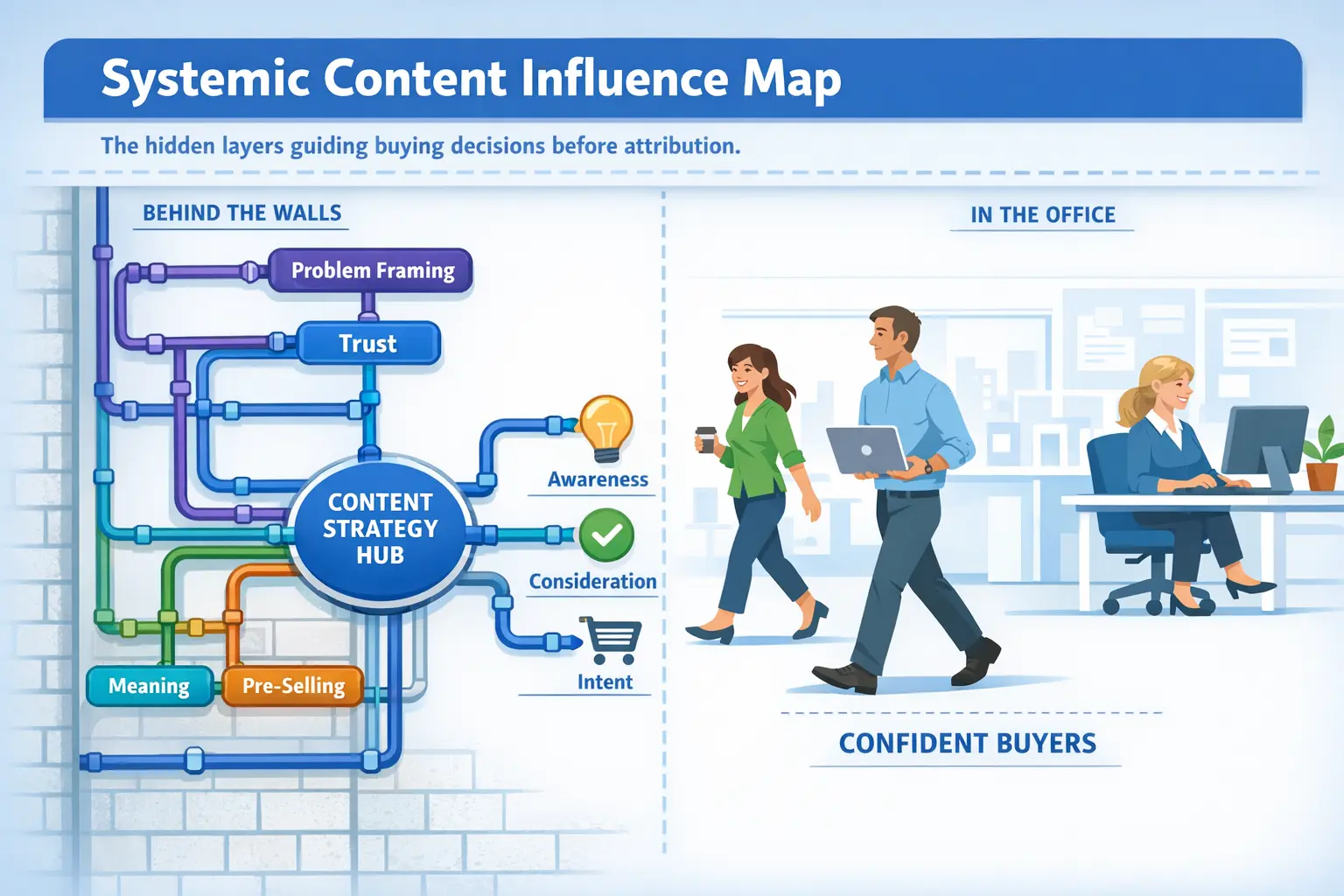
It’s more like the electrical wiring in an office: invisible, everywhere, foundational, only noticed when something short-circuits.
The system includes:
- problem framing (helping customers define their need),
- meaning creation (offering perspective on that need),
- trust accumulation (showing consistency and reliability),
- demand shaping (preparing the mind to prefer your solution).
These aren’t formats – they’re system parts working together quietly.
Content as a system, not a tranche of outputs
Components of the Content Marketing System
| Content Touch Type | Role in Buyer Journey | Timing |
|---|---|---|
| Problem-solving guide | Introduces solutions | Early stage |
| In-depth opinion piece | Shapes perspective | Mid stage |
| Quick testimonial | Validates credibility | Late stage |
| Well-timed social insight | Maintains awareness | Throughout |
We’ve watched ambitious teams push out more blogs and case studies, expecting a jump in leads.
The content flowed, traffic trickled in, but conversions barely budged.
Why?
The outputs had no shared system.
Content wasn’t framed to solve for the customer’s deepest stress or position the offer as the natural answer.
If the system behind your outputs isn’t shaped around meaning and trust, no output by itself will tip the scales.
Myth: The only content that matters is content that ranks or gets tracked conversions.
In reality, some of your strongest pieces never “go viral” or spark obvious action, but they prime minds, surface questions, and create the quiet appetite for more.
Think of content’s invisible influence like compound interest – the real payoff is exponential, but only when each part acts with the others.
Would you notice if the wiring in your office doubled your productivity tomorrow?
Or would you just feel that things seem to “work better”?
Time lag and multi‑touch influence
Multi-Touch Content Influence Over Time
| Component | Function | Analogy |
|---|---|---|
| Problem Framing | Helping customers define their need | Starting the circuit |
| Meaning Creation | Offering perspective on the need | Powering the signal |
| Trust Accumulation | Showing consistency and reliability | Building the wiring |
| Demand Shaping | Preparing the mind to prefer your solution | Setting the switch |
Ever had a client say they “just found you”, but you already know they’ve read five articles and watched two videos in the last six months?
That’s the time lag at work.
Content’s role is often pre‑selling – not by direct pitch, but by layering value until the moment is finally right.
You can’t measure influence in a straight line.
The path from first awareness to action often involves a dozen (or more) content touches: a problem-solving guide, an in-depth opinion piece, a quick testimonial, a well-timed insight on social.
It’s less like a single jump and more like stepping stones across a river in fog.
Each touch reduces uncertainty and increases trust, but no one piece gets full credit.
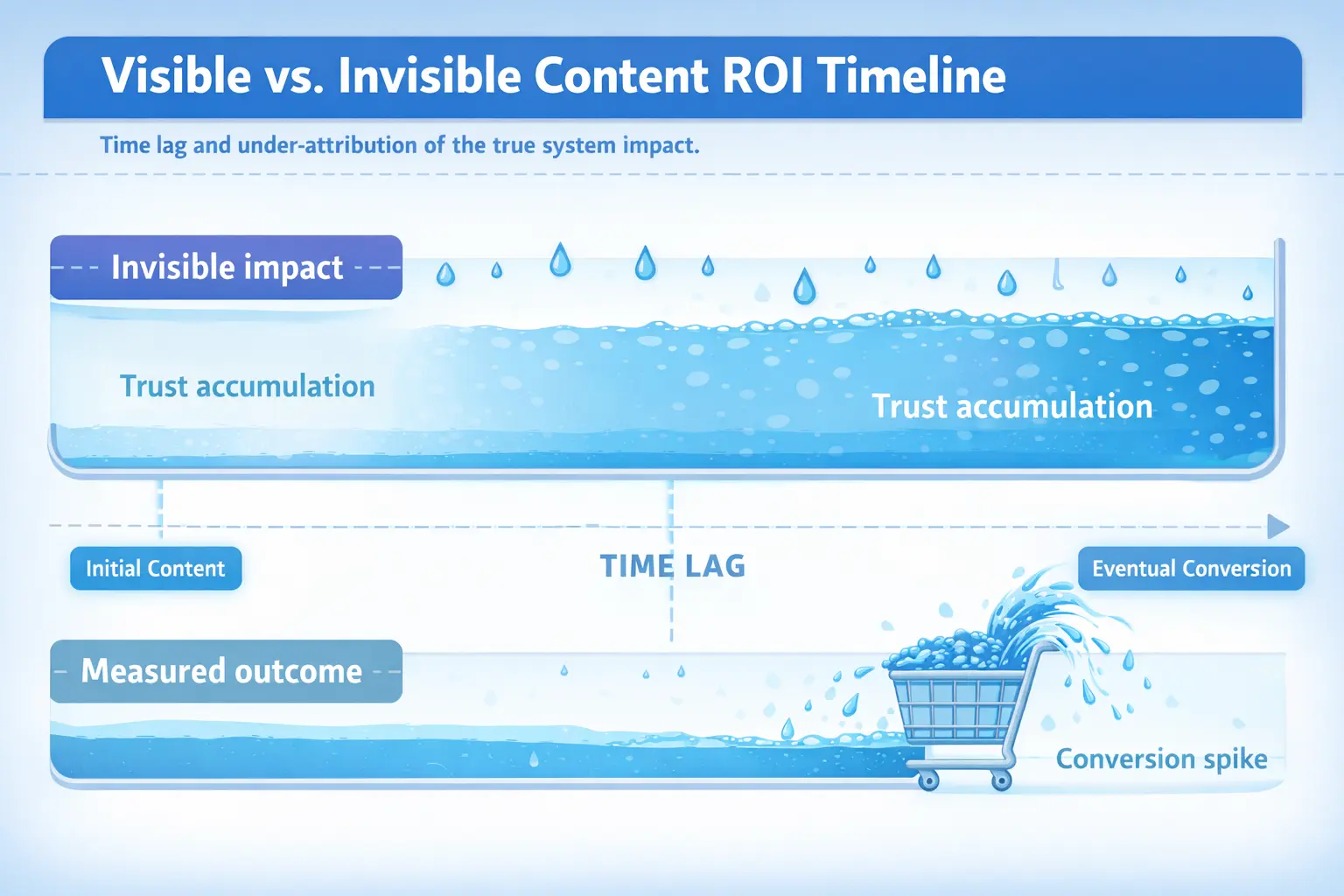
With one SaaS client, we saw “delayed content effect” in action: a surge in product demos six months after a strategic content push – not because content suddenly “worked”.
The audience finally reached a trust threshold.
Attribution dashboards missed the story entirely.
Here’s the simple analogy: content influence is like water slowly filling a reservoir.
You don’t see the shift until it overflows – then everyone rushes to measure the flood, forgetting the steady drip that made it happen.
The question to ask: Are you frustrated because the river isn’t moving, or because you only see the surface while the current builds below? Content’s invisible power lies not in the immediate spike, but in shaping readiness over time.
Expect the system to do its slow, powerful work as every touch builds trust and demand for you.

What Content Changes Before the Click
Reducing uncertainty and pre‑selling
Imagine this: Your highest-value prospect reads ten pieces of your content but never clicks a single “Book a Demo” button.
Months later, they show up to your intake call echoing your own language back to you.
Did content fail, or did it prime the ground before you ever saw a spike?
That’s the paradox – most content’s true influence is invisible, shaping beliefs and expectations upstream of conversion.
In our experience with B2B clients who struggled with “silent” lead pipelines, a strategic content burst focused on objection-busting sparked a double-digit lift in demo-to-close rate – despite flat top-funnel traffic.
The real movement happened in the mind, not the analytics dashboard.
Why?
Content that addresses uncertainties, clarifies value, and treats the reader’s inner voice (“Is this actually for me? What if this won’t work here?”) eliminates hidden friction.
Pre-selling isn’t about blunt persuasion – it’s about setting mental cues.
Like scenting a room with fresh coffee before hosting important guests.
The decision-maker steps into call #1 already inclined toward trust.
High-performing teams know: If your content does its job, the audience rarely remembers the specific blog or video. Instead, they recall the feeling of “finding the right fit”.
Trust accumulation and narrative consistency
Trust doesn’t build in bursts; it drips, accumulates, and solidifies with repeated, consistent perspective.
Here’s a simple analogy: Think sediment collecting in a riverbed.
You don’t notice it daily, but over time, it forms rock.
One client – a fintech brand – faced hesitant enterprise buyers.
Through a regular stream of expert explainers (with minimal direct pitching), we watched third-party attributions in CRM notes like, “Followed their market breakdowns for months – seem credible”.
But attribution models flagged “low ROI” for the same efforts.
The content didn’t just inform; it built the sense of a steady, trustworthy hand.
If your content vanished overnight, would trust in your brand erode silently?
A single one-off asset can’t patch a credibility gap.
Reliable impact comes from a pattern.
Executives remember narrative, not numbers or one-off pieces.
This is why measuring only last-click wins leads teams astray – narrative trust outlives every landing page.
Here’s a common myth: Only “viral” content moves markets.
In practice, consistent storylines and voice are what reposition a company from unknown vendor to default choice in the buyer’s mind.
Indirect influence is the driver: the reason why “invisible content marketing impact” and “trust accumulation content marketing” matter more than any view count.
In sum – if you’re searching for evidence before the click, look for patterns in perception and confidence, not isolated spikes.
Next: How attribution tech leaves most of this value in the shadows.
Definition: Invisible content marketing impact is the cumulative, often untrackable influence content has on buyer behavior, trust, and demand – rarely captured by standard attribution or ROI metrics, but critical for long-term authority.

Where Attribution Systems Rout Content’s Value into the Shadows
Attribution mismatch: capturing last click vs system effect
Why do your numbers look flat, while your audience is heating up?
Here’s a shocker: More than 70% of buyers say they made a shortlist “before ever talking to sales”.
Yet, most attribution tools credit just the last ad or click.
That’s like rewarding the waiter for your favorite dish and ignoring the chef.
In practice, we’ve seen C-suites cut budgets on content programs delivering measurable growth – because reports missed indirect wins completely.
One client’s whitepaper sparked conversations that led to $1M+ deals, but the analytics dashboard showed these leads “appeared out of nowhere”.
Here’s why: attribution models are built for linear, trackable actions.
Content marketing – especially trust accumulation and pre-selling – works like water soaking into soil, not like a light switch turning on.
There’s rarely a neat, single path from content to conversion. Instead, content weaves through search, social, direct outreach, and even word of mouth.
Most systems only catch the leap, not the long climb.
Ever wonder why an opportunity feels “warmed up” before sales even say hello?
That’s the invisible content marketing impact: your influence is spread out and time-released, never pinned to a single moment.
Attribution complexity grows with multi‑touch journeys. Data silos and cross‑team collaboration gaps further mask content’s indirect effects – making true impact even harder to trace in complex organizations.
Misleading signals: traffic, views, and vanity metrics
We’ve seen a 10X jump in pageviews produce exactly zero pipeline movement.
Meanwhile, an unremarkable blog post led to a flood of high-quality conversations – because it built trust and equipped champions inside target firms.
When you chase vanity metrics, you risk tying your perception of value to surface activity, not sustainable influence.
Vanity metrics are like looking at the sun setting in the rearview mirror – pretty, but they won’t get you home.
True system health shows up as assisted content influence: deals close faster, decision makers arrive with fewer objections, and inbound leads reflect your point of view.
Numbers alone don’t reveal these shifts.
Frameworks like Multi-Touch Attribution attempt to bridge the gap, but even these often miss the “invisible hand” of trust-driven content.
Is traffic a signal, or a distraction?
If your ears pricked up, you’re not alone.
The metrics most leaders default to miss trust accumulation content marketing delivers. Content’s real returns might be untagged, but they’re never absent.
Turning a cold spreadsheet into a recognition of delayed content effect means questioning what value looks like – often, it’s what remains when the noise dies down.

Common False Conclusions That Lead to Format Chasing
It doesn’t rank so it fails
What if a single keyword ranking could blind you to the actual purchase?
It’s a hard truth: content can power millions in indirect content ROI – and still never touch page one of Google.
One client fixated on search positions, convinced their content had failed.
But a deep look showed high-value conversations, sales call readiness, and inbound interest were quietly increasing.
Ranking wasn’t their source of movement.
The real story?
Structure, framing, and decision-stage clarity mattered more than position.
When content aligns with how your buyers think, it unlocks trust accumulation and pre‑selling value – even off the front page.
Has anyone on your team asked, “Why did that lead really convert?”
The answer isn’t always search.
Sometimes it’s trust, built drip by drip, across overlooked corners of your site or even through old thought leadership pieces.
Think of the search algorithm like an X-ray.
It can show structure but not lived experience or motivation.
Ranking is one feedback loop, but not the only one that shapes content influence without attribution.
Chasing rank can trap teams in a cycle: always tweaking, rarely reflecting on whether content structure resonates with the audience’s problem frame.
Surprise: Most authoritative voices in your niche don’t lead with rankings.
They dominate because their structure, not format, powers authority – and because they resist quick switches when the traffic graph wobbles.
That’s the path to invisible content marketing impact.
AI made content meaningless / More formats will fix it
Here’s a contrarian thought: Churning out more formats or jumping on the latest AI tool rarely fixes content fatigue.
The belief that AI suddenly erased all meaning from content?
It’s a myth that soothes tactical anxiety, not a signal of actual system risk.
In our work with growth-focused teams, the temptation to flood every channel with more – podcasts, short clips, AI-rewritten blogs – is constant.
Yet in multiple cases, ramping up production just buried core messages and confused buyers.
More “stuff” actually made content’s invisible impact worse, robbing the system of narrative consistency.
Why?
Because when the content machine prioritizes speed over substance, it forgets the slow compounding of trust.
AI and rapid publishing may increase output, but without system-level coherence, they amplify content failure patterns.
What’s the question most execs quietly ask?
“Does this actually move buyers closer to us, or just fill up feeds?”
Content’s real value is like compound interest. It works slowly, quietly, and with focus.
A team once switched from measuring output formats to tracking repeated, high-trust signals across buyer touchpoints.
The delayed content effect was real – sales cycles shrank, and referrals grew.
The change?
Dropping the fixation with “AI vs human” or “blog vs video” in favor of diagnosing the real system gaps.
Here’s a useful analogy: adding more formats to a broken content engine is like trying to win a race by swapping tires when the engine timing is off.
Tires matter.
But if the core engine (narrative, structure, buyer framing) isn’t tuned, all the formats in the world can’t make the car run right. When you avoid these common false conclusions, you keep your team out of the dangerous loop – chasing the next shiny thing – instead of building the invisible compounding influence that actually changes business outcomes.

What Must Be True for Content to Compound Into Authority and Demand
Problem space clarity and consistent perspective
Ever notice how audiences remember the brands that define the problem – not just their product?
Turns out, content that compounds authority isn’t just about volume.
It’s about the content’s gravitational pull: clear, consistent framing that shapes how prospects see their world, not just your offer.
Here’s a surprise: Teams with hundreds of blog posts often get stuck in traffic plateaus, while a rival with half the volume becomes the category’s reference point.
Why?
The latter owns the problem space in the mind of the buyer, repeating clear cues and perspectives until they become the default.
One client saw indirect content ROI jump after ruthlessly pruning content that blurred their core narrative; web-to-lead conversions doubled in eight months, but only after decision-makers agreed to kill the “maybe it helps” posts.
It’s like tuning an old-time radio – consistent frequency brings clarity, but static confuses and loses the signal.
Content without a coherent narrative becomes background noise.
The strongest influence comes from repetition of core truths, sequenced through every piece, not just the latest campaign.
Think about it: have you ever found yourself trusting a source simply because it keeps returning to the heart of your challenge?
Most leaders focus on content formats, but the non-obvious force is perspective persistence.
Trust accumulation isn’t a random walk; it’s a narrative drumbeat that gets louder with time.
Influence without attribution often shows up as shortened sales cycles or recurring brand mentions in decision meetings, even if no single click “converts”.
Internal routing and reuse across channels
Here’s a brutal fact: If your best insights live and die on a single channel, you’re giving away authority compounding for free.
Content’s compound power depends on smart internal routing – the way insights travel across every stage and channel.
A memorable example: One SaaS leader moved a core explainer post upstream into sales collateral and cross-linked it in webinars.
Six months later, win rates in late-stage deals lifted by 18%.
This wasn’t from more production, but from content structure enabling assisted influence beyond its original setting – a digital version of saying the right thing in every room, not just the first one a lead visits.
Reusing doesn’t mean copy-pasting.
It’s like water moving through an irrigation system – every branch amplifies the reach, but remove one and patches stay dry (aka invisible content marketing impact).
Strategic rerouting builds narrative consistency, and over time, content begins to pre-sell, reduce friction, and even close deals that attribution software misses.
Ever wonder why “more formats” rarely fixes flat pipeline metrics?
The unseen leverage is how core ideas get architected for reuse, not just repackaged for channel variety.
Trust and authority compound when meaning is constructed, routed, and reinforced everywhere your audience searches for answers.
Content influence scales when you frame the problem clearly and route those insights through every channel that matters.
That’s when the invisible impact becomes tangible – and rivals get left guessing where your edge comes from.Multi-touch attribution frameworks try to capture content’s system influence, but most fail to surface the true depth of delayed return and cross-channel effects caused by system-level content. True authority compounding relies on breaking down data silos and fostering cross-team collaboration to recognize outcomes beyond last-touch metrics.

Next Steps: From Frustration to Diagnosis
Ever looked at a flat line in your analytics dashboard and asked, “Did all this content even do anything?”
Here’s the twist: most invisible content marketing impact comes from a system defect, not broken tactics.
Sometimes, teams pour a year into content and – despite having pockets of strong traffic or engagement – revenue stays inert.
We’ve found in client diagnostics that the culprit is nearly always a failure to map, reinforce, or maintain the entire influence system.
One CMO recently asked us why competitor traffic grew despite no single “viral” post; our system audit surfaced a layered pre-selling content role quietly accumulating trust and influencing assisted conversions – completely missed by their attribution models.
Imagine a city grid with broken power lines.
You won’t see blackouts in every neighborhood, but flickering lights signal a deeper system problem, not just a burnt-out bulb.
The real question: is your content infrastructure healthy, or are you just swapping bulbs hoping the grid will fix itself?
If you can’t trace how your content pieces reinforce each other (and where trust accumulation content marketing fits), it’s time to audit the full structure.
Start by asking: Does each asset serve a distinct purpose in the buyer’s journey, or is your strategy just an output parade?
Diagnose the connections – not just the outcomes – before chasing more formats or burning resources on incremental fixes. You don’t need a fancy tool for the first check.
Map your problem spaces, cross-reference purpose and outcomes, and review for narrative consistency.

Scientific context and sources
The sources below provide foundational context for how decision-making, attention, and performance dynamics evolve under scaling and constraint conditions.
- Invisible Pre-Suasion and Trust Accumulation
”Pre-Suasion: A Revolutionary Way to Influence and Persuade” – Robert B. Cialdini – Simon & Schuster
This academic book details how influence is shaped long before conscious decision, yielding true impact that often escapes analytic detection in complex systems.
https://books.google.com/books/about/Pre_Suasion.html?id=GI7tDAAAQBAJ - Multi-Touch Attribution Limitations
”Attribution (marketing) – synthesis of empirical research on attribution bias and limitations” – multiple peer-reviewed sources summarized
Peer-reviewed and research-backed synthesis demonstrating how attribution models systematically misallocate credit, especially by overvaluing observable touchpoints while ignoring underlying causal effects.
https://en.wikipedia.org/wiki/Attribution_(marketing) - Decision Complexity and Bounded Rationality
”Judgment Under Uncertainty: Heuristics and Biases” – Daniel Kahneman, Amos Tversky – Cambridge University Press
Landmark research into how fragmented, pre-conscious cues – like content – shape eventual decisions and perception without direct trace in analytics.
https://www.cambridge.org/9780521284141 - Trust-Building through Consistency
”Building and Restoring Organizational Trust” – Nicole Gillespie, Graham Dietz – Oxford Handbook of Organizational Climate and Culture
Details the slow, cumulative effects of consistent communication on trust formation, supporting the “drip effect” model of content’s hidden influence.
https://www.researchgate.net/publication/265623168_Building_and_Restoring_Organisational_Trust#:~:text=PDF%20%7C%20On%20Jan%201%2C%202011%2C%20Graham,Find%2C%20read%20and%20cite%20all%20the%20research - The Hidden Power of Narrative Framing
”Narrative Economics” – Robert J. Shiller – Princeton University Press
Explores how narratives shift collective behavior over time, explaining how repeated content framing can shape buyer readiness far ahead of attribution signals.
https://press.princeton.edu/books/hardcover/9780691182292/narrative-economics
Questions You Might Ponder
Why is content’s impact often invisible in analytics?
Content’s real value is often in building trust and reshaping perceptions upstream of conversion. These effects, such as trust accumulation and narrative consistency, rarely show up in direct analytics but drive long-term authority and buyer readiness behind the scenes.
What causes a lag between publishing content and conversions?
The lag occurs because buyers need multiple exposure points before acting. Content creates progressive familiarity, reduces uncertainty, and builds trust through consistent messaging – effects that influence decisions gradually, leading to measurable impact only after repeated touches.
How does invisible content marketing influence sales performance?
Invisible content marketing influences sales by priming prospects through education, reducing objections, and fostering trust before sales engagement. This ‘pre-selling’ effect accelerates pipelines and improves close rates, even when attribution tools can’t tie outcomes to specific content assets.
Why do vanity metrics mislead content strategy decisions?
Vanity metrics like traffic and views often reflect surface-level engagement, not system effect or buyer intent. These metrics can mask whether content is truly shaping perceptions, building trust, or contributing to conversion readiness – leading to misallocated resources.
What helps content compound authority if direct results aren’t visible?
Consistent narrative framing, problem-space clarity, and cross-channel routing compound authority over time. These strategies reinforce a brand’s position in the mind of the buyer, creating a ‘default trusted option’ effect that multiplies results despite limited direct attribution.