
What You’ll Learn
Regulated industries content marketing logic is the practice of creating content where trust, clarity, legal safety, and harm avoidance come before persuasion.
It applies to sectors such as healthcare, finance, insurance, pharma, addiction treatment, and other markets where inaccurate claims, missing disclaimers, vague language, or implied promises can create legal and reputational risk.
The logic is simple: content must guide the reader safely, state limits clearly, avoid unsupported claims, and use precise language that compliance teams can defend.
In regulated industries, effective content does not win by sounding aggressive – it wins by being accurate, restrained, reviewable, and trustworthy.
Key Takeaways
- Trust and harm avoidance take precedence over persuasion in regulated industry content strategies – clarity and restraint mitigate legal and reputational risks.
- Omission is a primary liability: what is not said can lead to significant regulatory exposure and erode trust faster than overstatement.
- Early, embedded legal collaboration transforms compliance from a last-stage obstacle into an enabler of efficient, safe content creation.
- Precisely managed language and structured exit points ensure risk is minimized and guide audiences safely through information, elevating brand authority and regulatory safety.
Why do seasoned executives in regulated sectors lose sleep over a missing sentence, not a bold headline?
Because in regulated industries, what gets left unsaid often carries more legal and reputational risk than what’s printed in black and white.
Imagine a medical device company explaining their product’s benefits but skipping one edge-case risk – even unintentionally.
That gap isn’t just an oversight; it’s potential regulatory fire and a trust-killer.
In regulated industries content marketing logic, the first mandate is to reduce harm risk through clarity and restraint – not to persuade at all costs.
This page explains how and why content strategies must shift focus: from conversion and cleverness to trust and regulatory safety.

Why Structured Harm Avoidance Rewrites Content Goals
Diagnostic summary: In regulated industries content marketing logic, harm avoidance is a system-level requirement. Here, the content’s first job is to avoid introducing risk – not simply to attract or convert.
In our work with global life sciences teams, we’ve seen legal reviews halt entire campaigns because a single phrase failed to mention a rare side effect.
No flashy persuasive copy ever undid that kind of damage.
Here, omission can mean crossed boundaries and regulatory blowback – not just disappointed prospects.
Even seasoned marketers find the silence unnerving; it’s like walking through a museum where alarms are invisible, but very real.
Asymmetry of Harm: When What You Omit Matters More
Definition: Harm avoidance in content marketing means structuring information to preclude gaps, ambiguities, or omissions that could increase legal or reputational risk in regulated sectors.
It sounds backward: in most markets, clever omission powers conversion.
In regulated content marketing logic, though, omission is a liability factory.
The biggest myth?
That “what you don’t say can’t hurt you”.
In fact, what’s unsaid can trigger investigations that last months or even years.
Trust as Clarity + Restraint, Not Persuasion
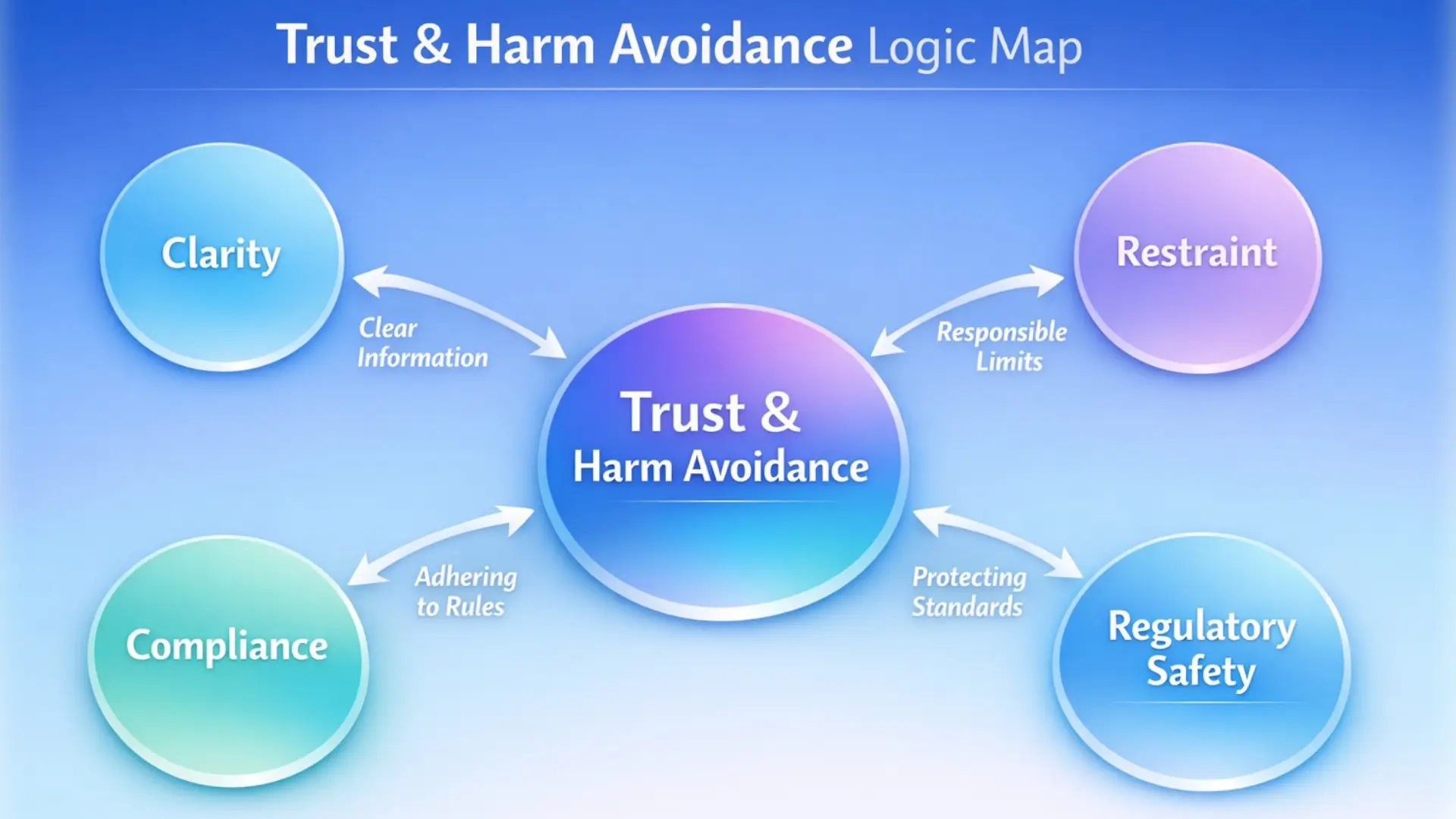
Definition: Trust threshold in regulated content refers to the minimum standard of clarity, restraint, and accuracy needed to be seen as credible by both regulators and audiences.
Note: With the rise of AI content generation, unreviewed language can now introduce unseen risks – automated content may omit vital disclaimers or blur boundaries, amplifying trust challenges.
Trust in regulated content isn’t won with dazzling vision or persuasive storytelling.
Instead, it’s built with clarity, restraint, and precision – where every claim and omission are carefully weighed.
For pharma, finance, insurance, or health, the content boundary is not just legal – it becomes the brand’s most visible promise.
Working with a leading fintech provider, our team saw that the highest engagement – and lowest risk – came from plain-language pages that stated exactly what’s offered and just as crisply, what is not.
The surprise?
Users lingered longer, asked better questions, and authority scores rose faster than with conversion-focused copy.
Think of trust like a crystal glass: it shines when clear, but one small crack – from a single exaggeration – shatters the whole.
How often do your briefs ask, “What must be resisted here?” instead of “How do we persuade?”
In regulated sectors, the logic is flipped: guardrails come first, persuasion a distant second.
One practical tool: redline reviews between compliance and content strategists.
It’s less about finding the cleverest phrase, and more about confirming risk is minimized before creativity flows.
The power move isn’t in showmanship – it’s in showing you can be trusted enough to stop short.
Restraint, then, becomes a signal.
It says: “We know the limits, and we respect them”.
That’s the new baseline for trust-building in regulated industries content marketing logic.
Reframe your outcomes: the win isn’t the boldest pitch.
It’s being the company regulators don’t need to call – and audiences lean in because you’ve drawn the safe, unambiguous line.

Operationalizing Safe Content: Logic, Not Checklists
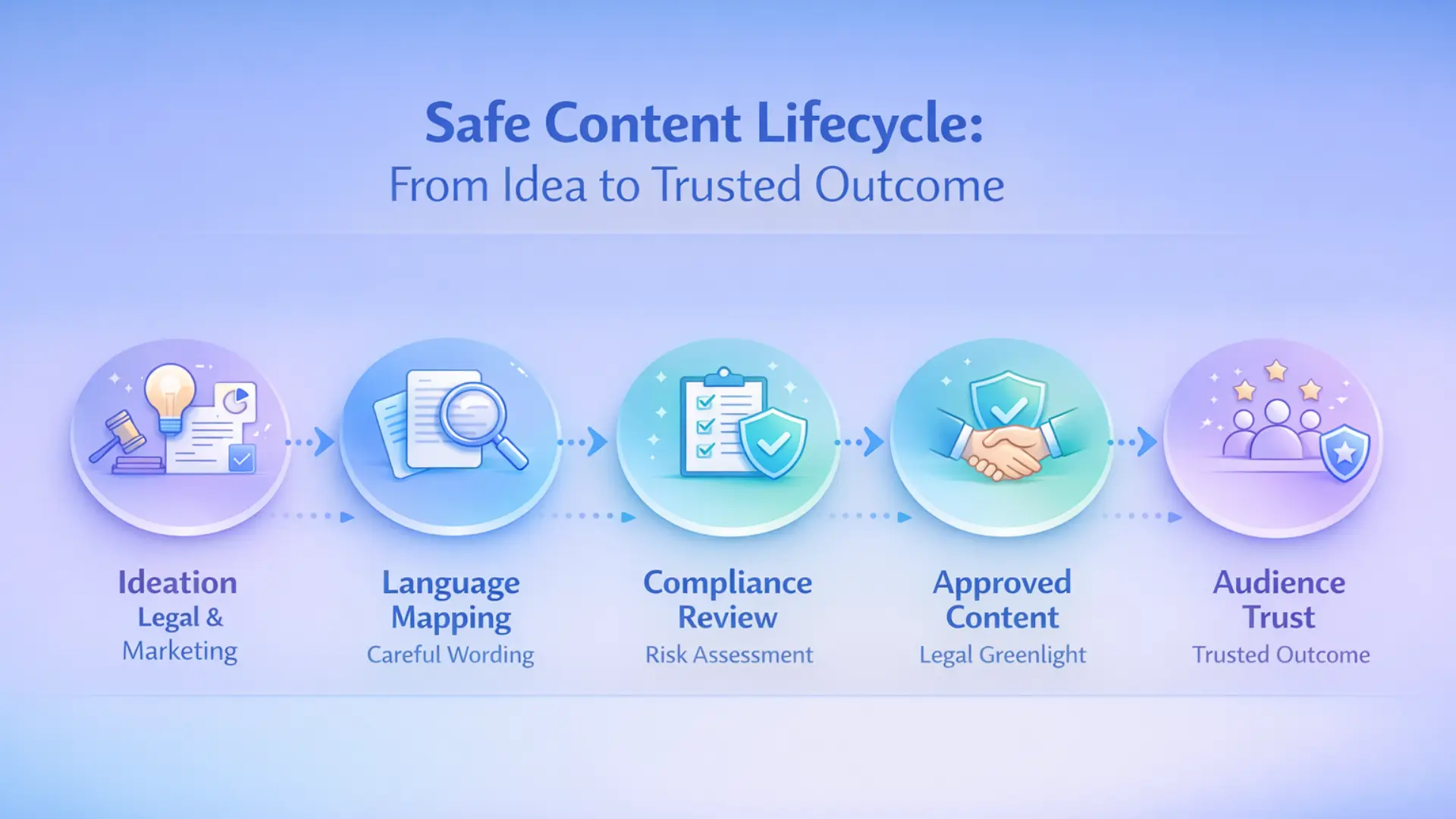
Embedding Safe Paths: Collaboration with Legal Before Ideation
Benefits of Early Legal Alignment in Regulated Content Marketing
| Aspect | Before Early Legal Collaboration | After Early Legal Collaboration | Impact |
|---|---|---|---|
| Timing of Legal Involvement | Last-minute referee | Integrated at ideation/pre-briefs | Reduced delays and better risk management |
| Review Cycles | Long, inefficient | Cut in half | Faster campaign approval |
| Blocked Launches | High occurrence | Reduced by 70% | Improved campaign launch reliability |
| Creative Process | Retrofitting warnings | Safe creativity stories | More positive team dynamics |
| Compliance Perception | Bottleneck | Enabler | Smoother collaboration |
Early legal alignment is the most reliable way to reduce compliance complexity. Integrating compliance teams at ideation transforms compliance from a bottleneck into an enabler.
What if the number one threat in your content plan isn’t what’s written – but how the first idea is born?
Most teams still treat Legal like a last-minute referee, whistling infractions after the play.
In regulated industries, that delay often turns the whole campaign into a legal fire drill.
Here’s the shift: At one financial services firm, moving Legal “upstream” – literally sitting with marketing during pre-briefs – cut review cycles in half and reduced blocked launches by 70%.
Marketers sketched the first concept within invisible guardrails, not retrofitted warnings.
No more torn-out sections at the eleventh hour.
The mood in the room changed too: Legal began sharing ‘safe creativity’ stories instead of citing rulebooks.
Early legal alignment in content strategy is fundamental: it ensures risk is removed at the source, making subsequent review and approval streamlined and less stressful.
Do you really want your best idea scrapped in the final round – just because “compliance wasn’t in the loop” early enough?
Language as Code: Safe Terminology and Interpretative Boundaries
Definition: Content boundaries in regulated marketing are explicit limits on what claims, benefits, or risks may be communicated – set to protect both organization and end-user within the regulatory frame.
Phrases can behave like code in high-stakes sectors: a single word triggers a halt, or releases trust.
One insurance client realized their conversion bump after a copy refresh was almost wiped out weeks later; a regulator flagged a single ambiguous term (“guarantee”) tucked halfway down the page.
Subtle, but the fallout was real – weeks offline, pipeline paused.
Safe terminology isn’t about empty blandness. It’s about using precision that creates clear boundaries.
Clients who treat language as programmable logic – mapping every possible meaning, flagging soft edges – move faster and sleep better.
Their review tools run like linters in software development: highlight, suggest, approve.
Authority in regulated industries comes not from sounding persuasive, but from never tripping hidden wires.
Here’s the myth to bust: “Compliance-first language kills response rates”.
Not so.
The best-performing regulated content benchmarks use clarity as the feature, not a bug.
Decision-makers prefer content that feels like an owner’s manual – reliable, direct, no fine print sleight of hand.
Safe content logic is a product, not a checklist.
The more you design with boundaries built-in – early, visibly, and with forensic attention to language – the faster your content gains authority. The system improves every cycle, not just the output.
When your process bakes in these standards, compliance stops feeling like an obstacle – and starts acting like a launchpad for trust.

Next Steps
Related Capabilities
Imagine reading a compliance-focused content resource that quietly slips practical tips throughout – feels helpful, right?
Now, picture a regulator combing through, spotting one stray sentence that could be misconstrued as legal guidance.
Suddenly, the helpful moment becomes a documented risk, not just for your brand, but for anyone following that advice.
Why do competent teams steer clear of direct tactics at this high-level conceptual phase?
Because in regulated industries, the consequence of well-meaning shortcuts is asymmetrical – what you mention invites trouble, but what you leave ambiguous can be even more dangerous.
Here’s what we’ve found: Sharing “just one” tactical hack tempts copy-and-paste behaviors in fields like healthcare, finance, pharma, or insurance, turning guidance into implied authorization.
During a real compliance review for a MedTech client, one misplaced case example (meant as illustration) triggered weeks of internal debate and an emergency legal check.
For another financial services brand, simply referencing a regulatory clause – without full context – forced us to rewrite months of blog content.
Think of this hub page like an airport security screening: its job isn’t to hand out travel tips, but to channel you safely toward the right gate.
No ambiguity, no casual side doors.
Until you’re safely past the conceptual checkpoint, not a single tactical hint should appear – otherwise, the whole system’s authority starts to crumble.
Doesn’t that make you wonder how much “practical” content you’ve read actually endangers trust?
Addiction Treatment Facilities
An addiction treatment facility compliance director once thanked us for what we didn’t do: “The fact that we never found an offhand or out-of-scope suggestion in your content made legal’s life easier and let us share your page internally”.
It’s a compliment, but also a warning – trust is built by what isn’t here, as much as by what is.
Disciplined content transitions are engineered to safeguard both the organization and the reader, guiding step-by-step through well-marked, risk-aware pathways.
If you’ve ever clicked an article and been whisked to a how-to guide before you felt ready, you’ve seen the opposite.
In regulated industries content marketing logic, disciplined exits protect both the audience and the business.

Scientific context and sources
The sources below provide foundational context for how decision-making, attention, and performance dynamics evolve under scaling and constraint conditions.
- Risk Communication and Trust
“Message Mapping, Risk and Crisis Communication” – Vincent T. Covello – U.S. Environmental Protection Agency / WHO context
Explains how structured message mapping organizes complex risk information into clear, consistent, and trustworthy communication, improving stakeholder understanding and reducing misinterpretation in high-stakes contexts.
https://www.orau.gov/hsc/ercwbt/content/ERCcdcynergy/content/activeinformation/resources/Covello_message_mapping.pdf - Legal Effects of Omission in Health Communication
“Problems of Risk Communication” – National Research Council – National Academies Press
Explains that legal constraints such as liability, statutory duties, and “right-to-know” requirements directly shape what must be communicated, showing that omission can create legal exposure when duty of care exists.
https://www.ncbi.nlm.nih.gov/books/NBK218586/ - Words as Legal Triggers
Omission (law) – Legal doctrine overview – Encyclopedic legal reference
Defines omission as failure to act under a legal duty, explaining how absence of information or action can trigger liability when a duty of care exists, highlighting the legal consequences of precise or missing language.
https://en.wikipedia.org/wiki/Omission_(law) - Trust and Transparency in High-Stakes Environments
“Managing the Unexpected: Sustained Performance in a Complex World” – Karl E. Weick, Kathleen M. Sutcliffe – Wiley
Analyzes how high-reliability organizations maintain performance through transparency, continuous monitoring, and error sensitivity, showing that clarity and structured awareness are central to preventing failure in complex environments.
https://onlinelibrary.wiley.com/doi/book/10.1002/9781119175834 - Interdisciplinary Compliance Collaboration
“Introduction: Compliance as the Interaction between Rules and Behavior” – Benjamin van Rooij, D. Daniel Sokol – Cambridge Handbook of Compliance (Cambridge University Press)
Explains compliance as a system emerging from the interaction between legal rules, organizational structures, and human behavior, highlighting that effective compliance requires coordination across legal, behavioral, and operational domains rather than isolated functions.
https://assets.cambridge.org/97811084/77123/excerpt/9781108477123_excerpt.pdf
Questions You Might Ponder
How does trust and harm avoidance shape content strategy in regulated industries?
Trust and harm avoidance shift content strategy by prioritizing clarity and risk minimization over persuasion. Content must address legal, ethical, and reputational boundaries, ensuring omissions don’t introduce liability and that trust is built through transparency rather than marketing tactics.
Why is omission more dangerous than exaggeration in regulated sectors?
In regulated sectors, what’s left unsaid can lead to regulatory violations and trust erosion. Regulators scrutinize omissions, which may conceal risks or lack disclosures, and this can result in investigations, fines, or reputational loss, making omission particularly perilous.
What role does early legal involvement play in safe content creation?
Early legal involvement embeds compliance into the content creation process, preventing last-minute rewrites and ensuring risk is managed upstream. This transforms compliance from a barrier into a proactive enabler, streamlining approvals and reducing regulatory setbacks.
Why is precise language critical for trust and harm avoidance?
Precise language eliminates ambiguity, reduces legal risk, and establishes clear boundaries. In regulated industries, certain words or phrases can trigger audits or regulatory action, so using exact terminology is essential for both protecting the organization and building audience trust.
How do controlled transition points increase content safety?
Controlled transition points, like designated navigation to sector-specific hubs, ensure readers only move from conceptual to tactical advice when safe. This disciplined structure prevents accidental legal exposure, improves user confidence, and reinforces the brand’s reputation for responsible communication.