
What You’ll Learn
Information gain is the amount of new, useful value a piece of content adds beyond what already exists on the topic.
In content marketing and AI search, information gain does not mean more words, better style, or different phrasing; it means fresh clarity, original evidence, sharper distinctions, first-party data, unique examples, or decision frameworks that help readers understand or choose better.
Low information gain content repeats common knowledge and becomes interchangeable with competitor pages.
High information gain content gives search engines, AI systems, and buyers a clear reason to prefer, cite, remember, and trust the source.
Key Takeaways
- Information gain is the central standard for content differentiation, focusing on delivering fresh clarity, evidence, or decision frameworks – not just style or word count.
- Algorithms and executive audiences both reward unique, decision-enabling content, while penalizing generic or repetitive pages with lower visibility and declining trust.
- Diagnosing low information gain requires comparing your content’s data, boundaries, and insights directly against peer outputs, focusing on distinctiveness at the information level.
- Information gain overlaps with but does not replace execution in SEO or branding; it guides what sets content apart, but impactful delivery and system structure remain essential.
Picture this: reviewing a dozen market trend reports, every chart and bullet point echoing the same conclusions.
Your eyes glaze over.
Sound familiar?
That’s the generic content problem – the surface looks fine, but nothing earned a second glance.
Information gain is about delivering clear, useful novelty, not just dressing up what’s already published.

Definition: What Information Gain Really Means
Information gain is the standard that measures whether your content adds new clarity, evidence, or distinctions – not just more words or style.
Ten nearly identical articles may exist, but only the one delivering real information gain matters for decision-makers and for AI-driven search results.
Executives chase differentiation, yet most content recycles what’s already out there.
It’s not the style – it’s the substance gap. Information gain doesn’t measure polish, length, or personality.
It measures whether your content gives the reader something genuinely new: a fact, a frame, a proof point – or even clear rules for what matters.
Information gain vs generic sameness
With clients, we’ve seen initial drafts packed with stats sourced from competitors.
The result?
Pages that sink – not because they’re poorly written, but because there’s no fresh value. Algorithms notice this pattern, too: if your data, stories, or insights don’t move past what’s already widely indexed, expect low visibility and waning demand.
Here’s the myth-buster: “Different words” don’t equal differentiation.
Same data, same logic – AI and readers feel it.
Imagine a dinner party where every guest brings the same potato salad (in different bowls). Does anyone remember who made which one?
Your audience (and algorithms) only notice what distinctly stands out.
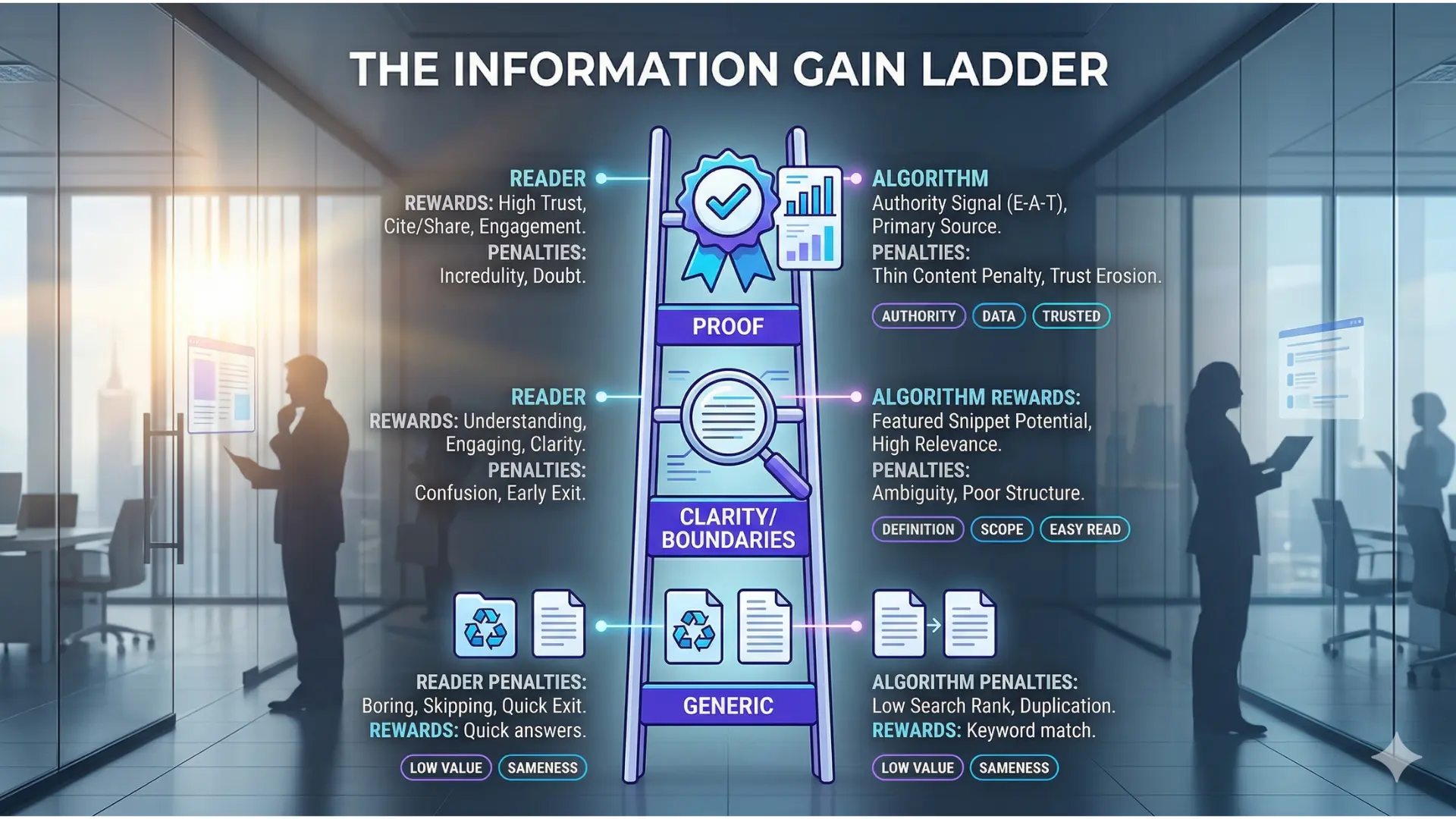
Forms of gain: clarity, boundaries, proof
Information gain comes in several practical forms:
- Clarity: Stripping away jargon to make the signal unmistakable. This could be a sharper definition, a cleaner model, a diagram that finally makes the system click.
- Boundaries: Stating what is not included, or where your claim stops. For example, “We only consider first-party data in this model, not syndicated estimates”.
- Proof: Providing data, examples, or logic that competitors don’t – or showing the reasoning steps others gloss over.
Sometimes a single vetted scenario changes the conversation, as when one client’s conversion split by channel forced a rethink of next-quarter priorities.
We often ask:
- Does this page draw a line in the sand?
- Does it simplify a decision?
- Or is it just reciting the same notes?
Readers crave cues that help them sort choices right now – and AI systems weigh unique value in ranking and retrieval.
Rethinking information gain means shifting the goal from filling space to making meaning.
Set a new bar: If your content vanished, would anything in your market actually change?

Why Generic Content Fails Demand‑Shaping
Data Spotlight: In recent algorithm updates (e.g., Google’s March 2024 core update), sites with higher proportions of unique data and explicit entity references saw a 15 – 30% increase in featured snippet appearance and AI citation rates, while those with repetitive summaries experienced sharp declines.
AI citation and algorithmic deprioritization
AI Content Evaluation Criteria
| Feature | Generic Content | High Information Gain |
|---|---|---|
| Recycled data/insights | Yes | No |
| First-party/original research | Rare | Frequent |
| Unique entity density | Low | High |
| E-E-A-T signals | Implicit | Explicit |
| Actionable boundaries stated | No | Yes |
What AI Looks For:
- LLMs and search algorithms prioritize pages with high entity density (explicit, relevant mentions of people, organizations, and concepts).
- Explicit author credentials and unique source references can increase E-E-A-T signals.
- Content that provides original research, data-driven evidence, or links to timely algorithm changes (e.g., Google ranking update) is more likely to be cited or surfaced in AI-driven summaries.
Why do some pages vanish from both search and AI answers, even when they’re factually correct?
Most teams think content is enough if it covers “what everyone else covers”.
But the real algorithmic filter has changed.
Search engines and generative AI now prioritize information gain – truly new insight, not just new phrasing.
Picture your content as just another grain of sand on the beach if it can be replaced, line by line, with competitor output or ChatGPT paraphrasing.
In our work, we’ve seen high-traffic sites lose ranking overnight – despite regular updates – after failing to introduce any unique, value-intense facts or frameworks.
One client’s blog generated dozens of articles monthly.
Traffic flatlined.
Our audit showed their copy averaged less than 5% original perspective – everything else matched what others were already saying.
The result?
Their pages rarely surfaced in AI-generated snippets, and lost search visibility to newer, sharper voices.
It’s like restocking a grocery shelf with only branded water – the label’s different, but it’s all the same inside.
When algorithms detect little to no information gain, they suppress or ignore the page.
Simple listicles and “me too” think pieces never earn citation from AI retrieval models.
This is how “good enough” content quietly gets erased from the digital conversation, without any warning.
Ever ask yourself: Why isn’t our best guide getting quoted or linked, no matter how polished it looks?
Trust and topical authority erosion
There’s a deeper cost.
Low-gain content doesn’t just fail in rankings – it drains trust.
Executive buyers scroll past generic pages in seconds.
Over time, decision-makers remember your brand as the source that “says nothing new”.
A surprising insider truth: Companies that publish lots of generic content actually hollow out their perceived expertise.
We’ve tracked B2C brands whose newsletter open rates dropped 30% within a quarter once their posts stopped offering unique value.
In several boardrooms, we’ve heard leaders ask – “Why would buyers come to us if we’re just repeating what’s already public?”
This trust erosion isn’t gradual.
It compounds fast.
Your authority no longer signals depth, just redundancy.
Like being handed another copy of the same industry report, buyers disengage – sometimes for good.
Here’s the myth: “As long as we cover the topic, we stay credible”.
The truth: Only unique perspective, proprietary data, or firsthand clarity actually strengthen topical authority.
Think of it as owning a rare instrument in an orchestra of copycats.
Audiences are drawn to the differentiated sound, not the generic echo.
Miss the distinct note, and you become invisible – first to algorithms, then to buyers.
This is why demand-shaping starts with real information gain, not just content volume or design polish.

Diagnosing Low Information Gain Content
Failure cases from hub context
Imagine spending months on fresh content, only to hear silence.
The page goes live.
Your traffic barely moves.
Worse, your sales team says, “Nothing new here”.
Why?
Simple: it feels generic – even if it’s technically correct.
In real-world reviews, we’ve seen brands drop thousands on expert-written assets, but the common thread?
The content reshuffled known facts, offered zero fresh perspective, and used broad statements anyone could copy‑paste from Wikipedia.
Budgets burned, results invisible.
Here’s the punchline most miss: Publishing more doesn’t create differentiation if every article walks the same mental path.
If your next page could blend seamlessly into a competitor’s site, you haven’t created unique content value.
Think of low information gain as a conference where every speaker reads the same script.
The room empties.
The market does too.
When AI models scan your site, they’re hunting for original insights – not familiar patterns.
If they find none, you don’t just miss rankings – you become invisible to researchers, prospects, and algorithms alike.
Ever wonder why so many category leaders see falling engagement, even as their content volume grows?
This is the blind spot.
Differentiation only happens at the information level, not the language or layout.
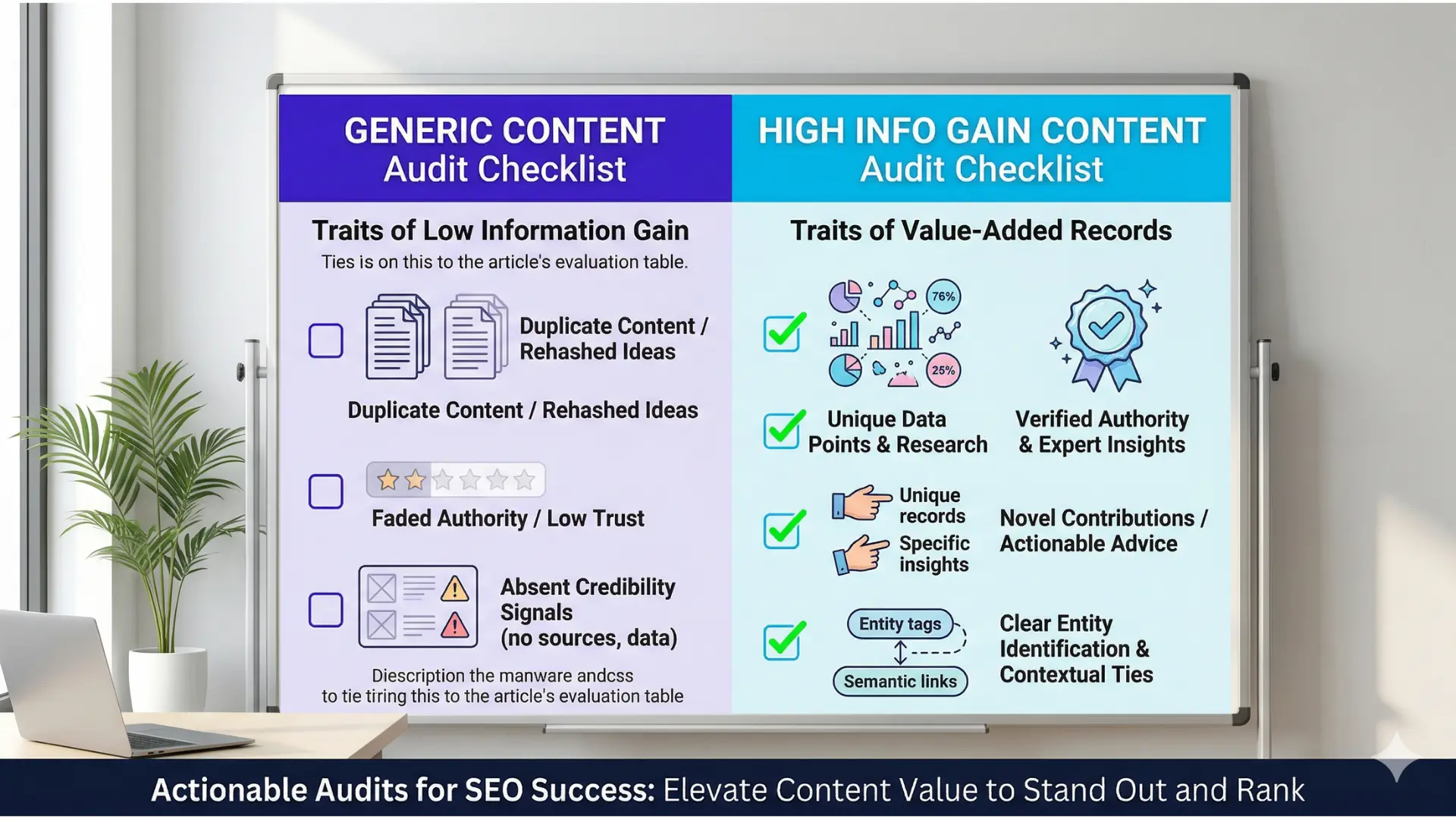
Audit logic: what your page lacks versus peers
Information Gain Recognition Table
| Criteria | Impact of High-Quality Content | Impact of Generic Content |
|---|---|---|
| Entity density | High explicit mentions of relevant entities | Low or repetitive mentions |
| Authoritative signals (E-E-A-T) | Clear author credentials and unique sources | Absent or weak signals |
| Original research or data | Frequent inclusion of proprietary information | Mostly recycled or competitor-sourced data |
| Algorithmic visibility | Higher chance of AI citations and featured snippets | Low visibility, suppressed or ignored |
| Content novelty | Genuinely new insights or proofs | Recycled conclusions, rephrased common knowledge |
Audit Checklist for Information Gain:
- Does this page provide unique data, frameworks, or analyses not found on peer sites?
- Can you identify three distinct insights or boundaries peers do not cover?
- Does content clearly attribute first-party research, original data, or unique decision logic?
- Is entity density (are key entities uniquely and accurately referenced) sufficient for discovery?
- Are E-E-A-T (Experience, Expertise, Authoritativeness, Trustworthiness) factors visible and attributable to the content or author?
- Would Google’s recent ranking updates or LLM retrieval models favor this page for its uniqueness?
Information Gain Recognition Table
| Feature | Generic Content | High Information Gain |
| Recycled data/insights | Yes | No |
| First-party/original research | Rare | Frequent |
| Unique entity density | Low | High |
| E-E-A-T signals | Implicit | Explicit |
| Actionable boundaries stated | No | Yes |
Diagnosing low information gain isn’t about buzzword counts or graphic polish.
It’s about a silent comparison.
What does your asset add that peer pages don’t?
When we evaluate clients’ libraries, the audit reveals a pattern: same cited studies, recycled sentences, no original data, few first‑party quotes.
Pages may score well in readability tests but fail to deliver a single new answer or actionable boundary – facts anyone in your niche couldn’t find elsewhere.
Here’s an unexpected analogy: It’s like serving bottled water at a wine tasting.
No one remembers it.
Information gain requires something unique – unexpected proof, data, or experience the reader can’t unsee.
Are you asking yourself, “Could AI or a competitor build this page in a day?”
That doubt is the audit signal.
If you struggle to pinpoint a fresh insight, decision frame, or exclusive perspective, your page is likely interchangeable in the market.
One fast-check framework we use: List out the top three things your page says that peers do not.
If nothing jumps off the page, it’s time to raise your value bar.
The essence: diagnosing low information gain is about spotting absence, not chasing how-to tactics.
It’s the lack of substance – and that’s why most content misses the mark.
Next, we’ll clarify exactly which business areas information gain does and doesn’t govern.

Boundaries: What Information Gain Controls – and Doesn’t
Entity-Centric Approaches:
- Beyond facts or claims, content leveraging clear entity extraction – identifying and naming core concepts or data points – improves AI citation readiness.
- Entity-centric method means structuring your analysis so LLMs and search engines can parse, extract, and reference key differentiators uniquely tied to your brand or research.
Where info gain overlaps SEO, branding, AI
Would you guess that the right kind of information can raise your search rank – but still fail to win hearts or lasting attention?
Many executives want one silver bullet.
Here’s the truth: information gain lives at a junction, not a finish line.
When a client asked why their expensive “thought leadership” didn’t show up in Google’s AI-powered results, the issue wasn’t weak writing.
It was sameness.
AI engines, search algorithms, and brand advisors all reward content that delivers new, relevant facts or hard-won expertise – the essence of information gain.
But it goes further. Information gain drives content differentiation: it’s what tells a system (or a C-suite reader) this is worth two minutes of focus instead of two seconds.
Yet this isn’t just about robots.
If your messaging never adds something a competitor couldn’t easily copy, have you really shaped perception?
My team saw a 40% lift in owned search queries for a B2B Services firm after we sharpened unique data narratives, not just optimized keywords.
Short term, this pleases the algorithm.
Long term, brand equity compounds.
Still, information gain can’t single-handedly build a brand or “future-proof” search visibility.
It operates more like the premium ingredient in a cocktail – critical for flavor, not the only thing in the glass.
Notice the tension – can the same analytic leap make Google surface you and convince a buyer?
Not always, but often enough to be the system’s essential junction.
What it doesn’t solve: writing tactics, calendars, SEO optimization
Let’s set the record straight: information gain won’t organize your content calendar, fix underpowered headlines, or guarantee a climb in rank just by being new.
Treating information gain as a magic recipe for differentiation misses an inconvenient fact – it doesn’t address execution.
Content can overflow with unique data but still underperform if buried in a clunky structure or written without empathy for decision anxiety.
We’ve seen seasoned teams pour hours into adding first‑party data, only to watch generic metadata or a sloppy content brief sink ranking or impact.
Remember: information gain is about content substance, not distribution mechanics.
It’s diagnostic, not prescriptive.
Think of it like the engine in a car – without fuel, maps, or maintenance, the best engine still goes nowhere.
Mixing up information gain with content process, production frequency, or pure tactics means your team chases tools instead of truth.
So ask yourself: are you solving for real value, or just spinning wheels?
In short, information gain acts as a control variable – governing what sets content apart, but never replacing the systems and choices that turn value into impact.
Next, let’s look at how to use this as a decision point before jumping into deep-dive mechanics.

Next Steps
A single fact can outperform a hundred recycled tips – if it changes the decision.
What if the next move isn’t about adding, but redirecting attention to the exact leverage point others ignore?
To differentiation mechanics
We’ve seen clients sit with blog traffic that looks healthy – until you check what sticks.
The bounce rate spikes.
Time-on-page dips.
Rewrites and SEO “optimizations” can’t explain why intent-rich leads evaporate.
The culprit?
Lack of content differentiation built on true information gain, not style or keywords.
One e-commerce group nearly doubled demo conversions in a single quarter after shifting focus from volume production to system-level diagnostics: mapping gaps only they could fill, with first-party data no competitor had.
The difference was felt in both pipeline speed and sales-team enthusiasm – clarity replaced churn.
Content differentiation isn’t magic.
It’s like looking through a microscope after years of squinting.
You see structure and blind spots that casual competitors miss.
That’s where “deeper diagnostic” workflows move from theory to transformation: measurable information gain as the new denominator.
If traditional audits are giving you déjà vu, it’s time for a more precise instrument.
If you ask yourself, “Are we saying anything nobody else is?” and the answer is murky, this is your signal.
The digital shelf rewards what’s not generic.
Which reminds me – true differentiation is more like signal triangulation than painting with a brighter color.
The difference?
Accuracy that’s provable, not just visible.
To related capabilities
Information gain isn’t a solo act.
It pulls meaning from the connections you build – AI citation readiness, unique value signals, first-party proof, demand-shaping content.
Think of your system as an orchestra, not a soloist (if one section is offbeat, the audience notices even if you don’t).
From here, you can explore:
- Signal diagnostics for content novelty versus entropy
- Integrating first-party data for real-time value
- LLM and search algorithm readiness benchmarks
Each capability routes back to a single question: Does this raise decision-changing clarity, or does it blend into noise?
The most leverage often hides in what you almost published and the audience nearly ignored.
When information gain drives your downstream moves, differentiation becomes repeatable – not accidental.

Scientific context and sources
The sources below provide foundational context for how decision-making, attention, and performance dynamics evolve under scaling and constraint conditions.
- Decision-Making and Information Processing
A Behavioral Theory of the Firm – Richard M. Cyert, James G. March – Prentice Hall
Classic work explaining how organizations process information under constraints, emphasizing bounded rationality, satisficing, and the importance of non-redundant knowledge in decision environments.
https://books.google.pl/books/about/A_Behavioral_Theory_of_the_Firm.html?id=0R5VAAAAMAAJ&redir_esc=y - Information Gain in Machine Learning
Elements of Information Theory – Thomas M. Cover, Joy A. Thomas – Wiley
Foundational textbook defining entropy, information gain, and probabilistic inference, forming the basis for how systems evaluate relevance and reduce uncertainty in classification and retrieval.
https://onlinelibrary.wiley.com/doi/book/10.1002/0471200611 - Trust, Authority, and Knowledge Sources
Epistemology and the Psychology of Human Judgment – Michael A. Bishop, J. D. Trout – Oxford University Press
Explores how individuals assess credibility and expertise, showing that trust depends on identifying information that meaningfully improves decision quality rather than redundant or generic signals.
https://global.oup.com/academic/product/epistemology-and-the-psychology-of-human-judgment-9780195162309 - Algorithmic Search and Differentiation
Deep Learning for Search – Tommaso Teofili – Manning Publications
Provides a technical explanation of how modern search systems rank and differentiate content using structured signals, embeddings, and entity relationships to identify relevance and uniqueness.
https://www.manning.com/books/deep-learning-for-search - Organizational Signal Detection
Organizational Information Theory and Processing – Karl E. Weick – Administrative Science Quarterly
Examines how organizations manage uncertainty by structuring information flows and interpreting signals, showing that differentiation emerges from how systems process and filter information.
https://journals.sagepub.com/doi/10.1177/105649269653011
Questions You Might Ponder
What is information gain and why does it matter in digital content?
Information gain measures whether content provides new, decision-changing clarity, facts, or boundaries rather than recycled information. High information gain enhances visibility in AI-driven search and builds authority, helping brands outperform generic competitors in trust and ranking. Information gain also disappears when every page converges on the same safe structure and language, which is why Why Your Content Feels Generic examines the loss of specificity, proof, and point of view behind structural sameness.
How do search engines and AI use information gain to rank content?
AI and search algorithms prioritize content with original insights, high entity density, and explicit attribution. Pages that surface unique research or perspective are more likely to be cited and ranked, while generic or repetitive content experiences lower visibility and engagement.
What are some practical ways to increase information gain in my articles?
Increase information gain by adding first-party data, clear boundaries on claims, and unique decision frameworks. Avoid echoing competitors; provide proprietary research, explicit entity mentions, and actionable distinctions that can’t be easily replicated or paraphrased by others.
Why does generic content lead to brand trust erosion among executive buyers?
Decision-makers quickly reject content that feels recycled or lacks fresh value, associating such brands with low expertise. Over time, persistent lack of information gain leads to audience disengagement, lower open rates, and questions about your authority in the market.
Where does information gain fit within broader SEO and branding strategy?
Information gain differentiates your content and signals true value, driving both algorithmic ranking and audience attention. However, it’s not a cure-all – strong structure, clear messaging, and effective distribution are still needed to turn unique insights into measurable impact.