
What You’ll Learn
Data lineage analytics trust is the confidence teams gain when they can trace a metric from its original source through every transformation, filter, definition change, ownership handoff, and dashboard output.
It matters because analytics reports can change even when dashboards work, especially when ETL jobs, late-arriving data, schema edits, duplicate transformations, or hidden logic updates alter numbers without visibility.
Data lineage turns “which number is right?” into a traceable diagnostic question by showing where data came from, what changed, who owns it, and why it moved.
Trusted analytics requires lineage transparency, clear metric ownership, consistent definitions, and auditable paths from raw data to final report.
Key Takeaways
- Data lineage analytics trust is essential to avoid confusion caused by hidden metric transformations and conflicting reports.
- Lack of lineage tracking often leads to silent metric drift, undermining executive confidence and stunting growth.
- Assigning clear metric ownership and defining metrics unambiguously at every layer restore credibility and alignment across teams.
- Treating lineage as a diagnostic asset, not a technical formality, reveals risks early and empowers organizations to take confident, informed actions.
Most executives assume a dashboard is the truth – until “data lineage analytics trust” is tested by the same metric showing two different numbers in supposedly separate ‘source of truth’ systems.
That silent panic when the board sees revenue reported three ways is not just a data bug – it’s a lineage failure hidden in plain sight.
What if every data point could come with a full backstory, readable in seconds, ending the “which number is right?” debate before it starts?
The broader framework behind these failures is mapped in Analytics & Attribution.

Why understanding data lineage matters for analytics trust
The difference between actionable analytics and a guessing game often boils down to what you can’t see.
A single tweak – maybe someone quietly recodes “trialing user” to “active” last Thursday – ripples through downstream metrics.
Performance tracking for marketing, sales comp calculations, even quarterly forecasting can all shift quietly, with none the wiser until numbers stop matching across teams.
One client spent weeks battling a revenue dip that existed only because a routine ETL job changed logic in the background.
The dashboard updated, but the root source didn’t; trust collapsed instantly.
How hidden transformations break trust in metrics
Key Issues Caused by Hidden Data Transformations
- Silent recoding of user status changing metric definitions
- ETL job logic changes causing unexpected revenue shifts
- False alignment with previously matching reports suddenly diverging
- Untracked transformations acting like silent contract edits
- Leadership hesitating to make decisions due to metric mismatches
False alignment is a chronic offender: reports agree for months, then suddenly diverge, eroding confidence not just in the numbers but in the teams behind them.
The myth: “If the pipeline runs, our numbers are safe”.
Reality: every invisible step is a possible crack in trust.
Untracked transformations in analytics are like silent edits in a contract – no one notices until results go sideways and nobody agrees on what actually happened.
If you’ve ever watched leadership question whether to make a decision at all because “Analytics and Finance don’t match”, you’ve seen exactly how hidden lineage flaws block growth.
A metric is only as trustworthy as its audit trail.
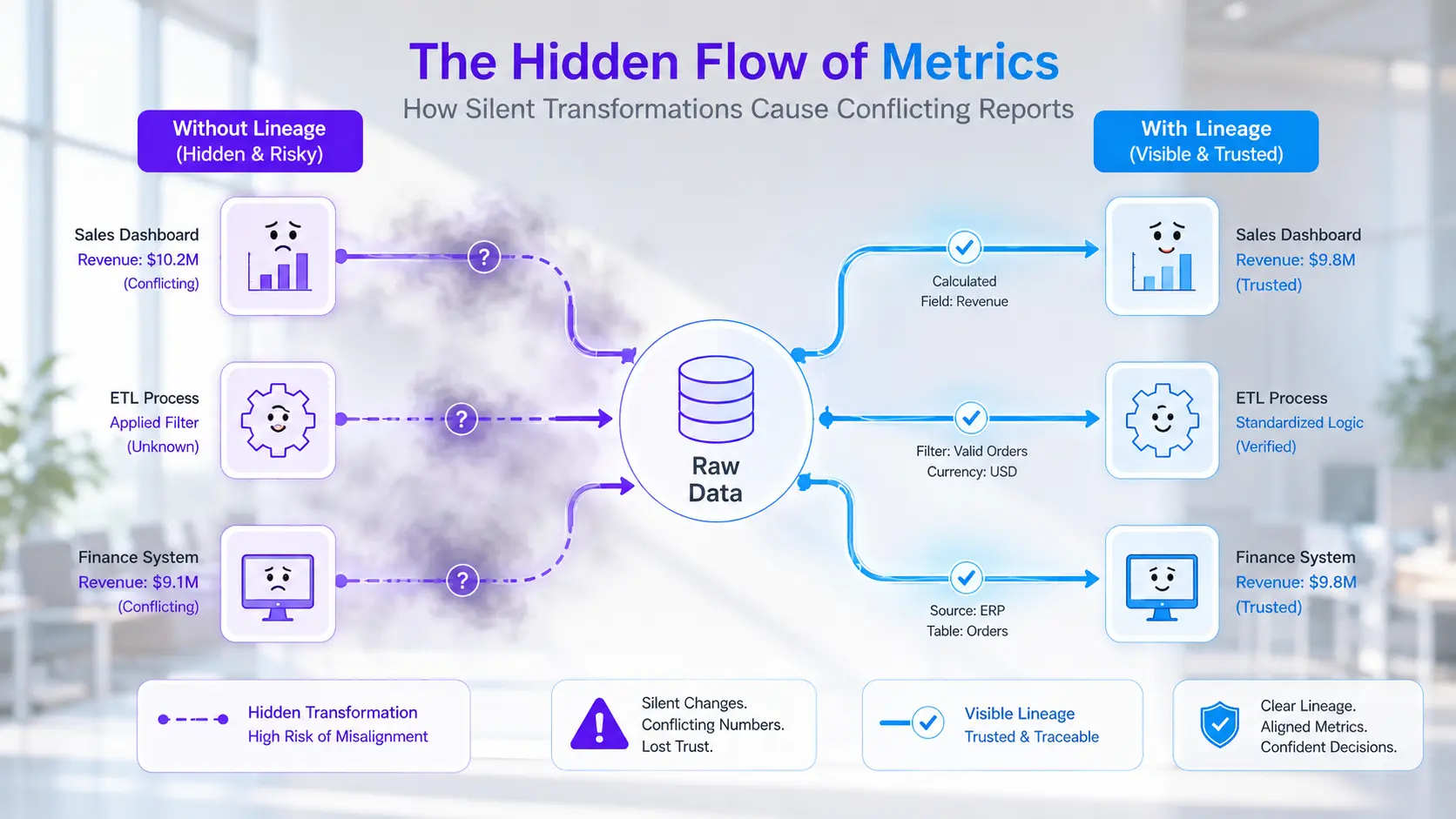
Why data origin and flow visibility aligns teams on reality
Executives rarely ask, “Where did this data come from?” – until numbers don’t add up and finger-pointing erupts.
Shared access to data lineage stops blame cycles and realigns teams faster than new tools ever could.
When every function can trace a metric’s history – what changed, why, and when – debate shifts from suspicion to progress.
One analogy: data without lineage is like flying with a fogged cockpit – you don’t realize you’re off course until it’s too late.
But when everyone can see the whole flight path, even turbulence (mistakes, updates, late changes) no longer feels like sabotage.
We’ve seen cross-functional teams recalibrate in hours – sometimes by simply reviewing a transparent lineage tracker side by side – because the conversation finally moves from “which number is real?” to “here’s what happened, now what’s the best next step?”
Trust in analytics doesn’t come from any one metric but from the confidence every team has in how that metric is built.
The core: data lineage transparency isn’t just technical hygiene; it’s the only foundation for unified, confident action.
When every stakeholder can follow the data’s journey, confidence returns – misunderstandings fade, and teams move forward together, not in debate.
Next, see what happens when lineage is absent, and the story starts to unravel.

What goes wrong when lineage is absent in measurement systems
Most teams don’t realize their analytics systems are quietly rewriting history every week.
The reason dashboards suddenly change isn’t new business performance – it’s invisible shifts as data trickles in, or as hidden processing repeats step over old footprints.
Every executive has seen it: Friday’s revenue number becomes Tuesday’s, and nobody can explain why.
That’s not fluctuation, it’s a failure of data lineage.
One moment you’re steering the ship; next, you’re navigating fog with yesterday’s coordinates.
When metric values drift because of unseen revisions
A client once discovered their monthly signup metric was changing – days after the period closed – because late-arriving signup records kept backfilling into the source table.
To operations, this looked like a minor correction.
To marketing and finance, it shredded confidence in the monthly review: the same metric had different values each time they pulled the report.
The underlying problem wasn’t data entry or pipeline stability.
The real risk was the absence of lineage tracking, turning what should be a single, auditable stream of facts into a shapeshifter.
When you can’t see which values arrived late, got edited, or were reprocessed by scripts triggered after “final” reporting, it’s like building forecasts on sand.
Myth: “The dashboard’s number is right if it comes from the master table”.
Reality: If the data path rewrites or restates facts after reporting, the metric stops being reliable, no matter what the schema claims.
Is your team treating any metric as fixed when its underlying data silently shifts underfoot?
Why duplicate transformations lead to conflicting numbers
Parallel ETL jobs aren’t always coordination – they’re often accidents.
I’ve seen companies define revenue three ways: once in product analytics, once in finance, and again in a custom data warehouse – all fed by the same raw data but transformed out of sync.
The outcome?
Each system “proves” itself right, but in board meetings, the story falls apart.
Without lineage governance, each metric path mutates separately, duplicating filters or business logic and producing multiply defined truths.
Imagine three surgeons working from different versions of a patient’s chart: confidence collapses, no matter how skilled they are.
Examples of Conflicting Metric Definitions Across Departments
| Step | Description | Outcome |
| Assign Single Owner | Designate one named accountable person per business KPI | Escalations drop by nearly 80% |
| Inspect Lineage | Owner reviews definitions, dependencies, and transformations | Clarity replaces confusion |
| Enforce Accountability | Owner responsible for recalculations and process tweaks | Prevents endless metric disputes |
It’s tempting to blame tooling differences, but the roots are organizational.
If nobody owns the journey from raw event to reported number, every group invents fixes – resulting in metrics that agree only by accident.
Metric inconsistency is not a technical fluke, it’s a lineage crisis hiding in plain sight.
When you don’t see how data travels, facts become opinions, and every weekly review restarts the debate.
Next: fix the root, not the symptoms.

How governance of definitions and ownership restores metric credibility
Most teams expect better tools or new dashboards to solve their analytics trust issues.
The reality: without governance of definitions and clear ownership, even the most advanced platforms breed confusion – because nobody can tell which number is truly the source of truth.
You don’t need more features; you need someone on the hook.
Assigning ownership: who owns the source of truth
Imagine watching two departments argue over the same sales metric – each side armed with “their” dashboard, each certain their number is correct.
The missing ingredient is accountability.
Without an explicit steward for every core metric, disputes become political, not analytical.
Assigning Ownership of Metrics: Steps and Benefits
| Metric | Department/System | Definition |
| Revenue | Product Analytics | Revenue recognized at point of sale |
| Revenue | Finance | Revenue recognized on invoice date |
| Revenue | Custom Data Warehouse | Revenue adjusted for returns and discounts |
One client assigned a single owner – by name, not committee – to each business KPI.
Suddenly, escalations about “which number to trust” dropped by nearly 80%.
Clarity replaced confusion because someone actually inspected every definition, dependency, and transformation in the lineage.
Here’s the myth: metrics are self-evident if you document them once.
In reality, measurement ecosystems drift unless someone is accountable for every recalculation, backfill, and process tweak.
If you don’t assign a metric steward, you invite endless circular debates about what’s “actual”.
Ownership is the difference between a common playbook and a playground full of shifting rules.
Who’s responsible for that final, published metric?
If you can’t answer in a sentence, you haven’t escaped the “multiple truths” trap.
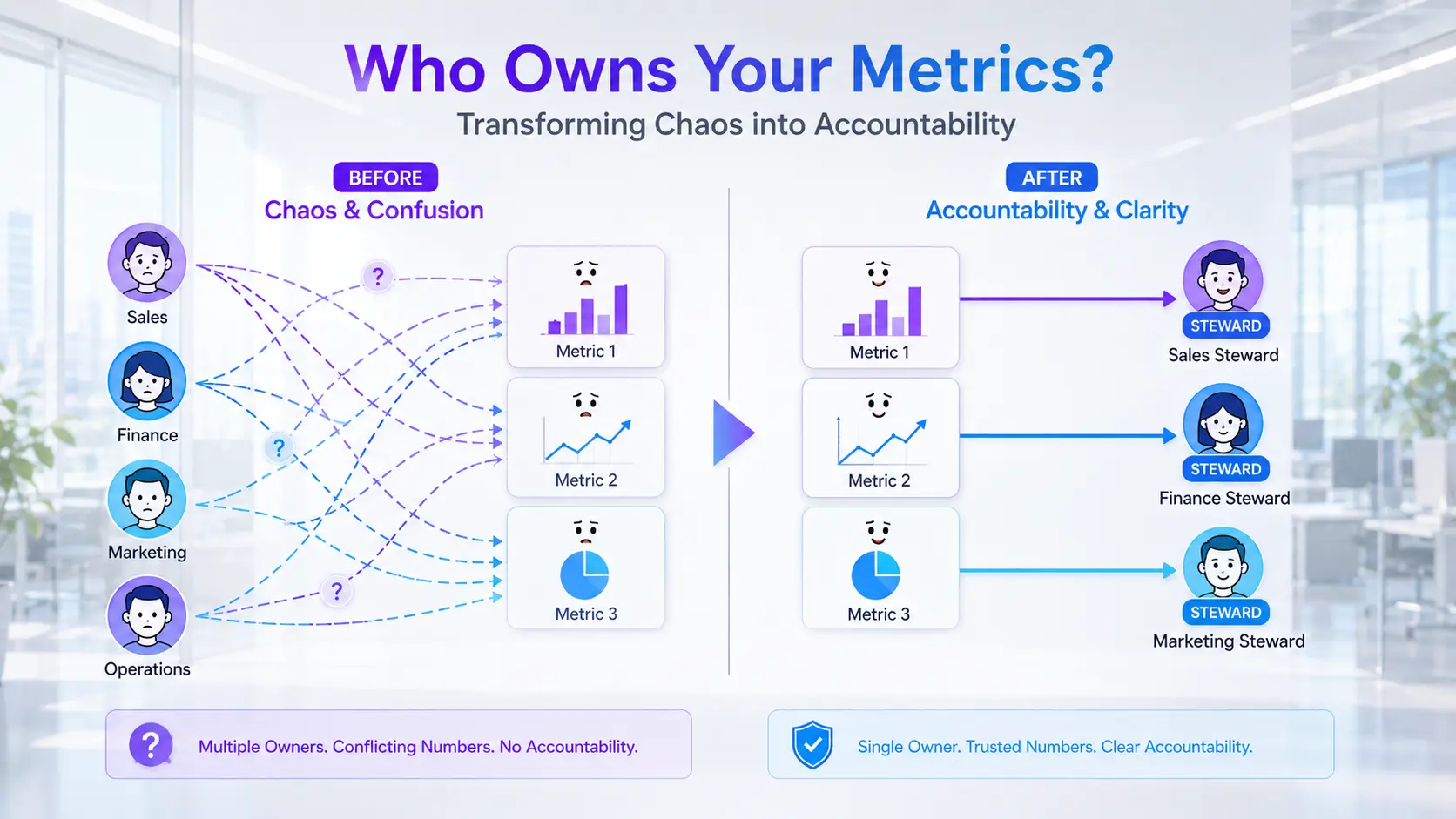
Defining metrics clearly and consistently at each layer
A metric without context is like a recipe missing half its ingredients.
Even with clear ownership, inconsistent definitions at different layers – source data, transform scripts, dashboards – open the door to ambiguity.
We’ve worked with companies where “active users” meant one thing to product, another to engineering, and yet a third in finance.
Alignment didn’t come from another meeting – it came from nailing down unambiguous definitions, then weaponizing them throughout the data lineage.
Every transformation, every report, every dashboard references the same shared meaning, no matter where the data moves.
Ask yourself: can every stakeholder recite what each KPI actually means, and trace it back through every system it touches?
If not, decisions rest on shifting sand.
When definitions are locked and referenced at every layer, ambiguity collapses and measurement governance becomes tangible.
Governance isn’t bureaucracy – it’s the shortcut to metric confidence.
If you want data lineage analytics trust, start with accountable owners and shared definitions.
That’s how credibility is won – and how the next data dispute can be prevented, not just resolved.
Without ownership, lineage still won’t be trusted – a logic expanded in Metric Ownership.

What changes when lineage is treated as a diagnostic asset, not a technical exercise
Most leaders still think of data lineage as an IT checklist: document the pipeline, check the box, move on.
But that assumption quietly sabotages decision confidence – because the value isn’t compliance, it’s clarity on which number to trust *before* a tough call.
If you’ve ever watched execs debate whether to pause a campaign or double down – only to hit an impasse over whose numbers are “right” – you’ve seen the cost of missing this asset.
The difference isn’t an audit trail; it’s the ability to spot decision risk before it derails strategy.
Lineage as a lens to see decision risks before they surface
Treating lineage as a living diagnostic means you stop asking “Where’s the bug?” and start asking, “Where could confidence fail next?” Think of it like a pilot’s preflight checklist: it’s not bureaucracy, it’s early warning for turbulence ahead.
One client, staring down conflicting MQL counts on the eve of a product launch, realized the problem wasn’t the numbers – it was an untracked schema tweak three systems upstream.
No alert, no error – just subtle drift, masked until the moment mattered.
Decision Risks Revealed Through Lineage Diagnostics
- Untracked schema tweaks causing subtle metric drifts
- Late data feeds modifying reported values post-close
- Filter or logic changes that quietly shift metrics
- Absence of alerts or errors masking changes
- Risk points that can derail board confidence or investment
The most dangerous myth?
That decision risk shows up as an obvious error or missing data.
In reality, risk sneaks in as barely perceptible shifts: a late data feed one month, a filter change the next.
Without visibility into the path metrics take, even seasoned teams miss these cracks until they undermine board confidence or investment priorities.
Lineage lays out every bend and branch, making it much harder for hidden misalignments to hijack your strategy.
When you reframe lineage as risk radar, every step in the reporting chain becomes a possible failure point – one you can test or question before bets are placed.
Why wait for the blowup?
Using lineage visibility to route next actions – not tools
A visible lineage map is less like a wiring diagram and more like a field guide for action.
When numbers clash or confidence frays, the instinct is usually to demand a new tool or escalate to analytics leadership.
But a mapped lineage lets you triage in real time: is this an ownership problem, a metric definition gap, or a process error?
Decisions get routed to the right steward, not lost in circular blame.
We’ve helped teams break analysis deadlocks by showing exactly where a metric passed hands – and where handoffs introduced fuzziness.
One analytics leader put it best: “Lineage tells us not just what broke, but *who* can actually fix it”.
If a report is out of sync because someone modified the reporting logic, you know instantly who governs that node.
If two versions of a metric exist, lineage points to the fork, not the tool.
Most importantly, this approach detaches trust from just software.
It puts root-cause clarity and accountability front and center – meaning teams can spot and solve issues before they become executive fire drills.
In effect, measurement governance ceases to be reactive, and starts driving confidence proactively.
When you treat lineage as a diagnostic asset, risk is revealed before it explodes – and next steps become action, not debate.
That clarity is the real asset, and it raises the bar for every analytics decision going forward.

Scientific context and sources
The sources below provide foundational context for how decision-making, attention, and performance dynamics evolve under scaling and constraint conditions.
- Understanding data lineage and trust in analytics
Towards a Conceptual Framework for Data Management in Business Intelligence – by Ramakolote Judas Mositsa, John Andrew Van der Poll, Cyrille Dongmo – Information Systems
Explores how lineage (data provenance) helps resolve trust issues by tracing data origins and transformations in BI environments.
https://www.mdpi.com/2078-2489/14/10/547 - Organizational impact of data ownership and governance
Data Governance: How to Design, Deploy, and Sustain an Effective Data Governance Program – John Ladley – Morgan Kaufmann
Outlines the business consequences of unclear ownership and ambiguous definitions, reinforcing the need for explicit metric stewards and governance to prevent measurement drift.
https://www.sciencedirect.com/book/9780124158290/data-governance - Risk of conflicting transformations in distributed systems
A Survey of Data Provenance in e-Science – Yogesh L. Simmhan, Beth Plale, Dennis Gannon – ACM SIGMOD Record
Analyzes technical and organizational reasons why metrics drift when lineage is missing, emphasizing the importance of traceability for trust in distributed data systems.
https://dl.acm.org/doi/10.1145/1084805.1084812 - Consequences of hidden changes and schema drift
Data Quality Assessment – Thomas C. Redman – MIT Press
Covers the impact of unnoticed changes in processing logic, schema, or data definitions on metrics consistency and business performance.
https://sloanreview.mit.edu/article/improve-data-quality-for-competitive-advantage/ - The behavioral science of metric trust and shared reality
Pooling of Unshared Information in Group Decision Making: Biased Information Sampling During Discussion – Garold Stasser, William Titus – Journal of Personality and Social Psychology
Research shows that groups overweight shared information and under-discuss unique information, which directly supports the analogy that transparent shared metric lineage improves alignment, trust, and collective interpretation quality.
https://psycnet.apa.org/doi/10.1037/0022-3514.48.6.1467
Questions You Might Ponder
Why do data lineage analytics trust issues create conflicting metrics in reports?
Conflicting metrics often arise when different systems transform or interpret the same data differently. Without visible data lineage, hidden changes or duplicate processes cause numbers to diverge, leading to confusion and undermining executive trust in analytics.
How can organizations prevent silent metric changes from eroding decision confidence?
Organizations can prevent silent changes by implementing governance of metric definitions and assigning accountable owners. Explicit stewardship and clear, consistently referenced definitions throughout the lineage chain help ensure that any updates or transformations are tracked and communicated.
What are the risks of not tracking late-arriving or revised data in analytics systems?
If late-arriving or revised data isn’t tracked transparently, reported metrics can shift unexpectedly after reports are published. This undermines confidence in “final” numbers, leads to recurring debate about accuracy, and can result in misguided business decisions.
Why is visible data lineage more effective than adopting new analytics tools for trust?
Visible data lineage pinpoints where and why numbers change, helping teams resolve issues quickly. Unlike new tools, which may only surface symptoms, lineage transparency addresses root causes, improves accountability, and builds cross-team confidence by ending “which number is right?” debates.
How does data lineage alignment accelerate executive decision-making?
When every stakeholder can trace a metric’s origins and transformations, uncertainty and blame cycles disappear. Teams move from suspicion to action, enabling faster decision-making and improved performance because everyone understands and trusts the basis for reported analytics.