
What You’ll Learn
Constrained visibility in analytics is the loss of complete measurement clarity caused by privacy rules, consent limits, data minimization, platform restrictions, siloed systems, or regulated-industry boundaries.
It means analytics teams cannot always see every user, touchpoint, conversion path, location, or identity link, even when tracking is implemented correctly.
Under constrained visibility, exact attribution and deterministic ROI claims become unsafe because important data may be intentionally unavailable.
Strong analytics shifts from chasing full coverage to using aggregate signals, cohort trends, probabilistic attribution, uncertainty ranges, and safe reporting boundaries.
The goal is not perfect visibility, but decision confidence that honestly reflects what can and cannot be measured.
Key Takeaways
- Constrained visibility in analytics is structurally imposed by privacy and consent frameworks, resulting in persistent data blind spots that technology alone cannot resolve.
- Overstated certainty and deterministic attribution are unsafe under restricted data regimes, as they encourage false confidence and expose organizations to compliance and reputational risks.
- Effective analytics pivots focus from complete data coverage to directionally useful aggregate signals and probabilistic attribution, maintaining decision agility in uncertain environments.
- Recognizing and distinguishing between constraint-driven blind spots and fixable execution errors is critical for strategic escalation and sustainable measurement practices.
Most leaders still operate as if full data access is the default – when, in reality, every layer of modern analytics is built around boundaries that are intentionally imposed.
The uncomfortable truth: the real risk isn’t in what you don’t see, but in how much false confidence limited visibility creates.
Ask yourself – how often are your “confident” dashboards projecting certainty when the underlying glass is frosted over?

Why incomplete visibility undermines confident decisions
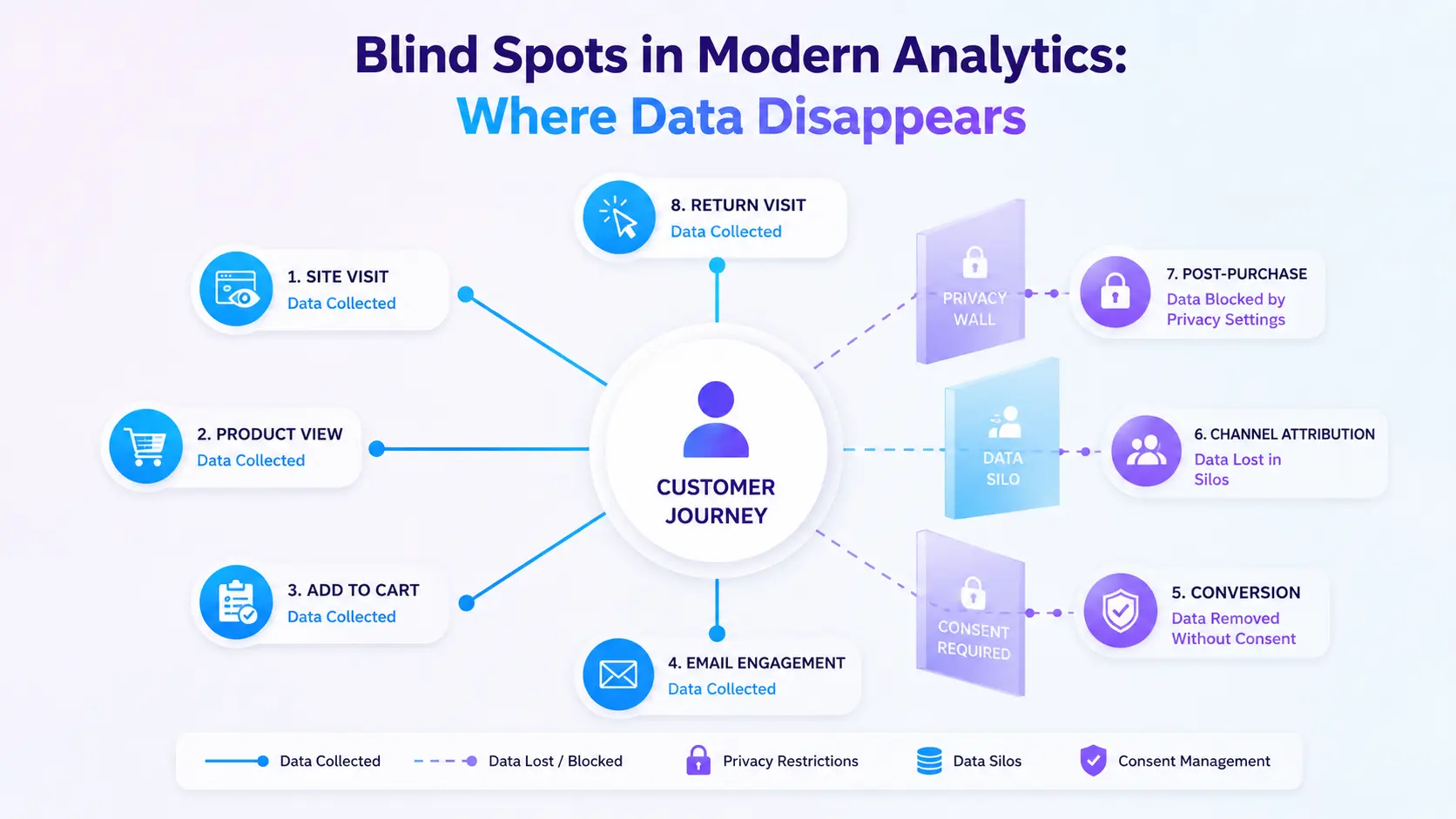
Every time a customer denies consent, the data trail snaps.
Minimized identifiers – what privacy-preserving measurement calls success – break the chain of events you once took for granted.
Then add the maze of siloed platforms, each holding only part of the journey; it’s like trying to watch a movie through scattered postcards.
One global brand we worked with lost over 30% of their cross-channel attribution data practically overnight when privacy rules tightened – turning familiar patterns into gaps.
How fragmented data and privacy rules create blind spots
Here’s the myth: that incomplete data can be “fixed” with enough technology.
In reality, privacy by design means some signals are walled off from the start, no matter how clever your tools.
Consent banners, data minimization strategies, and jurisdiction fences – these weren’t engineering accidents; they’re safeguards with legal teeth.
The result?
Blind spots that no plug-in or patch can dissolve.
Analytics doesn’t fail from noise, it fails from silence – when data goes missing without acknowledgment.
How safe are your decisions when you can’t see the edge of the map?
That broader fragility in measurement is clarified in Analytics & Attribution.
What uncertainty replaces deterministic truth in measurement
In incomplete data analytics, the pivot isn’t about patching holes but reframing your definition of truth.
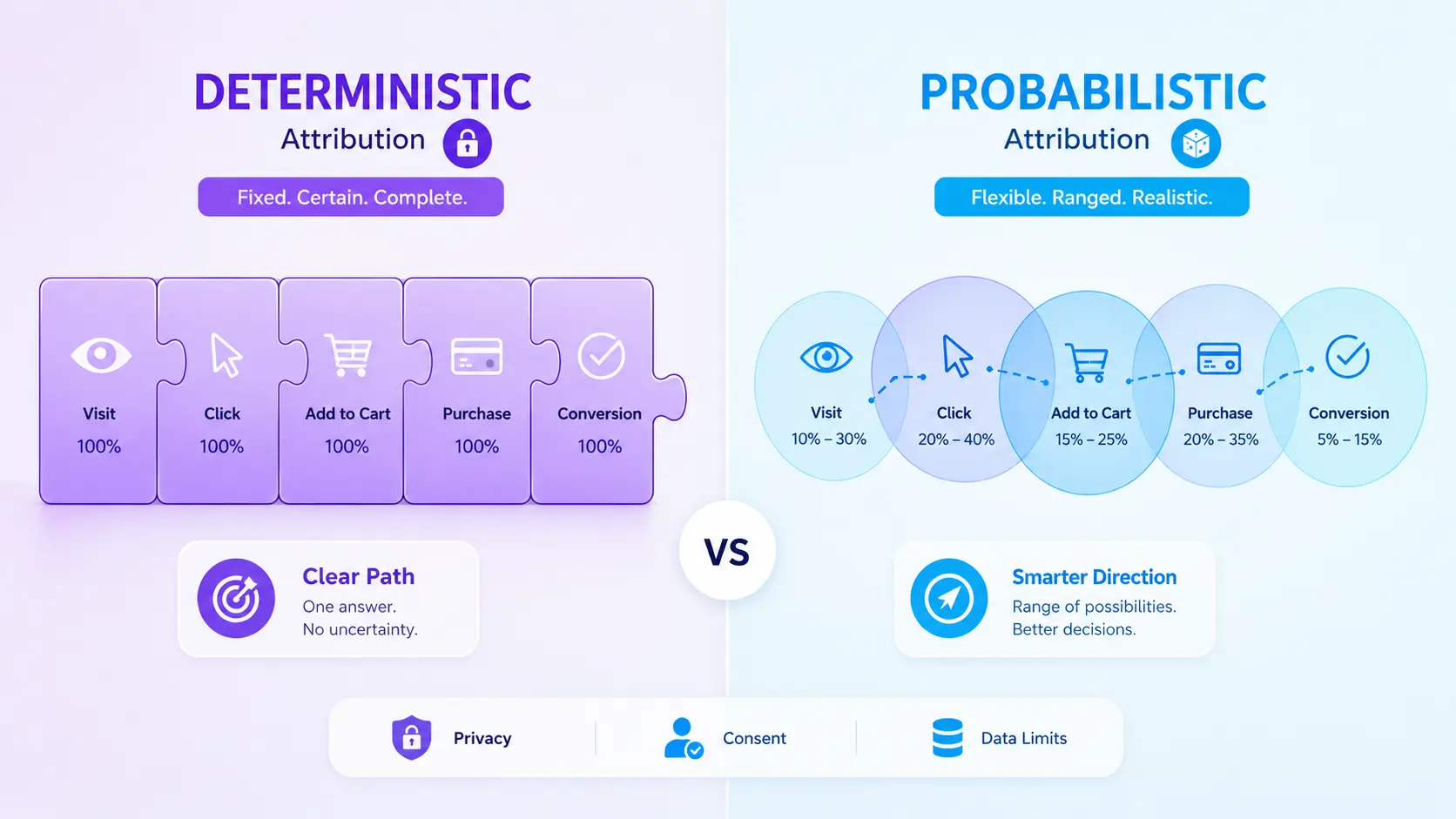
Deterministic attribution – the “one customer, one click, one sale” mindset – breaks down in regulated industries.
Instead, uncertainty becomes the norm, and measurement shifts toward probabilistic attribution and aggregate-level measurement.
Think of it like reading the room’s temperature instead of tracking each molecule – direction, not precision, is what survives compliance.
We’ve seen SaaS teams paralyzed by the illusion that regulatory constraints killed insight.
But the real shift is recognizing that measurement uncertainty isn’t a failure; it’s the cost of operating safely.
When we coached a fintech client through EU data minimization mandates, the discussion flipped – from craving exact source breakdowns to acting on cohort trends and confidence intervals.
It wasn’t about surrendering rigor, but adopting safe reporting boundaries.
Which leaves this reality: in analytics under constraint, certainty is scarce but clarity isn’t lost.
The winners are those who learn to trust signals over snapshots – and keep one eye on what the data leaves unsaid.
Leaders who adapt to constrained visibility frame risk honestly and decision-making stays sharp, even as the unknowns mount.
The question isn’t “How do I get it all back?” but “How do I choose well when the lights are dim?”

What measurable claims become unsafe under constrained visibility
A growth report that quotes a “definitive” ROI number under privacy constraints is more dangerous than a blank spreadsheet.
Why?
Because incomplete data gives the illusion of precision when uncertainty is invisible – putting reputations and strategy on the line.
Most leaders still expect direct cause-and-effect answers, but under constrained visibility in analytics, those answers become half-truths at best and calculated risks at worst.
The real break doesn’t come from what you see – it comes from what you’re sure you’re seeing, but isn’t there.
Key Risks of Unsafe Measurement Claims
- Illusion of precision leading to false confidence
- Potential for legal and regulatory audits
- Damage to reputation and loss of stakeholder trust
- Internal paralysis and skepticism among leadership
- External compliance risks including public backlash
Why exact attribution breaks and leadership loses trust
Imagine placing a bet on horse racing where half the track is hidden by fog.
That’s how exact attribution works with privacy-preserving measurement.
Regulatory boundaries, data minimization analytics, and aggregate-level measurement all force marketers to work with incomplete data analytics.
The myth is that with advanced models or enough sampling, you can “restore” certainty.
Reality check: a missing click, an unlogged conversion, or a siloed channel means the puzzle never completes.
With one client in a regulated industry, leadership demanded campaign-level profit calculation.
We had to explain – the best we could deliver, given safe reporting boundaries, was a range, not a number.
Trying to force the comfort of pre-GDPR exactness led to skepticism.
Decision-makers froze not because they lacked reports, but because false confidence turned real risk invisible.
Letting go of deterministic truth frustrates executives, but clinging to it guarantees doubt.
Here’s the uncomfortable insight: the more you promise “exact” results in an uncertain environment, the faster leadership’s trust unravels.
Where overconfident claims create compliance and reputational risk
Overstated certainty isn’t just a technical error – it’s a legal and reputational trap.
In privacy-first analytics, compliance teams scrutinize every claim.
One reckless promise of user-level targeting or point-to-point attribution, and you’re not only misleading stakeholders – you’re risking regulatory audit and public backlash.
In our experience, companies unwilling to switch to more conservative, uncertainty-aware reporting often see potential lawsuits or negative headlines, especially in analytics in regulated industries.
Here’s the analogy: making overconfident measurement claims under constraints is like driving at night with fogged-up glasses – every green light you think you see could actually be a wall.
When measurement uncertainty is papered over, trust erodes not just with leadership, but with partners, auditors, and customers.
Safe reporting doesn’t mean timid – it means precise about where certainty ends.
Conservative framing preserves credibility because it surfaces uncertainty before someone else does.
Unsafe measurement promises erode trust on two fronts: internally (paralysis and skepticism) and externally (compliance and credibility).
The way forward requires leaders to trade the comfort of exactitude for the confidence of transparent boundaries.
The next challenge: pivoting analytics from tracking every detail to securing decisions – even when the view is incomplete.

How measurement must pivot from tracking to decision assurance
Most companies obsess over tracking every click and conversion, convinced that precision guarantees better outcomes.
But here’s the truth: chasing complete coverage under constrained visibility is not just futile – it’s a strategic distraction.
When data privacy, consent, and minimization cut off half your sightlines, the pursuit of perfect tracking actually increases measurement uncertainty and can paralyze executives at the wrong moments.
Why directionally useful signals outweigh full coverage
“Full coverage” sounds like safety, but in analytics, it can quickly become a mirage.
In regulated environments, every extra identifier or individual-level data point raises both risk and noise.
Practitioners in privacy-preserving measurement know that completeness is a myth – what matters is whether the remaining signals, however partial, accurately flag trend changes or signal real business risk.
One retail client insisted on capturing granular events for every device.
Result?
Their dashboard grew dense, but decisions stalled as confidence plummeted – outliers skewed aggregate-level measurement and noise drowned out the useful patterns.
In contrast, another client focused explicitly on cohort-level outcomes and aggregate shifts.
Even as their individual user data shrank under GDPR, they made faster pivots, tracking which product categories rebounded first after regulatory shifts.
So, why does less sometimes give you more?
Because incomplete data analytics forces you to focus on the signals that move the needle, not on the illusion of total coverage.
Think of it like reading the wind direction: you might not need to know the speed of every single gust to tell a storm is coming.
If trends are directionally correct, trade-offs can be made swiftly, even if some noise remains.
When probabilistic attribution preserves decision agility
There’s a myth that only deterministic, user-level attribution drives growth.
In fact, over-reliance on this model is exactly what regulatory change is breaking – especially in analytics for regulated industries.
Today, the most resilient teams substitute deterministic truth with probabilistic attribution: modeled inference that estimates causal links without exposing sensitive data or blowing past safe reporting boundaries.
In one compliance-heavy client case, deterministic attribution became unusable almost overnight after data minimization mandates.
Instead of chasing a vanishing ideal, they shifted to probabilistic approaches – estimating conversions at the channel level with clear uncertainty ranges.
“We stopped asking which single ad drove each sale, and started asking which channels actually shifted revenue cohorts month over month”.
This pivot enabled the team to act quickly, iterate on budget, and keep leadership confidence – even as measurement uncertainty grew.
Probabilistic attribution doesn’t fake certainty.
It frames analytics in terms of risk and trade-offs, so decision-making stays nimble without violating privacy.
The insight: probabilistic, aggregate-level measurement unlocks agility that deterministic models stifle the moment boundaries harden.
Direction, not perfection, is what moves markets now.
What matters is that analytics clears a path for action – especially when the data behind it is intentionally incomplete.

How to recognize and manage analytics failure modes strategically
Most analytics failures masquerade as technical glitches – when in reality, they’re designed in by invisible boundaries.
Leaders often chase fixes, thinking more investment or new tooling will restore clarity, when the real culprit is constrained visibility.
So, how do you spot the difference before wasted cycles pile up?
Indicators of constrained visibility vs execution error
If you see unexplained holes in campaign attribution or sudden drops in data granularity, don’t assume the team has missed a step.
In our work with privacy-preserving measurement, the sharpest signal isn’t noisy dashboards – it’s the disappearance of once-reliable metrics after privacy rules tighten.
For example, geographic breakdowns blur, user-level pathways vanish, or certain conversion funnels now show aggregate-level measurement only.
Comparison of Indicators: Constrained Visibility vs Execution Error
| Indicator | Constrained Visibility | Execution Error |
| Pattern | Silent, consistent blind spots | Spikes, outages, or fixable patterns |
| Cause | Privacy rules and data minimization by design | Process or technical mistakes |
| Metric Behavior | Disappearance of once-reliable metrics | Erratic or inconsistent metric behavior |
| Examples | Loss of geographic breakdowns, aggregate-level measurement only | Misfiring tag manager, data glitches |
| Response | Escalate to expert navigation if persistent | Internal debugging and process improvements |
Here’s the myth: every gap comes from bad execution or bad vendors.
The reality?
Privacy regulation and platform limits often block even flawless execution.
Debugging an analytics stack under these rules is like searching for missing details in a story where the author intentionally omits entire chapters.
Ignore consent frameworks or safe reporting boundaries, and you’ll burn budgets chasing “fixes” that no tech can actually deliver.
Ask yourself: are your gaps persistent across vendors or tools, or do they appear after new privacy policies roll out?
If it’s the former, escalate internally.
If it’s the latter, you’re experiencing data minimization analytics by design.
Failure from constraint looks like silent, consistent blind spots – while execution error looks like spikes, outages, or patterns that fix with process rigor.
When to escalate to industry-specific measurement advice
If diagnosing the gap was as simple as toggling a report or swapping a connector, most leaders wouldn’t hesitate.
The truth is: once visibility blind spots align with regulated audiences or sector rules – think finance, health, or education – the base playbook stops working.
When to Escalate to Industry-Specific Measurement Advice
- Persistent data gaps after privacy policy rollouts
- Transition to aggregate-level measurement as default
- Reliance on probabilistic attribution for decisions
- Regulated industry contexts such as finance, health, education
- Critical decisions hinge on uncertain measurement signals
At BiViSee, we’ve seen executive teams lose months stuck on the difference between measurement uncertainty and a misfiring tag manager.
The safe move: when aggregate-level measurement becomes the default (especially in analytics in regulated industries), or when decisions hinge on probabilistic attribution, it’s time to bring in domain specialists.
General guidance gets you to the boundary; sector-specific nuance keeps you on the safe side of compliance and credibility.
Think of constrained analytics as operating in a walled garden: you can see the patterns at the surface, but the root systems underneath need expert eyes to interpret.
The strongest leaders don’t treat every data loss as a fire drill – they reserve escalation for when the risk profile changes.
Recognizing failure mode type early is the highest-leverage move you can make.
True strategic management of analytics means knowing not just when data is missing, but why – and when to call in expert navigation for the road ahead.
That sector-specific challenge is explored in detail in Addiction Treatment Analytics & Attribution.

Scientific context and sources
The sources below provide foundational context for how decision-making, attention, and performance dynamics evolve under scaling and constraint conditions.
- Decision-Making Under Uncertainty
Judgment Under Uncertainty: Heuristics and Biases – Daniel Kahneman, Paul Slovic & Amos Tversky, eds. – Cambridge University Press
This seminal work explores how human judgment departs from rationality when information is incomplete, uncertain, or constrained. It supports the risk of overconfidence in analytics when visibility is limited.
https://doi.org/10.1017/CBO9780511809477 - Organizational Blind Spots and Performance
Information in Organizations as Signal and Symbol – Martha S. Feldman & James G. March – Administrative Science Quarterly
This paper explains that organizations collect and use information not only for rational decisions, but also for symbolic and political reasons. It is a strong source for organizational blind spots, selective visibility, and misplaced confidence in information systems.
https://doi.org/10.2307/2392467 - Privacy by Design and Analytics Limitations
Privacy by Design: The 7 Foundational Principles – Ann Cavoukian – Information and Privacy Commissioner of Ontario
Explains privacy by design as a proactive design approach that embeds privacy into systems, business practices, and data flows from the start. It supports the idea that privacy-first architecture creates intentional data boundaries, not accidental data gaps.
https://www.datatilsynet.no/globalassets/global/english/7foundationalprinciples_anncavoukian.pdf - Probabilistic Attribution and Aggregate Measurement
Get started with attribution – Google Analytics Help
This official Google documentation explains data-driven attribution, including how Google Analytics uses available path data, key-event probability models, and fractional credit across touchpoints.
https://support.google.com/analytics/answer/10596866 - Impact of Data Minimization on Analytics Accuracy
Consumer Privacy and the Future of Data-Based Innovation and Marketing – Alexander Bleier, Avi Goldfarb & Catherine Tucker – International Journal of Research in Marketing
This paper explains how privacy concerns and privacy regulation can restrict data access, affect data-driven marketing, and shape firms’ ability to innovate with consumer data. It is a real source for the tradeoff between privacy protection and data-based marketing utility.
https://doi.org/10.1016/j.ijresmar.2020.03.006
Questions You Might Ponder
What is constrained visibility in analytics and why does it occur?
Constrained visibility in analytics refers to limitations on available data caused by privacy regulations, user consent policies, or technical boundaries. These constraints are intentionally designed and lead to incomplete or fragmented datasets, which can undermine confidence in data-driven decision-making and increase the risk of false precision.
How do privacy laws impact attribution models in analytics?
Privacy laws require data minimization and user consent, which restrict the collection of personal data. This shift forces companies to move from deterministic (user-level) attribution to probabilistic and aggregate-level measurement models, accepting greater uncertainty but reducing compliance and reputational risks.
What are the business risks of overconfident measurement claims with constrained data?
Overconfident claims – such as definitive ROI or exact attribution – using incomplete data under constrained visibility create legal, compliance, and reputational hazards. They can mislead leadership, trigger regulatory audits, and erode internal and external trust, especially if the limits imposed by privacy-first policies are not transparently disclosed.
How should leaders pivot their analytics strategy under data constraints?
Leaders should shift focus from exhaustive tracking to leveraging high-signal, aggregate-level data that emphasizes direction over precision. Embracing probabilistic models and explicit uncertainty framing enables faster, safer decision-making, while reducing the risk of drawing unsafe conclusions from missing or incomplete information.
When do analytics failures signal a structural constraint versus an execution error?
Structural constraints show up as persistent blind spots or unexplained drops in data granularity, often after privacy rule changes. In contrast, execution errors present as temporary, correctable data gaps or malfunctions. Recognizing this distinction helps leaders avoid wasted troubleshooting and guides timely escalation to domain experts.