What You’ll Learn
citation is visibility
Key Takeaways
- Citation in AI search replaces traditional traffic as the core metric of digital influence; being referenced directly shapes public and executive decision-making.
- Structured, evidence-rich content with clear entities is preferentially cited by AI, making clarity and organization more important than keyword strategies.
- Brands often become invisible to AI due to poor content structure and ambiguous identity signals, not lack of quality or popularity.
- Measuring citation frequency in AI answers, rather than page traffic, provides a more accurate view of brand authority and relevance in the emerging search landscape.
Definition: AI visibility as citation means being selected and referenced as a trusted source in AI-generated answers – not simply being ranked or driving clicks from search engines.
Imagine losing half your search traffic overnight – but your brand mention grows exponentially inside AI-generated answers.
Is that a nightmare, or the ultimate mark of authority?

Why AI Answers Don’t Send Traffic (They Cite Sources Instead)
For years, executives obsessed over SEO rankings.
Clicks meant new business.
But now, AI search doesn’t reward rank or position.
It chooses, quotes, and cites.
Suddenly, visibility means being cited, not getting traffic.
Citation replaces clicks as the new competitive edge.
This single shift flips search strategy on its head.
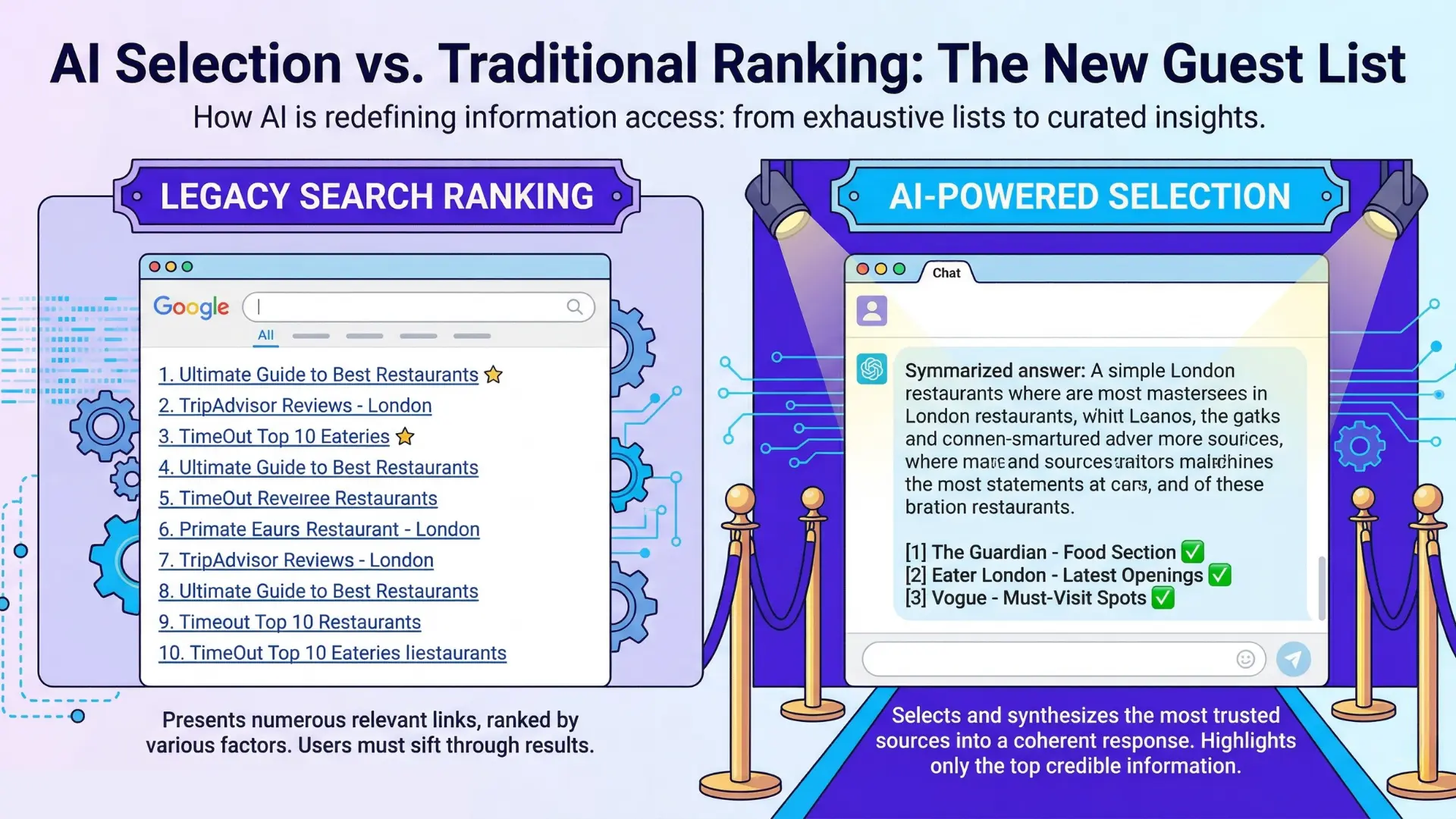
Selection Not Ranking
Here’s the contrarian truth: AI platforms have no front page.
There’s no golden spot to win.
Instead, the machine selects only a handful of trusted sources per answer – sometimes just two, rarely more than seven.
It looks for evidence, clarity, and credibility.
Volume, recency, or technical SEO tricks barely move the needle.
In client work, we’ve seen sites with low traffic become the backbone of AI answers simply because their content used clear claims, structured evidence, and unambiguous author profiles.
One biotech client’s blog, ignored for years by human searchers, now gets quoted dozens of times each week in AI-generated medical FAQs.
Why?
The structure matched what the AI needed to build trust.
This selection process feels less like a race and more like a VIP guest list.
The source is vetted for clarity and truth, not flash or frequency.
Imagine you’re picking safety instructions for a dangerous tool.
Do you pick the loudest pamphlet or the document that spells out every step, reference, and author?
AI does the same.
Ask yourself: If your site vanished from one AI answer, would you pop up in another?
Authority in this world flows from being cited reliably – not being seen by chance. Influence now beats raw traffic.
Failures in Visibility Without Citability
Common Barriers to AI Citation and Their Causes
| Diagnostic Door | Question to Ask | Outcome of Passing |
| Structured Citable Content | Are your contents clearly structured for AI extraction? | Eligible for AI citations with clear facts and evidence |
| Entity Clarity | Are your brand and product signals consistent and unambiguous? | AI correctly attributes and consolidates citations |
| Trust for Selection | Is your brand trusted enough to be selected over others? | Appears as a preferred and authoritative source |
Now for the blunt reality: most brands miss selection, not for lack of quality, but for lack of citability.
We see three main tripwires:
- Unstructured content. Long paragraphs without headers, lists, or references. Machines can’t find the facts in the fog.
- Entity ambiguity. Is “Acme” a vacuum maker, a distributor, or a construction firm? If the AI can’t tell, you’re invisible.
- Lack of evidence. Claims without sources, dates, or proof. A machine needs signals, not vibes.
A national finance brand we advised posted over 100 expert explainers, yet failed to appear in any AI answers.
The fix?
Table-based summaries, explicit fact citations, and consistent entity naming.
Within a month, their domain appeared in over 40% of tested AI-generated finance explanations.
Here’s the surprising analogy: being cited by AI is like your research paper getting footnoted in every major academic journal, even if no one clicks through to your actual article.
That citation isn’t just a mention – it’s quiet influence, baked into every automated answer.
A common myth: “If we write the best article, AI will find us”.
The truth?
Clarity and structure win, not raw word count or keyword saturation.
Authority is measured, in part, by how easy it is for the machine to cite you – and that’s a design choice.
The new reality: If you want your brand to influence markets now shaped by machines, you must be citation-friendly.
Next, we’ll show why this influence is a win, even when traffic drops.

Citation Is Influence, Not Clicks
From Traffic Decline to Influence Gain
Imagine watching your site traffic drop by half, yet your brand’s share of voice in AI-generated answers keeps showing up in boardroom screenshots and strategy decks.
That’s no accident.
What if being cited – rather than being visited – matters more for winning the next wave of digital decisions?
In the old search world, every executive tracked traffic from rankings.
Now, executives at our clients see their pageviews shrinking on the dashboard but notice something remarkable: their insights appear as the “source” in AI answers, even when they lose out on clicks.
One CEO called this their “silent influence effect” – they had become invisible to Analytics, but suddenly visible in C-level conversations where AI summary answers set the agenda.
This shift unsettles the old SEO instincts that equate high rankings with power.
The reality: citation replaces clicks.
AI systems quote the few trusted voices – even if nobody lands on your page.
Think of it as trading a crowded conference for an invitation to a small, exclusive panel whose take shapes what everyone believes the next day.
The real question: do you measure your influence by who lands on your site or by whose words anchor the answers millions see, even when the traffic graph points down?
Authority via Citability
Authority in AI isn’t about volume – it’s about being the kind of source the machine prefers to quote.
When we audit brands for AI visibility as citation, two patterns appear: content that’s structured, source-rich, and signals evidence consistently is selected and cited, even with far less organic traffic.
In contrast, massive volume with weak signals almost always gets ignored by generative answers.
One client, a midsized SaaS, built what they thought was a moat – hundreds of pages, updated weekly.
Yet only three articles were ever cited by AI, each constructed with direct claims, annotated sources, and unique entity identifiers baked right in.
The rest?
Ghosted.
It was a shock – but also a lightbulb moment: visibility means being cited, not just being seen.
Here’s the unexpected analogy: think of generative AI like a recipe curator.
To get picked, your ingredients (facts, evidence, structure) must stand out distinctly – spiced just right and not buried in soup.
When everything blends blandly, AI skips your kitchen altogether.
The myth?
More content equals more authority.
The truth: only citability – built on clarity, evidence, and structure – signals you’re the reference, not just an option.
What would change in your content operations if your scoreboard was citations per answer, not clicks per month?
Citation-driven influence is quiet, powerful, and measurable in a new way.
It’s the authority currency that matters when traffic fades but your stake in AI-selected answers grows.

Why Brands Feel Invisible (When AI Doesn’t Trust Them)
Entity Confusion
Imagine your brand mentioned all over the web – yet when you test AI-generated answers, it feels like you’re a ghost.
Ever wonder why GPT-like systems can summarize thousands of pages, but skip your resource as if you barely exist?
Here’s the short answer – entity confusion.
AI models crave clear, unified identity signals.
If your company name, products, or experts are referenced under varied spellings, addresses, or even outdated product lines, you fracture your own signal.
The AI can’t consistently match all those fragments to a single trusted source, so you slip from view – not ranked lower, but rendered nearly invisible.
One client, a SaaS provider, was stunned when three variants of their product name in technical docs led AI tools to split citations or default to competitors.
Our team mapped all the aliases and updated structured data to point to their canonical brand entity.
Suddenly, they started showing up in authoritative answer snippets.
Here’s a simple analogy: It’s like talking to someone at a loud party.
If half your group calls you “Alex”, others “Al”, and the sign-in sheet says “A.T”., no one can flag your expertise.
Cohesive naming is that powerful.
Are your digital signals making you easy to cite – or just easy to miss?
Unstructured, Uncitable Content
A common myth: if your content ranks in Google, AI will find and cite you.
The reality is sharper.
AI selection favors not just accuracy, but structure – think paragraphs that point to who, what, why, and how, all tagged clearly for extraction.
We’ve seen finance firms with brilliant white papers, yet their dense PDFs vanish from AI-generated responses.
Why?
Flat content with no headings, tables, or clear attributions is almost impossible for algorithms to cite with confidence.
Content that isn’t built for citation gets skipped – the substance lost in digital noise.
Here’s what surprised a biotech client.
By embedding claim-evidence tables and structured Q&A, plus schema.org types, they didn’t just see more citations – they observed mentions not attributed to any site before, essentially creating new visibility from zero.
That’s a direct path from unstructured to uncitable, to discoverable and influential.
Think of it as the difference between painting a mural on a smooth wall versus one covered with graffiti – if the lines are blurred, nobody sees the picture you’re trying to show.
If your brand isn’t appearing in AI-generated answers, the root cause might live in messy entity signals or content structure that’s invisible to algorithms.
Clean signals and structured content set the stage for real influence – hinting at the next steps in reclaiming AI visibility.

This Is Not a Loss
Visibility Redefined
Picture this: You hold the top spot in classic search, watching visitors pour in – then suddenly, the channel shifts.
AI answers begin surfacing, and traffic tails off sharply.
Does this mean your influence is shrinking?
As discussed above, citation now defines digital authority – being referenced inside AI-generated answers, rather than merely being visible in rankings.
In recent client reviews, we found compelling proof.
A B2B tech brand lost 64% of informational search traffic in 9 months.
Yet, in the same window, their brand was cited in over 40% of AI-generated answers for target terms.
Stakeholders were worried – until they saw those citations driving analyst, partnership, and media mentions downstream.
The brand’s digital footprint looked quiet on analytics dashboards – except their influence had never been broader.
Ask yourself – would you rather ten thousand visitors, or one influential citation in the answer that shapes industry opinion?
Many still chase ranking, missing that AI now selects, not just ranks: “AI selection not ranking”.
Every reference your brand earns is one more place you become the answer, not just an option.
That’s a deeper form of visibility – one you keep, even as others chase the next hot keyword.
Diagnostic, Not Tactic
If you’re expecting a tactical SEO checklist or a library of prompts – pause.
This spoke is diagnostic, not tactical.
It’s designed to cement a decision-stage lens: “AI visibility as citation” isn’t measured by click counts or keyword charts.
One repeated client insight: The hardest part isn’t implementing new tricks – it’s letting go of old metrics.
There’s no universal playbook because each brand’s citation journey starts with clarity, not hacks.
Instead, think: Where are you already being cited?
Where are you absent?
Metrics shift from rankings to “influence over traffic in AI”.
It’s like switching from a stopwatch to a thermometer.
You won’t get a single, time-bound measure of performance – the signal is about heat and diffusion: Are you part of the answer, or left in the cold?
This is the mindshift: Being cited is not a consolation prize – it’s the new scorecard.
Ready to audit where your influence really shows up?

Why Attribution Replaces Ranking in AI Search
Frameworks and Measurement
To diagnose AI visibility as citation, brands should observe citation authority measurement, track citation share metrics, and monitor how often they are referenced in AI-generated answers versus legacy search rankings.
Frameworks such as Foundation, Amplification, Measurement can clarify which signals drive selection – but this diagnostic page focuses on identifying gaps, not on prescribing tactical reporting or dashboard setup.
Citation as Visibility Unit
Imagine being referenced in an AI-generated answer – while your competitor only ranks on the old blue links no one clicks.
Most executives assume ranking equals visibility.
Yet, in AI search, the unit of visibility is citation, not position.
When only 2 – 7 websites are cited per answer, fighting to be “number one” means missing the real action – getting mentioned as a trusted authority.
Here’s what we see with clients: traffic drops but mentions inside AI answers quietly rise.
One B2B SaaS company watched organic visits shrink by 14% in six months, yet their core expertise appeared as an authoritative source in dozens of AI snapshots.
No spike in traffic.
Major jump in influence. It feels disorienting – until you measure the right thing.
Most executives ask: “Is it better to be cited in fewer AI answers, or seen by thousands with no attribution?”
The impact is stark.
Being frequently cited means shaping buyer perception even when direct visits dwindle – think of being quoted on stage while others are just sitting in the audience.
If the answer box cites your name, you own the narrative at the very moment of decision.
Once you flip from “ranking optimization” to “citability optimization”, you start to see that visibility means being cited.
A surprising analogy: in traditional SEO, ranking is like being displayed at eye-level on a supermarket shelf; in AI search, citation is more like being the ingredient label everyone reads before purchase.
Shoppers don’t always buy the eye-level box – they trust the ingredients and authority behind it.
Measurement with Uncertainty
Leaders want hard numbers – count, track, compare.
But citation authority measurement demands a new mindset.
AI systems don’t always cite the same sources, answer by answer.
One week your brand appears in nearly every buyer-facing response.
The next, a shuffle – thanks to algorithm tweaks, new training sets, ambiguous wording, or even unpredictable AI hallucination.
During two client audits last quarter (one mid-market SaaS, one challenger fintech), we mapped citation coverage across 50 target queries.
Results swung 20 – 40% week-to-week – a visibility rollercoaster completely invisible to legacy rank trackers.
Here, measurement means spotting patterns, not chasing precision.
Any marketer expecting a clean, quarterly report will be frustrated.
Citation measurement is seasonal and chaotic, more like tracking storm paths than airline departures.
Myth: citation replaces clicks, so the job is done.
In reality, citation authority fluctuates.
You will see “dark matter” – periods when you are trusted but not always visible, and days when a competitor briefly surfaces.
If you try to control every metric, you’ll miss the behavioral shift.
The real opportunity is learning to spot your moments above the noise, not obsessing over static rankings.
AI visibility as citation demands new tools for uncertainty – watching trends, capturing moments, and accepting some fog.
The payoff is high but never 100% neat.
Next: Understand how to diagnose visibility gaps before diving into execution.

What Must Be Understood Before Acting
Routing: Diagnostic Decision Doors
The next diagnostic steps involve evaluating entity clarity, assessing content structure for citability, and reviewing trust signals that drive AI selection – not just legacy ranking optimization.
For guidance by industry, see how regulated sectors implement these diagnostic layers.
Diagnostic Doors
AI Visibility Diagnostic Doors Checklist
| Barrier | Description | Impact on AI Visibility |
| Unstructured Content | Long paragraphs without headers, lists, or references | AI cannot extract clear facts, leading to invisibility |
| Entity Ambiguity | Unclear or conflicting brand/product naming | AI splits or misses citations, reducing trust |
| Lack of Evidence | Claims without sources, dates, or proof | Signals are weak, making AI less likely to cite |
Would you let a machine decide your influence – if it meant almost no clicks reached your site?
Here’s a decision that won’t feel natural: in the “AI visibility as citation” era, citation replaces clicks – period.
Influence over traffic in AI becomes the real scorecard, not the ancient metric of last-decade pageviews.
Most brands rush straight into execution, tools, or technical fixes.
But the hard truth (and the sooner you face it, the faster you win): if your content isn’t cited, it may as well not exist in the age of AI search.
When we audit brands, one pattern emerges: the teams skipping diagnostic steps get lost fast.
One recent client invested six months optimizing for feature snippets – none of it mattered when their entity wasn’t clear enough to earn an AI-generated answer citation at all.
Another had brilliant research, but wrapped in dense, unstructured text – uncitable by any LLM, invisible in AI selection logic.
Imagine watching a digital “map” where your brand should appear.
But if your entity signals are patchy or your evidence is buried, AI just leaves you off the grid.
It feels like having the right address on a street with no road signs – nobody finds you, and nobody asks directions.
There are only three doors here:
- Are you visibly citable (structured citable content)?
- Are your entity signals clear (entity clarity for AI citation)?
- Are you trusted enough for selection, not just ranking (AI selection not ranking)?
Everything else is execution theater.
If you’re not routinely cited, traffic hacks and tactical checklists can’t move the needle.
Not Execution – Diagnostic Reset
Tempted to jump into checklists?
Pause.
This isn’t yet about execution.
Real progress here starts with a diagnostic reset: first, measure your citation authority (hint: most brands don’t even try); next, review how your core pages appear – and whether they’re even eligible for AI-generated answer citations.
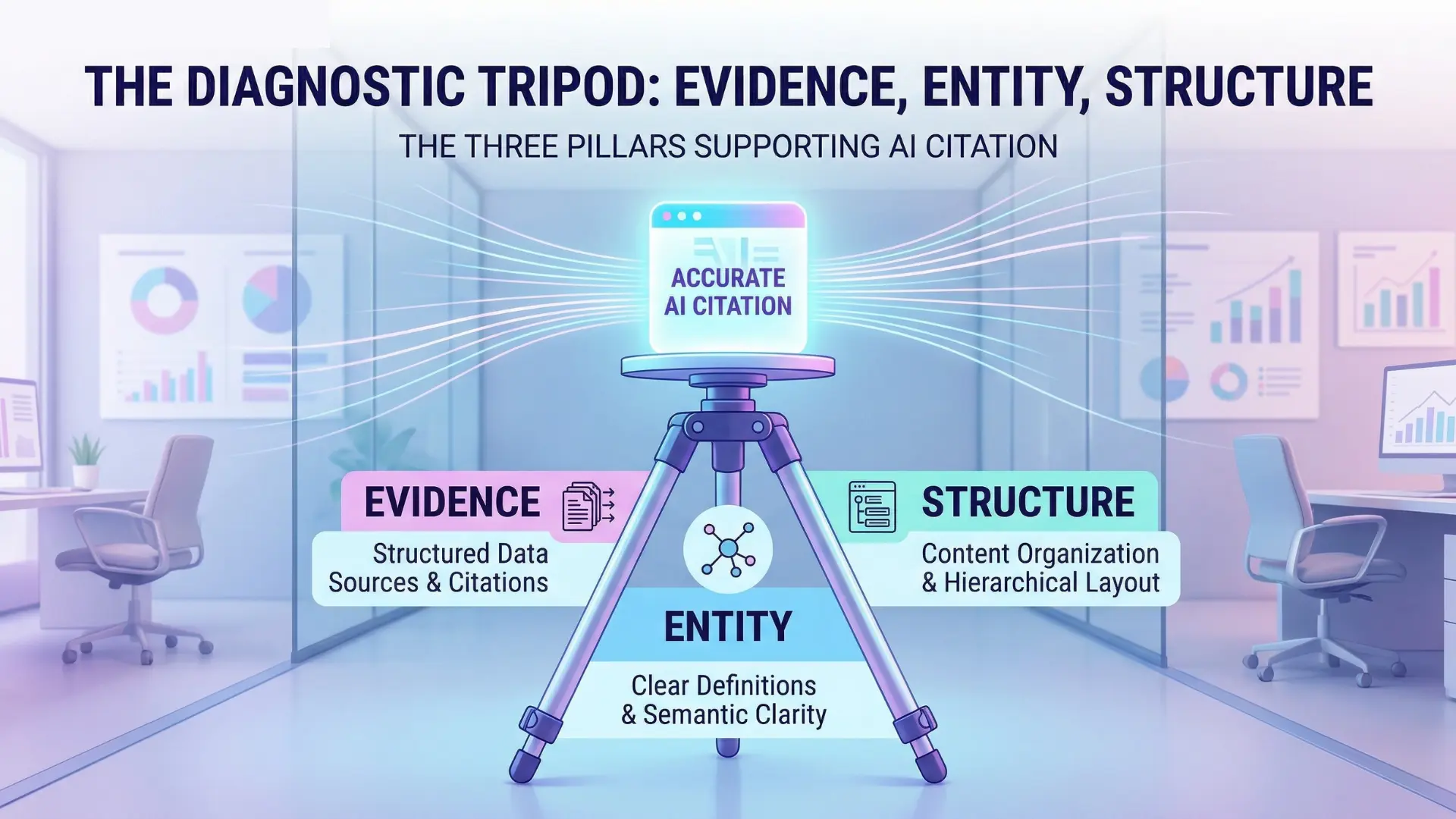
We sometimes use a simple framework: Evidence-Entity-Structure.
If one leg wobbles, AI ignores you, no matter your traditional rankings.
Visualize it like a tripod: lose one, the whole thing falls.
Isn’t it strange?
Visibility now means being cited, but so many metrics still obsess over traffic. What does that say about your current dashboard – and what it actually measures?
Before you act, understand: the map has changed.
Diagnose before tactics.
Agency comes from clarity, not speed.
The path to influence begins with asking the right diagnostic questions – then stepping into deeper analysis, not quick fixes.

Scientific context and sources
The sources below provide foundational context for how decision-making, attention, and performance dynamics evolve under scaling and constraint conditions.
- Citation credibility and selection in information systems
“Credibility and trust of information in online environments: The use of cognitive heuristics” – S. Metzger, A. Flanagin – Journal of Pragmatics
Discusses how source clarity and structured evidence shape trust and citability in automated and algorithmic selection environments.
https://www.sciencedirect.com/science/article/abs/pii/S0378216613001768 - Influence of citations in digital scholarly communication
“Characterizing Social Media Metrics of Scholarly Papers: The Effect of Document Properties and Collaboration Patterns” – S. Haustein, R. Costas, V. Larivière – PLOS ONE
Shows how citation counts and alternative metrics capture different dimensions of scholarly influence and visibility in digital communication systems.
https://pmc.ncbi.nlm.nih.gov/articles/PMC4363625/ - Structured data and machine reasoning
“Schema.org: Evolution of Structured Data on the Web” – R.V. Guha, D. Brickley, S. Macbeth – Communications of the ACM
Explains how structured vocabularies enable machines to interpret, integrate, and reason over web data for search and AI systems.
https://cacm.acm.org/research/schema-org/ - Entity disambiguation and influence in algorithmic systems
“Neural Entity Linking: A Survey of Models Based on Deep Learning” – O. Sevgili, A. Shelmanov, M. Arkhipov, A. Panchenko, C. Biemann – arXiv
Surveys deep learning approaches for resolving entity ambiguity, enabling accurate linking and influence tracking in algorithmic knowledge systems.
https://arxiv.org/abs/2006.00575 - AI explainability and trust
“A Systematic Review of Explainable Artificial Intelligence in Terms of Different Application Domains and Tasks.” – Islam, M. R., Ahmed, M. U., Barua, S., & Begum, S. – Applied Sciences
Reviews recent developments in explainable AI approaches, highlighting the need for interpretability and trust across applications.
https://www.mdpi.com/2076-3417/12/3/1353
Questions You Might Ponder
Why is citation more important than traffic in AI-driven search?
Citation in AI search means your content is referenced as a trusted authority directly in AI-generated answers, influencing user decisions. This shifts visibility from driving clicks to shaping digital opinion, making citation the new measure of authority and influence.
How do AI systems select which sources to cite in answers?
AI models prioritize structured content with clear entities, explicit evidence, and consistent author signals. Sources that use headings, lists, and verifiable claims are cited more frequently than high-traffic sites lacking clarity, as AI values citability over sheer volume.
What causes brands to be invisible in AI search results?
Brands become invisible when their content is unstructured, lacks entity clarity, or fails to provide credible evidence. Ambiguous brand names and poorly structured text hinder AI models from confidently citing them, leading to lost influence regardless of traditional rankings.
How should brands measure success if traditional search traffic drops?
Success in AI search should be measured by citation frequency in AI-generated answers, not by conventional traffic metrics. Brands with higher citation share gain greater influence over digital narratives and decision-making, even if direct visits to their site decrease.
What diagnostic steps help increase AI citation visibility?
To boost AI citation visibility, evaluate entity clarity, strengthen content structure for machine extraction, and enhance trust signals. Brands should audit where they’re cited now, identify structural or signal gaps, and focus on making their information citation-friendly.